Doug is the author of the landmark book, Extreme Project Management®: Using Leadership, Principles and Tools to Deliver Value in the Face of Volatility. He works with clients who undertake projects in very demanding environments: those settings that feature high speed, high change, high unpredictability and high stress. Doug has lived in the trenches—from Bethlehem, Pennsylvania to Beijing, China—with over 275 project teams with budgets that ranged from $25,000 to over $25 million. He is one of the founders of the Agile Leadership Network, an organization dedicated to connecting, developing and supporting great project leaders. He is known for his hard-hitting and humorous keynote speeches that address vital issues facing today’s project-based organizations. You can visit Doug at www.dougdecarlo.com.
A colleague of mine, Ravi Mohan, founder of ProjectScape once quipped, “Your project plan is obsolete even before you hit the print button.” Ravi was referring to traditional project planning as applied to software development projects.
I accepted his pronouncement as intuitively obvious and never gave it much more thought until the other day when I happened to be leafing through Mike Cohn’s excellent book, entitled Agile Estimating and Planning. (1)
Here’s a summary of Mike’s four reasons why traditional approaches to planning often fail:
1.Planning is by activity rather than by feature
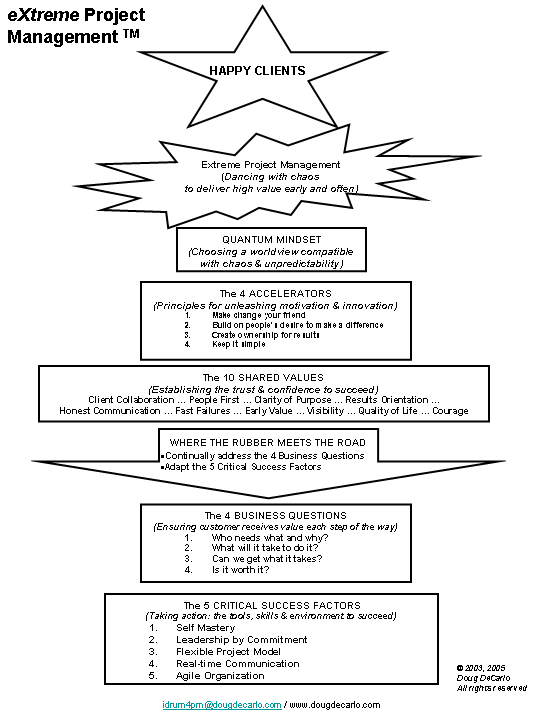
In traditional approaches, work breakdown structures are based on activities. Understandably, the project manager becomes a taskmaster, driven to focus on task completion. But completed tasks (or activities if you prefer) do not necessarily equate to value in the eyes of the customer. Delivering value early and often is a fundamental tenant of agile project management. (This is the underlying reason why “Results Orientation” is one of the 10 Shared Values of eXtreme Project Management (see Happy Clients).
Moreover, in using traditional methods, one could complete all the activities and not necessarily deliver the desired functions and features. Moreover, planning by activity instead of by feature is a leading …