






Guessing is not a strategy: How to build decision velocity with AI and real-time data
June 10, 2026 | Live Webinar

Who really owns the project budget? Clarifying financial accountability
How to learn AI the sensible way
Making sense of project cost reports
How real PM mentoring actually works
The Accidental Product Manager: What project managers need to know
accounting, agile, ai, appraisals, Artificial Intelligence, audit, Backlog, Benchmarking, benefits, Benefits Management, Benefits Realization, Bias, books, budget, Business Case, business case, business case, Career Development, Career Development, carnival, case study, Change Management, checklist, collaboration tools, communication, Communications Management, competition, complex projects, Conferences, config management, consultancy, contingency, contracts, corporate finance, corporate finance, cost, Cost Management, cost management, credit crunch, CRM, data, data security, debate, Decision Making, delegating, digite, earned value, Education, Energy and Utilities, Estimating, events, FAQ, financial management, financial management, forecasting, future, GDPR, general, Goals, Governance, green, Information Technology, Innovation, insurance, interviews, it, Knowledge Management, Leadership, Lessons Learned, measuring performance, Mentoring, merger, methods, metrics, multiple projects, negotiating, Networking, news, Olympics, organization, Organizational Culture, outsourcing, personal finance, Planning, pmi, PMO, PMO, Portfolio Management, portfolio management, presentations, privacy policy, process, procurement, product management, productivity, Program Management, project closure, project data, project delivery, Project Success, project testing, prototyping, qualifications, Quality, quality, Quarterly Review, records, recruitment, reports, requirements, research, resilience, Resource Management, resources, risk, Risk Management, ROI, salaries, Schedule Management, Scheduling, scope, Scope Management, security, small projects, Social Impact, social impact, social media, software, software, software, Stakeholder Management, stakeholders, Strategy, success factors, supplier management, team, Teams, testing, testing, timesheets, tips, training, transparency, trends, value management, vendors, video, virtual teams, workflow


| Recently a colleague asked me to do some training on business case benefits – how to identify them, manage them and track them. We spent a lot of the time thinking about different types of benefits, and I thought the list we brainstormed might be useful to you too. Why not copy/paste this list or bookmark it so that next time you are creating a business case you can review whether you’re going to get any of these types of benefits?
Let’s start with the obvious ones, and the ones most execs, in my experience, tend to care about the most – the money benefits. You might have:
Working capital efficiency benefits were only something I came across on a project last year. While they might not make such great headlines as increasing revenue, they are definitely something you should be looking at if you have the opportunity. 2. Customer BenefitsNext up, benefits to your customers.
3. Operational/Process BenefitsNext, we looked at internal benefits.
Some of these will translate into a financial benefit, for example, if you reduce the time it takes to answer a customer service call, you’d expect an agent to be able to do more calls in a day. Each call might turn into a sale, so there is the potential for increased revenue as a result of more calls answered. That kind of thing. You then start getting into the realms of assumptions – we assume 50% of calls convert to a sale, or something like that. I’d lean on your finance team or business planning and forecasting team here rather than try to guess at what the right assumptions might be. There’s no reason not to include process benefits – they are easy to track for the most part – but if you can convert them to money benefits you might find your business case stacks up better. 4. Strategic BenefitsPersonally, I think the strategic benefits are a bit vague. These are the kind of benefits you’d list in the exec summary to convince people of strategic alignment and the overall ‘goodness’ of the business case, but you wouldn’t necessarily put them in a financial model.
5. Employee and Organisational BenefitsBenefits to staff often use similar measures to the customer service metrics, so if you can reuse any calculations, assumptions of measurement methods, then that will save you time.
Get your HR team involved in measuring and tracking people-related benefits as they probably have access to a lot more data than you will about turnover, retention and so on. 6. Environmental, Social, Governance (ESG) BenefitsEven if you think your project might not have any benefits that fall into the corporate/social responsibility or ESG category, spend a few minutes thinking about them as you might find something.
These are pretty hard to track in my experience. Waste reduction and recycling not so much as you can measure what you throw away, but carbon reporting can get quite complicated, especially if you don’t have someone in your organisation who is responsible for this. 7. Risk Reduction/AvoidanceFinally, we talked about the benefits of reducing (or avoiding) risks, including:
Which of these could you use in your business cases? |
|
The sustainability agenda is something all aspects of business are thinking about, and project management is no exception. We all need to be working towards creating a more sustainable future, and making the right choices on our projects is definitely one way to do that. The first step is to make sure sustainability criteria are included in your documentation templates. You can add sustainable and carbon footprint criteria to your business case templates. Here are some suggestions for how you can consider reducing the carbon footprint on your projects. Create a benchmarkMany companies these days have teams dedicated to energy management and sustainability, so your first point of call should be to check in to see what initiatives are already underway. If your carbon efforts are going to be officially recognised, you need to use official methods of calculating the reduction, with full transparency and a robust, proven measurement process in place. Who in the team will be responsible for tracking and measuring carbon savings, and do you need any additional processes in place to make it happen? A full approach like that might be overkill – if there is no expectation of having to save carbon, you might not want to go down the route of proving that you are in a measurable, transparent way. However, you can still follow the rest of the steps to brainstorm carbon-saving ideas with the team and build in carbon-friendly ways of working. Review project tasksTake a look at the work you are going to be doing on this project. Which tasks are going to generate a carbon calculation that can be measured? What tasks are going to generate carbon and what can you do differently? Identify carbon reduction activitiesFrom the work you are doing and the tasks identified, take a look at what extra actions you could to reduce the carbon impact. For example, are you planning to print a lot of leaflets or documentation? What could be delivered via a QR code or provided in digital format? What would still need to be created in paper format for a selection of users who would not be able to access digital content? What journeys are going to be undertaken on the project? Perhaps there are some workshops that can be held virtually and training delivered online instead of in a classroom. There are many advantages to getting together in person, but you might be able to identify some elements of the project that would work remotely. You can also look at the supply chain. Can you ask whether suppliers can deliver in a more sustainable way, such as with electric vehicles, or in recyclable packaging. What would that do to the budget, if anything? Add tasks to the planAdd your carbon reduction actions to your project plan. You might need to take specific actions, you might need to be more mindful of the way in which existing tasks are delivered. Make sure each action has an identified owner. Track and monitor progress towards your goalInclude carbon data in your reporting. If you are tracking according to your organisation’s metrics, then you might have some help from specialist teams who will know how best to report the data. Otherwise, add some narrative to your reporting to allow you to share your success with others. A lot of being smart with carbon on your project is just asking yourself the question: what can we do and are we doing things in the best possible way? Being aware of the challenges and helping others see that sustainability is a focus for you is key to keeping it on the agenda and making it part of the accepted ways of working. |
|
Let me see if I can make the difference between economic appraisals and financial appraisals interesting…. They are both covered in the UK Government’s Better Business Cases document. Here’s my take on what they both mean and why you’d want to use them.
Economic appraisalsThe document says that economic appraisals are all about value and benefits from the perspective of the stakeholders, users, and wider societal impact. They consider “all social, economic, environmental costs and all effects on public welfare.” Remember, this is a government publication, so the assumption is that projects will be for the public good. Your project might not have an effect on public welfare, but you can imagine that it will have an effect on the project’s customers or end users. This is the core of a business case. It includes an element of financial information as well, such as relative prices, direct and indirect costs, opportunity costs where there are any, environmental costs, and benefits however these play out. You’d also include staff time. It would exclude inflation, tax, sunk costs (let’s hope there aren’t any of those), depreciation of assets, and other accounting treatments. Financial appraisalsFinancial appraisals are purely the monetary calculations: can we afford it? Where is the money coming from? They consider cash flow, budgets, and accounting practices. This would feed into a business case because there is no point in progressing a project that you can’t afford to complete or that would not provide adequate financial returns where these are measured. A financial analysis would look at current pricing, cash-releasing benefits (like delivering a portion of the project early so it could start to ‘earn’ for you), capex and opex costs, tax payment, and inflation. The do nothing optionA business case should also include the minimum possible approach, which is normally the ‘do nothing’ case against which to compare your alternative(s). Complete an economic appraisal for that option, too, taking into account what stays the same and the benefit cost ratio of doing nothing. In my experience, it’s always worth including a ‘do nothing’ option as it really makes it clear to execs what they are giving up if they choose to reject a project. Is an economic appraisal a new thing?I don’t think an economic appraisal is a new thing, but I think project managers are more used to seeing it be called a business case or an options analysis. Once you have created an economic appraisal for a variety of options (including the ‘do nothing’), there is likely to be a clear option that stands out as the best course of action. If not, there might be a few to choose from with subtle differences – leave the choice up to the execs to debate in that case! I think the thing about an economic appraisal is that it forces you to think wider than the numbers. You’re looking for social and environmental benefit, community impact, and return instead of just a simple ‘if we do this, we’ll get paid that in a year’. It’s a way of reframing the business case conversation into something that is wider and more rounded, helping teams become aware of the full impact and benefit of their initiative instead of simply the bottom line. And I think that’s a good thing. We should be making rounded, fully informed decisions instead of simply relying on the top level numbers. We need to be aware of the full impact from idea to decommissioning and what impact that is going to have on the world around us, not just the bank account. By adopting the language of economic appraisal instead of business case, we might be shifting the thought process into a richer dialogue with ultimately better decisions being made. What do you think? Let me know in the comments! |
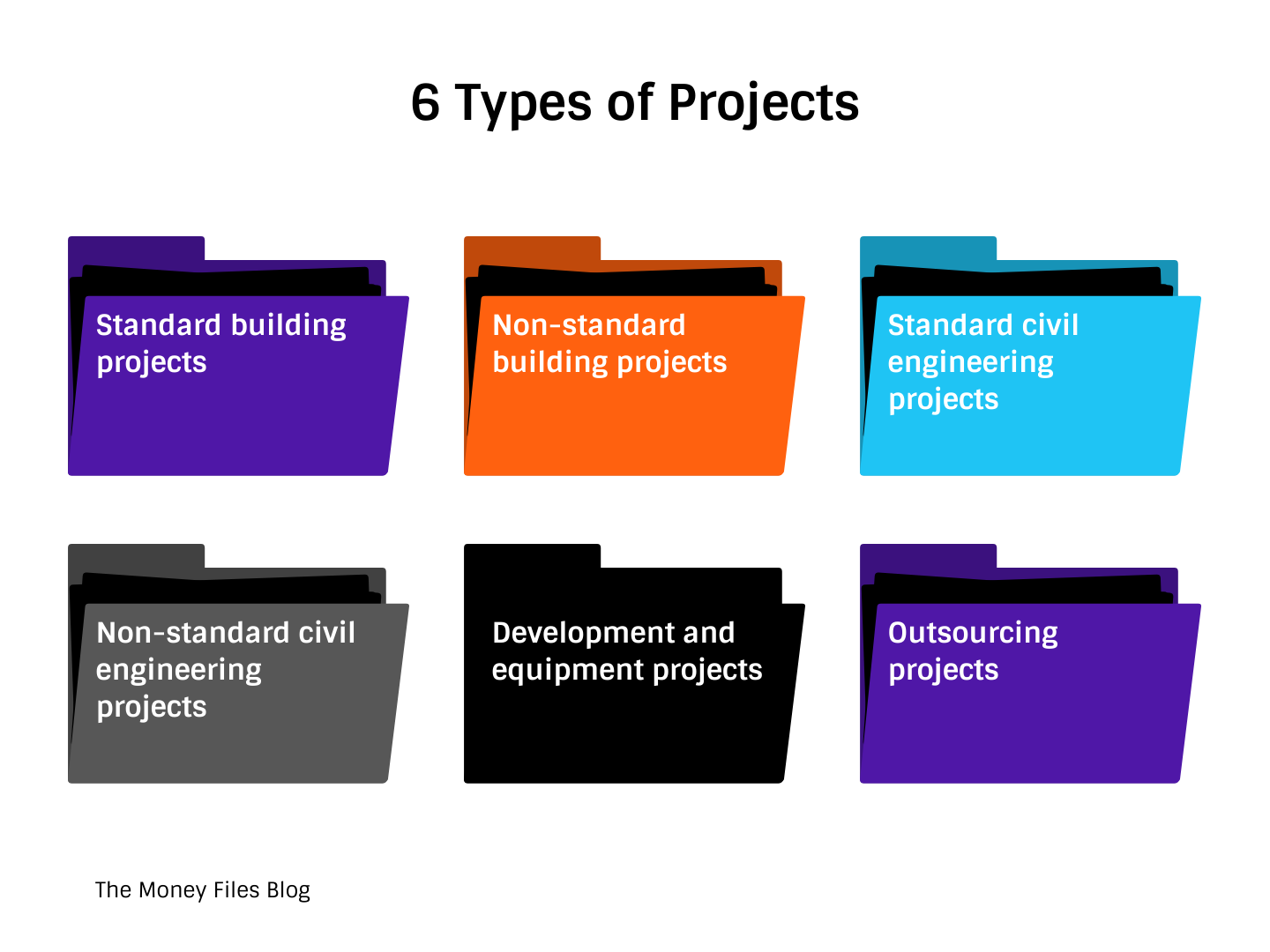
| There are loads of different ways of categorising projects, but I came across a way that was new to me recently. There are 6 categories of project outlined at high level in a UK government publication about creating a project business case. I’ve summarised them briefly below.
1. Standard building projectsLet’s start with the building projects. A ‘standard’ building project is one that pretty much uses a building blueprint that’s already available. There are no special design considerations, no fancy extras or design features to incorporate. Examples:
2. Non-standard building projectsAnything that is not a standard building construction project is a non-standard project. These are constructions that have special requirements or must meet certain conditions, perhaps dictated by use or space or the requirement to incorporate some high-tech feature. The environment around the construction might also make the project non-standard. For example, if the site has some special archelogical, scientific or envrionmental significance. Or it could be that the building is going on the side of a mountain or in a cave, or something like that. Examples:
While I was in a previous role, the company acquired an old building and changed its use, but had to keep the existing façade. I’d put that project in this category as the complications around what we could and couldn’t do within the footprint of the building made everything quite a challenge. 3. Standard civil engineering projectsStraightforward civil works would use tried-and-tested techniques. There’s not much else to say about these. Examples:
4. Non-standard civil engineering projectsDo you see the pattern? Unsurprisingly, non-standard public sector and civil works include things that don’t fit the mould of the standard work. They are non-routine constructions. Examples:
5. Development and equipment projectsIf you’re not building something physical, you might be building software or doing some other kind of development. These projects move an organisation forward and help get things done. They are often the work that underpins strategy delivery and can be big or small. All the projects I’ve ever worked on fall into this category, as I don’t work in construction or outsourcing (which we’re coming to). Examples:
These could be cutting-edge tech deliveries or simply upgrading your old phone system or something equally routine. 6. Outsourcing projectsFinally, projects that have the end result that something is outsourced. That could be providing a client with cloud computing solutions or running a building for them, and typically it’s all about ‘something as-a-service’. Examples:
Do you think this is a good way to split up projects? I’m not sure that I do – there isn’t enough granularity of the ‘development’ projects for me. Maybe they are all unique and we don’t need to split them between standard and non-standard. Most of the things I’ve worked on have felt non-standard at the time. What category of project do you work on? Let us know in the comments below! |
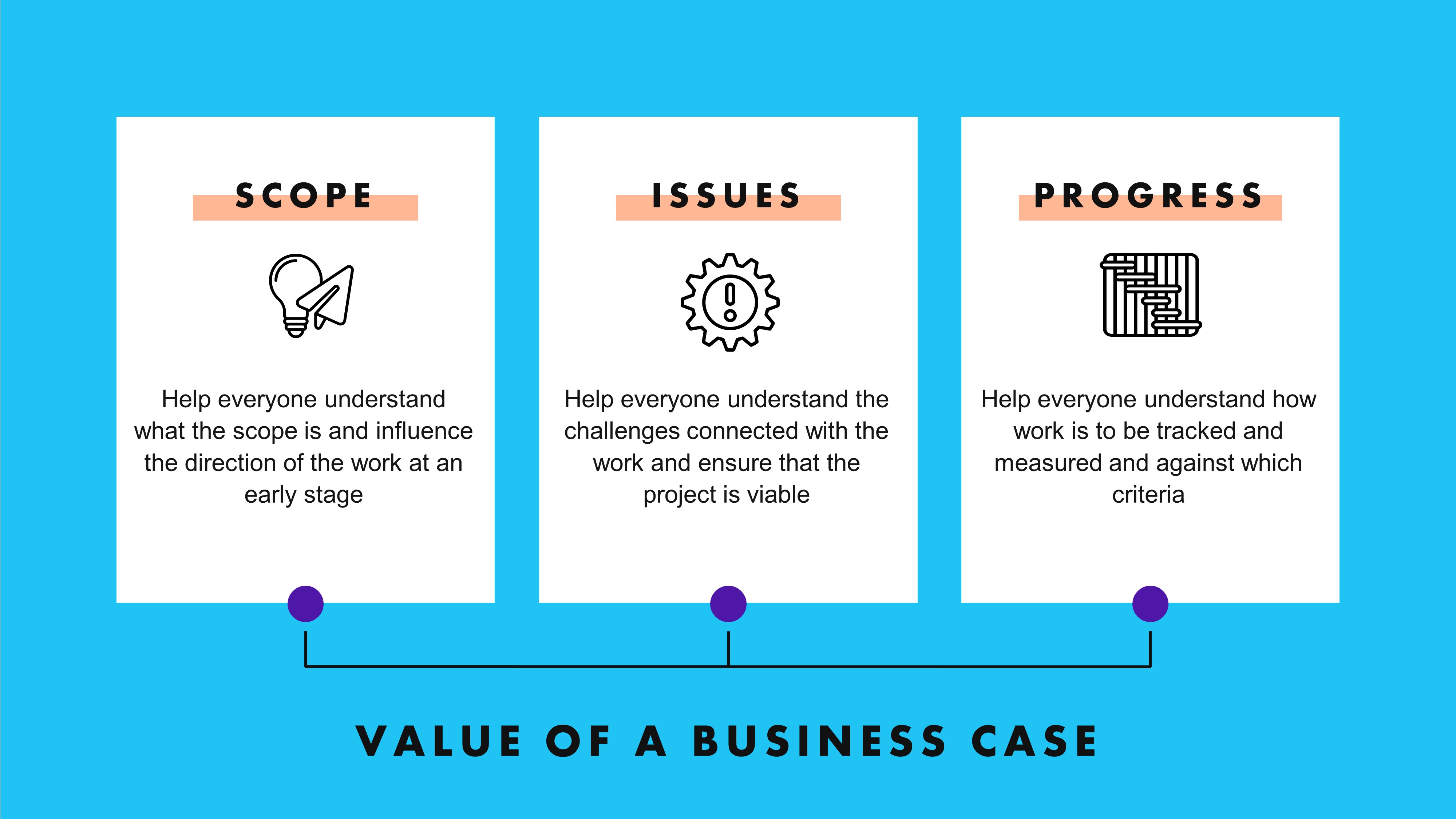
| Project documents (and there are some good templates here on ProjectManagement.com) are important to keeping projects moving, and many times, a project will start with a business case. You might accept the need to do a business case as part of the organisational process – just something you have to do to tick a box. Maybe your organisation doesn’t use them in a formal sense, but each project has to be justified in some way – whether that’s a slide deck or even an email. There is some ‘reason to work’ that kicks off a project. But have you ever really stopped to think about what role a business case really plays? If you do them, I think we shouldn’t take them for granted. If you don’t do them, it’s time to start. Here are a few reasons why it is advantageous to have a business case before the work begins. Understand the scopeThe process of putting together a business case helps everyone involved understand what the scope is going to be. And if they don’t like what that looks like, they have the opportunity to influence it early so the scope better aligns with the direction they want to take. Understand the issuesPerhaps there are concerns, issues, risks or challenges that decision makers need to be aware of – there always are. The discussions that feed into the business case help make sure that everyone is aware of what those are and what implications they might have for the work. Fact-based decision making will give the project a better chance of success. The leadership team can weed out the ideas that won’t work before any time and effort is spent on them. We can frame this conversation by thinking about project viability. Having a thorough discussion of the issues makes people aware of whether a project is viable and will continue to be viable throughout the delivery phases, despite any challenges that may arise.
Understand progressFinally, a good business case lays out information that is useful for managing the work, monitoring and controlling progress. For example, a schedule of stage payments or key milestones, scope elements or deliverables. The business case isn’t the project schedule and you will need more than simply the business case, but if it is a well-thought through, well-prepared document, there will be enough in there to help set up adequate project tracking. The document should also set out success criteria and/or benefits which give you the framework for evaluating success as the project progresses. As a project manager, you might be thinking that putting together the business case is not really your job, and you’d be right. However, on the projects I have worked on, it’s always been easier to get up to speed and start work when I’ve been involved from the business case stage or earlier. That doesn’t mean doing loads of work – just being interested and talked to and maybe asked an opinion about the resource information or timeline that should go into the document. Then when I come to lead the work (assuming it gets approved), I have a better understanding of the ‘why’ behind the project and the decisions that have already been taken. Do you have a business case template that you are happy with? If not, check out some of the templates on this site as a starting point, and adapt one to give you the information you need to start your projects from a good place. |
|
"There is one way to find out if a man is honest: Ask him! If he says yes, you know he's crooked." - Groucho Marx |