







Guessing is not a strategy: How to build decision velocity with AI and real-time data
June 10, 2026 | Live Webinar

Who really owns the project budget? Clarifying financial accountability
How to learn AI the sensible way
Making sense of project cost reports
How real PM mentoring actually works
The Accidental Product Manager: What project managers need to know
accounting, agile, ai, appraisals, Artificial Intelligence, audit, Backlog, Benchmarking, benefits, Benefits Management, Benefits Realization, Bias, books, budget, Business Case, business case, business case, Career Development, Career Development, carnival, case study, Change Management, checklist, collaboration tools, communication, Communications Management, competition, complex projects, Conferences, config management, consultancy, contingency, contracts, corporate finance, corporate finance, cost, Cost Management, cost management, credit crunch, CRM, data, data security, debate, Decision Making, delegating, digite, earned value, Education, Energy and Utilities, Estimating, events, FAQ, financial management, financial management, forecasting, future, GDPR, general, Goals, Governance, green, Information Technology, Innovation, insurance, interviews, it, Knowledge Management, Leadership, Lessons Learned, measuring performance, Mentoring, merger, methods, metrics, multiple projects, negotiating, Networking, news, Olympics, organization, Organizational Culture, outsourcing, personal finance, Planning, pmi, PMO, PMO, Portfolio Management, portfolio management, presentations, privacy policy, process, procurement, product management, productivity, Program Management, project closure, project data, project delivery, Project Success, project testing, prototyping, qualifications, Quality, quality, Quarterly Review, records, recruitment, reports, requirements, research, resilience, Resource Management, resources, risk, Risk Management, ROI, salaries, Schedule Management, Scheduling, scope, Scope Management, security, small projects, Social Impact, social impact, social media, software, software, software, Stakeholder Management, stakeholders, Strategy, success factors, supplier management, team, Teams, testing, testing, timesheets, tips, training, transparency, trends, value management, vendors, video, virtual teams, workflow


| Here in the northern hemisphere the evenings seem to be starting earlier and earlier, and the mornings are much darker. I don't know about you, but I do certainly start to feel less inclined to bounce into work when the sky is grey and it feels like I'm not spending any time in daylight. On reflection, I think I'm most creative during the lighter months because I can go for a walk in nature. I can have the windows open, I feel like there's an abundance of fresh air and space for thinking. Somehow, being wrapped in my warmest clothes and sitting in my shed/office wearing fingerless gloves doesn't quite give me the same conducive environment for creativity. If you are feeling the same, here are 5 suggestions that I am going to try to help me feel more creative and to inspire some creativity in my team.
What about hosting a 30-minute brainstorming sessions on process improvements? You could take part of your regular team meeting to pick a process and talk about the kinds of things that work and don't work and what you would like to do differently.
Turn “someday” ideas into real experiments. I have a very long To Do List of ideas that I keep in my personal project management software and it's about time I clear them out so that I either take action on one or two or delete some things. You could do the same at work with your development backlog. The other thing I'm going to try to do along the same lines is to revisit my pile of books that I have not read and pick something that I'm going to start reading. This year I've read a lot less management and leadership books and a lot more fiction and while I love fiction, I do still need to stretch my horizons by challenging myself with new ideas.
Try an online course or skills swap. Perhaps your organisation has online courses that you can take or access to a subscription service where you can work through online training materials. I know that learning online is not quite as good as meeting up and having the whole in-person experience but it is a fast and simple way to take yourself out of the day-to-day and into a new world of skills and put your brain to use. If online training isn't your thing, consider signing up to attend a webinar or go to a conference.
Move meetings outdoors (warn people so they can wrap up warm!), or just change your virtual background for fun.
Use retrospectives for deep learning, not just quick check-ins. How could you re purpose these sessions so that you get to the bottom of a real problem? Use tools like the 5 Whys to dig deep into one particular problem instead of skimming over everything quickly and highlighting lots of issues. Maybe offer to run a retrospective for another project manager or another team so that you can see if their challenges are the same as yours. It might be harder to kickstart creativity during the winter months, but your creative skills are still there. You just have to create the opportunity for them to shine. |
| In the Northern hemisphere, we’re going into hibernation mode. The weather might be getting colder but the deadlines are hotting up as we approach year end. It’s always the same: leadership teams trying to get projects done before the end of the year, often for no real reason other than it’s an arbitrary date and it lets everyone start fresh in January. However, if your financial year finishes in December, there could be good reason for trying to get everything done.
At this time of year there are also other distractions: people taking time off for holidays and the festivities. Here are 6 practical strategies that you can start using on your project to finish the year strong.
Map out who’s away and adjust your project timelines early. One of the problems I have found on projects is that I am not always told who will be on holiday because the individuals working on the project do not directly report to me. Check in with their line managers or ask each individual directly about their plans to be away over the holiday season.
Literally. Stop adding features or deliverables! When you get change requests, put them on the back burner until the new year. That will protect the capacity in the team in order to complete the work that you already have in your work stack.
Get critical tasks done before festive chaos hits. Even if you are not expecting chaos, you could still be caught off guard by key stakeholders being out of the office or decisions taking longer because decision makers are not around. Try to get decisions documented and agreed as early as possible so that your team is not held up.
Prep notes, shared docs, and checklists. If you have anything to hand over this season, make sure you're doing the prep work for it now. That also means making sure your project filing and archiving is up to date. Saved down any attachments from emails tidy up your SharePoint channels and make sure everyone is using the document storage the way that it should be used.
Bring in treats or plan some virtual thank-yous for the team. This year my project team is celebrating in November because December is too busy and it's hard to get people to have the opportunity to meet up. If that feels like it will be the same for your team, consider moving any festive celebrations earlier in the year or pushing them to January. January often has the benefit of being cheaper as well!
Schedule a January reset meeting before everyone disappears. Whether that is a lessons learned from a project before you will forget what happened, project scoping or a quarter one planning session, book the time now before all those recurring meetings start dropping into calendars. While you are at it, set up your steering meetings, any other governance meetings, regular project team meetings and anything else that needs to be in the diary on a recurring basis so that your team project sessions have protected time as you go into the new year. What else do you do at this time of year that helps you keep everything on track to end the year in a good place? |
| Over the last few weeks/articles we’ve looked at different aspects of resilience and how you can boost it in practical ways. Today, I wanted to look at some tools you could use – some you might already have access to, others you might have to request or lobby for. They are all things that will help your project team feel better equipped to handle the ups and downs of delivery.
Collaboration and communication toolsHopefully you’ve already got access to collaboration tools like Slack, Microsoft Teams, Google Meet or Zoom to keep lines of communication open. These days I don’t know how we would work without those. Project management tools that focus on scheduling and task management are also your friend because they help everyone see the same version of the truth. They help keep tasks organised, track progress, and help you spot trends so you can deal with emerging things before they become big problems. Stress management and well-being toolsMany organisations offer access to emotional support or mental health resources. Tap into what is offered by your company but also check out the plethora of wellness apps and resources that are available on your phone. I’ve found one I like but it’s a personal choice. Maybe one team meeting, open up about the apps you use or have tried and see whether other people can recommend apps they use themselves. How about doing a yoga video, breathing exercises or a guided meditation at the end of a busy week? Whether you do this as a team or just highlight to the team that you take time out for self-care, either is good. Decision-making frameworksDecision-making frameworks take the stress out of decision-making because the process to get to the decision is clear. Make sure people know how to use a range of decision-support tools and practice using SWOT analysis or root cause analysis at non-stressful times so people can turn to those tools when they do have complicated issues to resolve. Sort out a RACI matrix to clarify roles and responsibilities, as that can help avoid confusion and stress during decision-making. Use Terms of Reference and Delegation of Authority levels to work out who can approve what up to what level. Resilience training programmesIf you’re in a position to fund workshops and training on emotional resilience, mindfulness, and coping strategies, add these to the rota of available in-house learning. Or check out what your company already offers in the way of e-learning modules on these topics. There are also courses available on platforms like LinkedIn learning if you have access to those. Recognition platformsUse your in-house or app-based recognition tools to shout out when people have done well. Celebrate success, and make it the done thing to comment on resilience, overcoming challenges – even if things go badly and the end result was a failure. If you don’t have tools or apps you can use, you could either talk to your technical teams about building one in-house (at its most simple, it’s just a form that pushes out the results to a place where everyone can see them, or even into someone’s inbox to collate the submissions to share once a month). Sometimes, calling out what there is available helps people connect resilience with the things they are already doing and it makes it less of a daunting or incomprehensible topic. Resilience in project management is not just about bouncing back from setbacks, it’s about creating teams that can thrive in the face of challenges, adapt to changes, and remain focused on achieving project goals despite adversity. And there’s plenty of change in our dynamic business environments, where uncertainties and changes are just a daily occurrence. What do you use – do you have any favourite self-care apps? Let us know in the comments below! |
| I was inspired to do the Generative AI for Project Managers course (which is currently free, and definitely worth looking at on the PMI website) and from there, to sign up for a ChatGPT account. In parallel to that, I was asked to deliver a webinar on AI-proofing your career (spoiler alert: AI takes away the parts of the job that I didn’t like so much anyway, and frees up more time for you to shine in human relationships), so I seem to have embedded myself in the world of AI recently! I thought I would put ChatGPT to the test by asking it a question I get asked frequently: What are the top 5 challenges affecting project managers in the world today? This is an edited version of what it said. It gave me 246 words, and I’ve added my own thoughts after each point to add a human-in-loop spin on the feedback. The GenAI course explains human-in-loop if you have not come across this term before. (Sidenote: I feel weird calling it ‘it’ when you can have a conversation with it. I think I would like to give my ChatGPT bot a name, I just don’t know what!)
As of my last knowledge update in September 2021, the following were some of the top challenges affecting project managers worldwide:
Elizabeth says: So far so good. This seems to be a perennial problem across the ages. It’s not particularly new, but I’m sure it is true. Every project manager I speak to seems to have issues with resourcing and capacity planning.
Elizabeth says: Again, this is not new news. It’s not the modern, fresh take I was hoping for. Perhaps there isn’t one: we’re stuck with the challenge we’ve always had, which is reassuring and disappointing at the same time!
Elizabeth says: I’m sensing a theme here. These are all true, but as project managers, we’ve been overcoming the challenge of remote and distributed teams for years, even before the pandemic.
Elizabeth says: I agree that risk management and working in uncertainty is a challenge, but we have whole project approaches designed to minimise the impact of that and maximise user engagement through short deliverable sprints. Yes, the world is an uncertain place, but again, project managers have been looking out for the things that will bite us in the backside for years. That’s the job!
Elizabeth says: I would not have put stakeholder management as one of the challenges for project managers. In fact, it’s one of the fun parts! I do understand that it is challenging to manage competing priorities, but again, our processes are set up to identify those and work through them. Then ChatGPT goes on to add: Please note that the landscape of project management may have evolved since my last knowledge update. Factors like emerging technologies, evolving business models, and global events (such as the ongoing COVID-19 pandemic) can introduce new challenges or shift the emphasis on existing ones. It's recommended to stay updated with current industry reports, trends, and insights to understand the most pressing challenges faced by project managers in 2023. Elizabeth says: I agree that it is important to stay up to date with the pressing challenges, and the best way to do that is to stay connected to the industry. Conferences like the PMI Summit and publications like project management magazines provide timely insights into what is important. For example, sustainability isn’t on the ChatGPT list and I would have thought that would have been a concern back in 2021. I haven’t yet paid for an upgraded account, so perhaps a paid account would have better outcomes and give me a different take on what the current challenges are, so there’s that to consider. Meanwhile, I’m curious! Do you agree with these challenges? Do you think there are others more pressing for us as project managers? And what do you think of the output of ChatGPT if you’ve used it? Let me know in the comments below! |
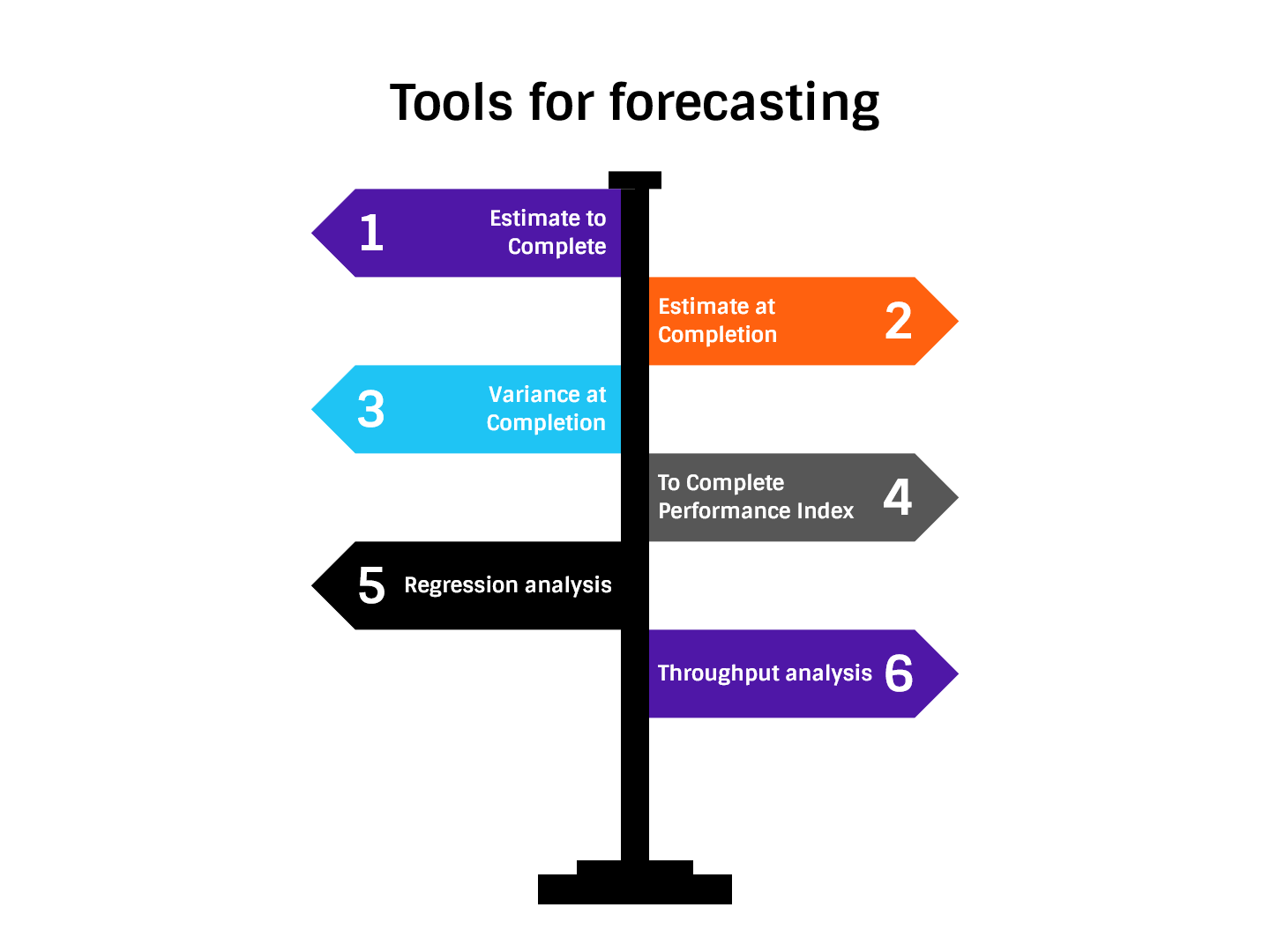
| I have an electronic copy of the PMBOK® 7th edition, so from time to time I open it up to check on something. Recently, I’ve been looking at different ways to forecast as we’ve got some work on that needs to be planned out. There are 6 quantitative forecasting options called out in the Guide. These are as follows.
Estimate to complete (ETC)This is top of the list and the one I personally use the most often. It works even if you are not in a full, compliant, earned value management environment. The risk here is that we assume past performance is indicative of future performance, and honestly, why wouldn’t you? Unless you know something is definitely going to change measurable performance, you would assume that work is going to continue at broadly the same rate. Just jot that down as an assumption so it’s transparent to everyone. Estimate at completion (EAC)For me, this goes hand in hand with ETC. It’s calculated by taking the actuals and adding the ETC, so again, while it comes under the umbrella of earned value acronyms, it’s completely accessible to those who don’t work in EV setting. Variance at completion (VAC)As forecasting tools go, this gives interesting data. It’s the measure that shows the amount of forecasted budget over or under at the end of the project, and it’s one most project sponsors will be interested in: “Will we have any cash left to do anything else when we’re finished?” To-complete performance index (TCPI)I have never had the opportunity (or reason) to use this forecasting metric. Perfect for those of you working with earned value day in, day out, it’s the cost performance required to meet whatever management target you’ve set for the work. It’s a ratio, so I think it is less meaningful to execs who are used to see tangible numbers of days or money. Regression analysisNow more and more tools are introducing AI features, it is possible to access regression analysis more easily. Perhaps you’ve got access to an AI-powered tool that will crunch these numbers for your automatically, removing the need for statistical knowledge. The output allows you to predict performance going forward based on what has happened in the past, so it’s arguably more grounded than other guesstimates! Throughput analysisThe final forecasting technique mentioned is throughput analysis. This looks at the number of items completed in a fixed time, so it’s useful for teams measuring features completed, velocity and story points. You can compare the output to those of other teams, although I’d be wary about comparing teams unless they work on very similar products or services. It wouldn’t be fair to judge a team on their throughput when dealing with very complex features against the performance of a team that has higher throughput but lower complexity. However, the team can compare its performance against itself: that would be a worthwhile exercise. Ideally, you’d want to see that the learnings from retros have been fully incorporated and, more importantly, that the changes have actually made a difference. Which of these are most used for your project forecasting? Let us know in the comments below! |
|
"It is best to keep your mouth shut and be presumed ignorant than to open it and remove all doubt." - Mark Twain |