Beyond Knowledge
From the Support to Develop Blog
by Luis Branco

This blog addresses management-related topics and has three areas of focus: 1. Technical skills; 2. Competencies in the field of interpersonal relations and communication (including personal organization and delegation, leadership, teamwork, conflict resolution, conducting meetings, and negotiation); and 3. Strategy (including diagnosis, strategic guidelines, and implementation).4.Technology
Recent Posts
PMOs as Coherence Architectures
Sprint Zero Reimagined
The Cybernetic Organization
Why Frameworks Cannot Eliminate Judgment
When Governance Becomes Behavioral
Categories
Agile,
Career Development,
Career Development,
Career Development,
Career Development,
Career Development,
Career Development,
Career Development,
Career Development,
Career Development,
Career Development,
Career Development,
Career Development,
Career Development,
Career Development,
Career Development,
Career Development,
Career Development,
Career Development,
Career Development,
Career Development,
Career Development,
Career Development,
Career Development,
Career Development,
Career Development,
Career Development,
Career Development,
Career Development,
Career Development,
Career Development,
Career Development,
Career Development,
Career Development,
Career Development,
Career Development,
Career Development,
Career Development,
Career Development,
Career Development,
Career Development,
Career Development,
Career Development,
Career Development,
Career Development,
Career Development,
Career Development,
Career Development,
Career Development,
Career Development,
Career Development,
Career Development,
Career Development,
Career Development,
Career Development,
Career Development,
Career Development,
Career Development,
Career Development,
Career Development,
Career Development,
Career Development,
Career Development,
Career Development,
Career Development,
Career Development,
Career Development,
Career Development,
Career Development,
Career Development,
Career Development,
Career Development,
Career Development,
Career Development,
Career Development,
Career Development,
Career Development,
Career Development,
Career Development,
Career Development,
Career Development,
Career Development,
Career Development,
Career Development,
Interpersonal Skills,
Interpersonal Skills,
Interpersonal Skills,
Interpersonal Skills,
Interpersonal Skills,
Interpersonal Skills,
Interpersonal Skills,
Interpersonal Skills,
Interpersonal Skills,
Interpersonal Skills,
Interpersonal Skills,
Interpersonal Skills,
Interpersonal Skills,
Interpersonal Skills,
Interpersonal Skills,
Interpersonal Skills,
Interpersonal Skills,
Interpersonal Skills,
Interpersonal Skills,
Interpersonal Skills,
Interpersonal Skills,
Interpersonal Skills,
Interpersonal Skills,
Interpersonal Skills,
Interpersonal Skills,
Interpersonal Skills,
Interpersonal Skills,
Interpersonal Skills,
Interpersonal Skills,
Interpersonal Skills,
Interpersonal Skills,
Interpersonal Skills,
Interpersonal Skills,
Interpersonal Skills,
Interpersonal Skills,
Interpersonal Skills,
Interpersonal Skills,
Interpersonal Skills,
Interpersonal Skills,
Interpersonal Skills,
Interpersonal Skills,
Interpersonal Skills,
Interpersonal Skills,
Interpersonal Skills,
Interpersonal Skills,
Interpersonal Skills,
Interpersonal Skills,
Interpersonal Skills,
Interpersonal Skills,
Interpersonal Skills,
Interpersonal Skills,
Interpersonal Skills,
Interpersonal Skills,
Interpersonal Skills,
Interpersonal Skills,
Interpersonal Skills,
Interpersonal Skills,
Interpersonal Skills,
Interpersonal Skills,
Interpersonal Skills,
Interpersonal Skills,
Interpersonal Skills,
Interpersonal Skills,
Interpersonal Skills,
Interpersonal Skills,
Interpersonal Skills,
Interpersonal Skills,
Interpersonal Skills,
Interpersonal Skills,
Interpersonal Skills,
Interpersonal Skills,
Interpersonal Skills,
Interpersonal Skills,
Interpersonal Skills,
Interpersonal Skills,
Interpersonal Skills,
Interpersonal Skills,
Interpersonal Skills,
Interpersonal Skills,
Interpersonal Skills,
Interpersonal Skills,
Interpersonal Skills,
Interpersonal Skills,
Leadership,
Leadership,
Leadership,
Leadership,
Leadership,
Leadership,
Leadership,
Leadership,
Leadership,
Leadership,
Leadership,
Leadership,
Leadership,
Leadership,
Leadership,
Leadership,
Leadership,
Leadership,
Leadership,
Leadership,
Leadership,
Leadership,
Leadership,
Leadership,
Leadership,
Leadership,
Leadership,
Leadership,
Leadership,
Leadership,
Leadership,
Leadership,
Leadership,
Leadership,
Leadership,
Leadership,
Leadership,
Leadership,
Leadership,
Leadership,
Leadership,
Leadership,
Leadership,
Leadership,
Leadership,
Leadership,
Leadership,
Leadership,
Leadership,
Leadership,
Leadership,
Leadership,
Leadership,
Leadership,
Leadership,
Leadership,
Leadership,
Leadership,
Leadership,
Leadership,
Leadership,
Leadership,
Leadership,
Leadership,
Leadership,
Leadership,
Leadership,
Leadership,
Leadership,
Leadership,
Leadership,
Leadership,
Leadership,
Leadership,
Leadership,
Leadership,
Leadership,
Leadership,
Leadership,
Leadership,
Leadership,
Leadership,
Leadership,
Leadership,
Strategy,
Strategy,
Strategy,
Strategy,
Strategy,
Strategy,
Strategy,
Strategy,
Strategy,
Strategy,
Strategy,
Strategy,
Strategy,
Strategy,
Strategy,
Strategy,
Strategy,
Strategy,
Strategy,
Strategy,
Strategy,
Strategy,
Strategy,
Strategy,
Strategy,
Strategy,
Strategy,
Strategy,
Strategy,
Strategy,
Strategy,
Strategy,
Strategy,
Strategy,
Strategy,
Strategy,
Strategy,
Strategy,
Strategy,
Strategy,
Strategy,
Strategy,
Strategy,
Strategy,
Strategy,
Strategy,
Strategy,
Strategy,
Strategy,
Strategy,
Strategy,
Strategy,
Strategy,
Strategy,
Strategy,
Strategy,
Strategy,
Strategy,
Strategy,
Strategy,
Strategy,
Strategy,
Strategy,
Strategy,
Strategy,
Strategy,
Strategy,
Strategy,
Strategy,
Strategy,
Strategy,
Strategy,
Strategy,
Strategy,
Strategy,
Strategy,
Strategy,
Strategy,
Strategy,
Strategy,
Strategy,
Strategy,
Strategy,
Sustainability,
Talent Management,
Talent Management,
Talent Management,
Talent Management,
Talent Management,
Talent Management,
Talent Management,
Talent Management,
Talent Management,
Talent Management,
Talent Management,
Talent Management,
Talent Management,
Talent Management,
Talent Management,
Talent Management,
Talent Management,
Talent Management,
Talent Management,
Talent Management,
Talent Management,
Talent Management,
Talent Management,
Talent Management,
Talent Management,
Talent Management,
Talent Management,
Talent Management,
Talent Management,
Talent Management,
Talent Management,
Talent Management,
Talent Management,
Talent Management,
Talent Management,
Talent Management,
Talent Management,
Talent Management,
Talent Management,
Talent Management,
Talent Management,
Talent Management,
Talent Management,
Talent Management,
Talent Management,
Talent Management,
Talent Management,
Talent Management,
Talent Management,
Talent Management,
Talent Management,
Talent Management,
Talent Management,
Talent Management,
Talent Management,
Talent Management,
Talent Management,
Talent Management,
Talent Management,
Talent Management,
Talent Management,
Talent Management,
Talent Management,
Talent Management,
Talent Management,
Talent Management,
Talent Management,
Talent Management,
Talent Management,
Talent Management,
Talent Management,
Talent Management,
Talent Management,
Talent Management,
Talent Management,
Talent Management,
Talent Management,
Talent Management,
Talent Management,
Talent Management,
Talent Management,
Talent Management,
Talent Management
Date
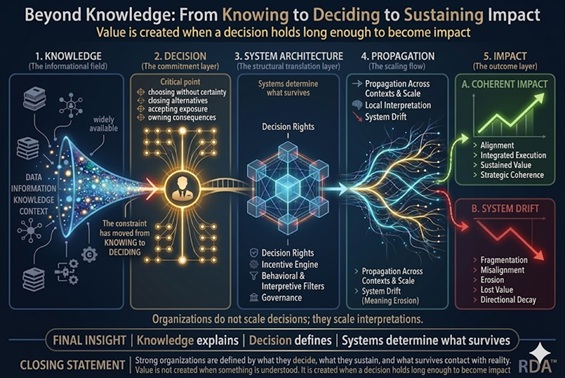 From Knowing to Deciding to Sustaining ImpactThe End of the Illusion
We started with a belief.
That knowledge creates advantage.
For decades, it did.
Data was scarce.
Information was slow.
Expertise took years to build.
Today, none of that is true.
Data is everywhere.
Information is instant.
Knowledge is accessible on demand.
What once differentiated organizations is now widely available.
And yet, performance does not converge.
Because the constraint has moved.
1. The ShiftOrganizations are no longer limited by what they know.
They are limited by what they decide.
Knowledge expands possibilities.
Decision closes them.
That is where difficulty begins.
2. The BreakBetween knowing and impact, there is a break.
Not visible.
But structural.
Organizations understand more than ever.
And move less than they should.
Not because they lack intelligence.
Because they avoid commitment.
3. The RealityDecision is not the continuation of knowledge.
It is a different act.
It requires:
Choosing without certainty
Closing alternatives
Accepting exposure
Owning consequences
This cannot be automated.
It cannot be distributed indefinitely.
It must be owned.
4. The SystemEven when decisions are made, they do not hold.
They move.
Through teams.
Through incentives.
Through pressure.
Through time.
And as they move, they change.
Not randomly.
Systematically.
Systems do not execute decisions.
They reshape them.
5. The FailureThis is where most organizations fail.
Not at the moment of decision.
After it.
When:
Intent weakens
Ownership diffuses
Priorities shift
Meaning drifts
Execution does not collapse.
It fragments.
6. The DifferenceIn this context, advantage is no longer informational.
It is decisional.
Not the ability to analyze.
The ability to:
Decide under uncertainty
Commit with clarity
Sustain direction through the system
This is not individual capability.
It is system design.
7. The ResponsibilityTechnology will continue to evolve.
AI will expand what can be known.
But it will not decide.
And it will not assume consequences.
That boundary remains human.
And organizational.
Final InsightKnowledge explains.
Decision defines.
Systems determine what survives.
Closing StatementIn the end, organizations are not defined by what they know.
They are defined by what they decide,
what they sustain,
and what survives contact with reality.
Because value is not created when something is understood.
It is created when a decision holds
long enough
to become impact.
Posted on: May 22, 2026 03:39 AM |
Permalink
Comments (2)
Please login or join to subscribe to this item

SANTOSH BADGUJAR
CHIEF OPERATING OFFICER| Accumax Lab Devices
Ahmedabad, Gujarat, India
Knowledge alone is increasingly insufficient in today's fast-changing business environment. The real differentiator for leaders and PMs is the ability to translate knowledge into decisions, and then sustain the impact of those decisions over time. As a COO, I've seen technically brilliant teams fail to create value because the knowing-doing gap was never bridged. Wisdom, judgment, and the courage to act on incomplete information are what separate good professionals from great ones.
SANTOSH BADGUJAR
CHIEF OPERATING OFFICER| Accumax Lab Devices
Ahmedabad, Gujarat, India
Luis, the progression from Knowledge to Decision to System Architecture to Propagation to Impact is a framework that captures something rarely taught but critically important: organizations don't scale decisions, they scale interpretations.
This resonates deeply in manufacturing and operations contexts. We invest heavily in creating knowledge—SOPs, engineering specifications, compliance documentation—but the value of that knowledge depends entirely on the decision structures built around it. When decision rights are unclear, or when incentive structures reward speed over quality, the system propagates the wrong behaviors regardless of how good the documentation is.
The concept of "system drift" as the alternative to coherent impact is well-illustrated. In quality-critical production environments, drift doesn't announce itself. It accumulates quietly through small local adaptations—each individually reasonable—until the system is producing outcomes very different from its original intent.
The closing insight—that strong organizations are defined by what they decide, sustain, and protect against the pressures of reality—reframes organizational design as an act of discipline, not just planning. An important and well-constructed post.
Please Login/Register to leave a comment.




