


Project Management

Re-evaluate: The Reviewing -- Deciding the Future

Doug is the author of the landmark book, Extreme Project Management®: Using Leadership, Principles and Tools to Deliver Value in the Face of Volatility. He works with clients who undertake projects in very demanding environments: those settings that feature high speed, high change, high unpredictability and high stress. Doug has lived in the trenches—from Bethlehem, Pennsylvania to Beijing, China—with over 275 project teams with budgets that ranged from $25,000 to over $25 million. He is one of the founders of the Agile Leadership Network, an organization dedicated to connecting, developing and supporting great project leaders. He is known for his hard-hitting and humorous keynote speeches that address vital issues facing today’s project-based organizations. You can visit Doug at www.dougdecarlo.com.
linkedin twitter facebook print Request to reuse this   Agile  
Warning: The Menu is Not the Meal!
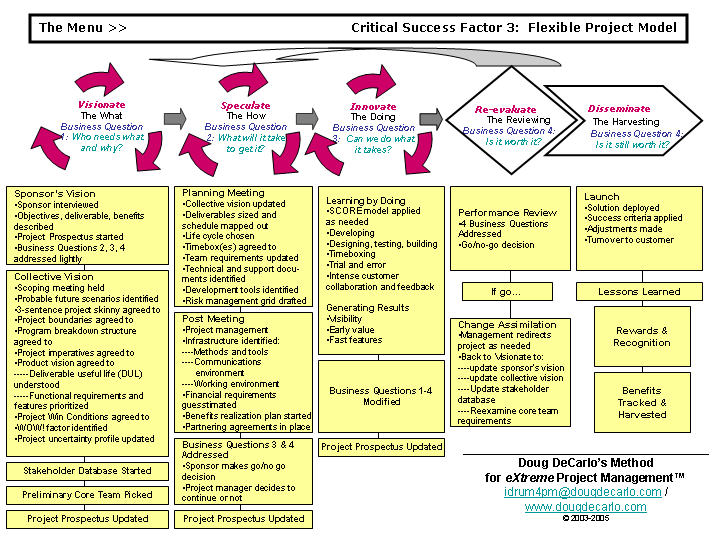
You can only be successful in applying the definitions, doing the activities and using the tools that comprise the Flexible Project Model by infusing and deploying them with the underlying principles, values and practices of eXtreme Project Management. 


Re-evaluate is a pause point on the project, a juncture where management makes a formal review of the venture and decides its future course. Here, Business Question 4 becomes the focal point: Is it worth it?

Two fundamental questions are being asked during Re-evaluate:
  • Are we doing the project right?
  • Is this still the right project to do?
Similar to a stage gate process, Re-evaluate sessions are typically held at agreed upon milestones; for instance, at the point where prototyping has been completed, technical feasibility has been determined or prior to going into production. 

The check points afforded by the Re-evaluate process enable management to make fact-based decisions as to the future course of the project and to minimize risk (and thereby have greater control) by funding the project in increments. This is especially important, because as the project goes from idea to maturity the stakes get much higher.

It’s also an opportunity to purge the project portfolio of projects that no longer have value to the organization relative to other projects. I’ve seen cases …

Please log in or sign up below to read the rest of the article.

ADVERTISEMENT

Continue reading...

Log In
OR
Sign Up
ADVERTISEMENTS

"[Musicians] talk of nothing but money and jobs. Give me businessmen every time. They really are interested in music and art."

- Jean Sibelius, explaining why he rarely invited musicians to his home.

ADVERTISEMENT

Sponsors