


Project Management

Innovate: The Doing -- Learning as You Go

Doug is the author of the landmark book, Extreme Project Management®: Using Leadership, Principles and Tools to Deliver Value in the Face of Volatility. He works with clients who undertake projects in very demanding environments: those settings that feature high speed, high change, high unpredictability and high stress. Doug has lived in the trenches—from Bethlehem, Pennsylvania to Beijing, China—with over 275 project teams with budgets that ranged from $25,000 to over $25 million. He is one of the founders of the Agile Leadership Network, an organization dedicated to connecting, developing and supporting great project leaders. He is known for his hard-hitting and humorous keynote speeches that address vital issues facing today’s project-based organizations. You can visit Doug at www.dougdecarlo.com.

linkedin twitter facebook print Request to reuse this   Agile   Innovation  
Warning: The Menu is Not the Meal
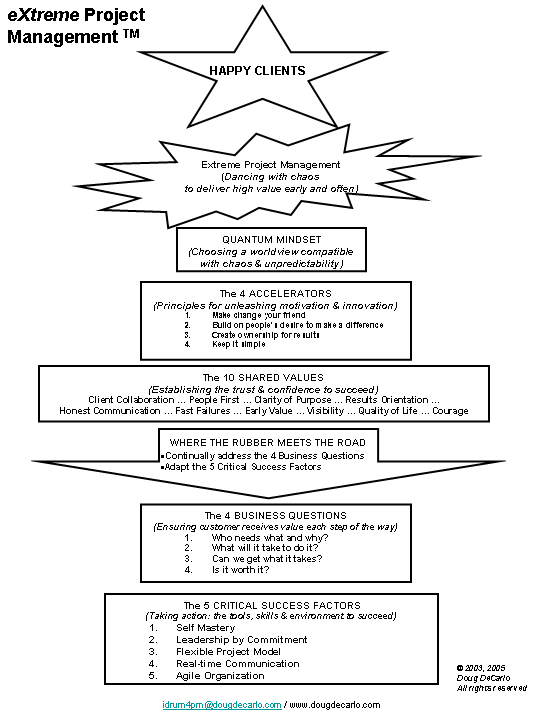
You can only be successful in applying the definitions, doing the activities and using the tools that comprise the Flexible Project Model by infusing and deploying them with the underlying principles, values and practices of eXtreme Project Management. (See the Happy Clients diagram.)
 

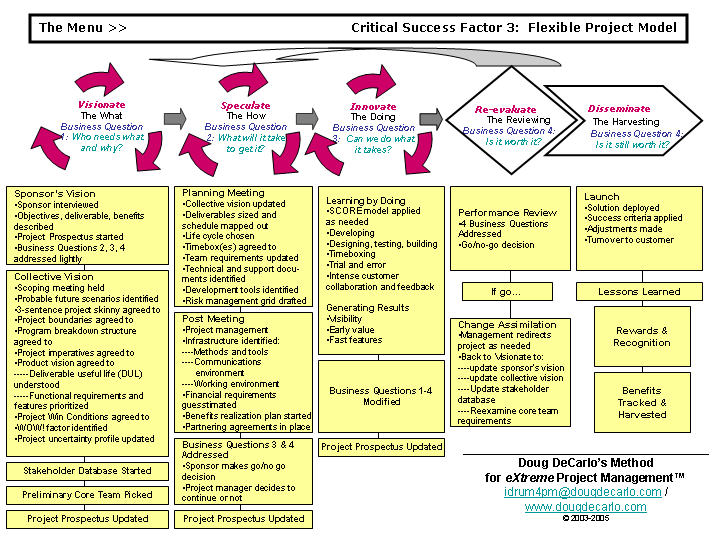
Innovate is the third element of the Flexible Project Model. It means learning by doing as opposed to learning by planning. Here the emphasis is on experimenting and generating rapid feedback. The operative Business Question is number 3: Can we do what it takes? The Shared Values that especially come into play during the Innovate Cycle are Client Collaboration, Results Orientation, Honest Communication and Fast Failures. 

Speaking of Fast Failures, a lot of what happens during the Innovate Cycle is trial and error. You are front-loading failure. The idea is to fail early and often. You can think of it as failing your way to success. Besides, the best time to fail is at the beginning of a project and not at the end.

The components of the Innovate Cycle are listed in the Flexible Project Model diagram.

Unlike traditional project management which may spend months in requirements gathering, agile project teams are impatient, yet focused. The focus comes from their shared understanding of the answers to Business Question 1: Who needs what and why?

You are …

Please log in or sign up below to read the rest of the article.

ADVERTISEMENT

Continue reading...

Log In
OR
Sign Up
ADVERTISEMENTS

"Two roads diverged in a wood, and I... took the one less traveled by, and that has made all the difference."

- Robert Frost

ADVERTISEMENT

Sponsors