Mike Griffiths is an experienced project manager, author and consultant who works for PMI as a subject matter expert. Before joining PMI, Mike consulted and managed innovation and technology projects throughout Europe, North and South America for 30+ years. He was co-lead for the PMBOK Guide—Seventh Edition, lead for the Agile Practice Guide, and contributor to the PMI-ACP and PMP exam content outlines. Outside of PMI, Mike maintains the websites www.LeadingAnswers.com about leading teams and www.PMillustrated.com, which teaches project management for visual learners.
When I started out as a PM and had a few successful projects under my belt, I wanted to manage larger and larger projects. Now I’m looking for ways to make them smaller and limit the functionality initially tackled. This is not just laziness or a lack of ambition on my behalf, instead it is a realization that delivering business value comes from successful projects and that large projects are inherently risky and more likely to fail.
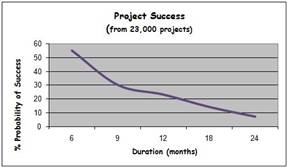
Jim Johnson of the Standish Group presented some interesting metrics at the PMI Global Congress conference in Toronto a couple of years ago that confirmed my suspicion. From a study of over 23,000 projects, it was found that the success rate dropped as project duration increased.
From the graph we can see that most (over 50 percent) of the six-month projects surveyed were deemed successful, dropping to 23 percent of 120-month projects, and less than 10 percent of 24-month projects. Now, we need to understand what “success” means here. The criteria was quite strict and defined as within 15 percent of cost and schedule and to customer-defined functionality and quality standards.
I expect a large proportion of these “failed” projects merely missed the 15 percent cost or time criteria, and the picture would not be so bad with a wider margin. Predicting costs over long periods is …