





Guessing is not a strategy: How to build decision velocity with AI and real-time data
June 10, 2026 | Live Webinar

Elok Robert Tee, PMP is a Project Lead in Singapore.
In agile, a piece of work may be determined, sized and completed in a sprint. In a traditional project environment however, work may be rolling in for the project team as tasks—each task seen as a story from a product backlog. This article presents a worksheet as a tool to track progress of similar tasks on a weekly basis over a project duration (in the Table 1 example below, for 13 weeks/one quarter).
The table was designed for the project team of a client to monitor the number of outstanding, new and completed tasks. These are similar but unique tasks aggregated in size and complexity, and assigned to a cross-functional project team. The concern of the client was to manage outstanding tasks as workload numbers (of tasks) and not of the specific tasks (e.g., Task B of Project Sunny), as the project team is empowered to manage the details.
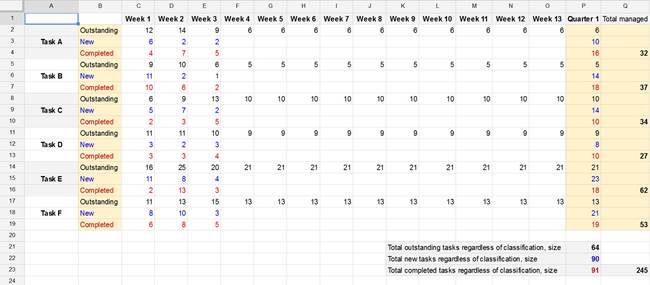
Table 1: A simple task tracking table
This tool is suitable for tasks with moving completion dates such as tasks with signoff dates that are dependent on external factors; (e.g., a completed task must be inspected and approved by only a single external official who has to schedule his or her appointments throughout the county, and inspected work may have to be reworked in the same task group); hence, tracking by numbers and not by dates.
In the example, similar tasks are grouped together as Task A to F (you may name or…
Please log in or sign up below to read the rest of the article.
|
"I have never met a man so ignorant that I couldn't learn something from him." - Galileo Galilei |