







Guessing is not a strategy: How to build decision velocity with AI and real-time data
June 10, 2026 | Live Webinar

Has Scrum outlived its usefulness? Should Scrum just go away?
The rise of Agile’s SAFe is like a bad episode of the movie Groundhog Day
Marcel Proust’s recursive novel: Why the concept of iteration in Agile is shortsighted
Forecast for 2015: The beginning of the end of Agile?
Google considered the best US company to work for due to HR agility


| Just saw the results of this survey poll on LinkedIn that I participated in:
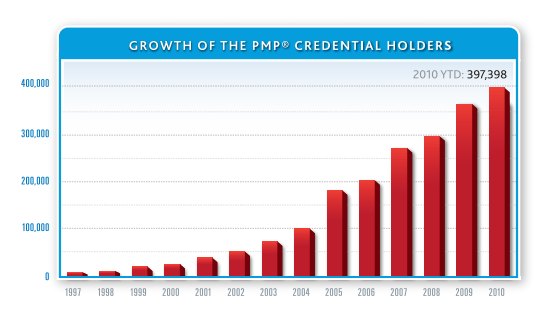
Not surprised that PMI leads the way, but was a bit surprised by how much. I really liked the age and demographic breakdown. Was surpised how low the ScrumMaster certification ranked in this survey, but I think that has to do with the fact that the barrier to entry is so low (you only need to attend a 2 day seminar and once completed you are a certified ScrumMaster). As I mentioned in another blog, I think we'll see the PMI adoption go higher with the recent explosive growth of the PMI-ACP certification within PMI. I recently found this graphic showing the growth of the PMP:
Love them or hate them, no doubt when it comes to project management certifications, PMI is dominating the standards and leading the industry to a near monopoly especially in the US with growth in the rest of the world following. As a commenter posted, "in terms of popularity, PMP would take the lead.....however, if a Project Manager does not how to implement the PMP processes in your working project environment, just 'knowing' the terminology either from PMP or PRINCE2 will not matter...." I wholeheartedly agree, but if your going to get certified, the best direction seems to be the PMI-way. |
|
As I’ve been studying for the PMI-ACP, I’ve been reviewing the idea of the “Agile Triangle” which is an extension of the traditional “Iron Triangle” of traditional project management. This is an idea that was originally conceived by Agile luminary, Jim Highsmith, where he states that “many agile teams are now caught in a dilemma. On one hand they are told to be agile, flexible, and adaptable, but on the other they are told to conform to pre-planned traditional Iron Triangle framework of scope, schedule, and cost. In essence they are being told ‘be flexible in a very small box.’ Agile teams are striving to meet one set of goals and managers and executives are measuring against another set”.
Value – for the customer in terms of a released product or deliverable.
Quality – continuous delivery of high quality and adaptive products.
Constraints - the traditional scope, schedule, and cost.
Jim Highsmith suggests that Agile applied to the Iron Triangle would consists of the following end points:
Value – for the customer in terms of a released product or deliverable.
Quality – continuous delivery of high quality and adaptive products.
Constraints - the traditional scope, schedule, and cost.
Jim Highsmith suggests that Agile applied to the Iron Triangle would consists of the following end points:
From this perspective, Agile teams should focus on releasing the project rather than getting constrained by the iron triangle. The three end points of the iron triangle would collapse into one end point of the Agile triangle called constraints. The other end points define the project’s goal of obtaining the value and quality of the deliverables that are of utmost importance to the stakeholders and that would require more attention. He expands on the Agile triangle image by adding an intermediary and internal value to the “Value” end point:
|
|
Though I was initially skeptical of the new PMI-ACP (Agile Certified Practitioner) exam, I have recently seen a quite big increase in its adoption which I blogged about before. I have seen discussion groups sprout on social networking sites like LinkedIn and Facebook and especially in training and education programs due to the requirement of obtaining 21 PDUs before taking the exam, by established and new Agile training and consulting companies.
Due to this, I started looking more into this certification and have to say that I do like its approach. Unlike the more well known Scrum certifications such as the ones provided by Scrum Alliance and the new fork created by co-founder Ken Schwaber which focus exclusively on Scrum, the PMI-ACP takes a much more broader approach and covers the full gamut of Agile practices, e.g. Scrum, XP, Lean, Kanban, etc.
Here’s a summary list of topics that are covered by the PMI-ACP:
Over 2500 people applied for the pilot program which is a record for PMI. Though I’m usually an early adopter for the latest and the greatest in the PM and technology fields, I decided to sit on the fence for a bit on this. With the popularity of the Scrum certifications and the glut of new certification from PMI that have not had widespread adoption, I was reluctant to partake in the pilot. But with the responses I’ve seen on social networking sites, the web and after reviewing the contents of the exam, I’ve now decided to take the exam. If you’re already a PMP, it integrates nicely under it as you are only required to maintain 30 PDUs per 3 years which is half of the PMP and you can have them count for both. Though it goes from PMI-ACP to PMP and not the other way around (In other words, your Agile based PDUs can count toward the PMP, but your PMP PDUs if they are not based on Agile cannot be applied to the PMI-ACP).
Of course you shouldn’t get a certification just because it is popular (unless that popularity translates directly to getting a better job and/or pay increase, which as of now the PMI-ACP can hardly claim) nor does passing this exam accurately gauge an Agile PM’s competency... I don’t want to revisit this topic and open that can of worms again, as I know it has been debated endlessly both on this site and other places regarding the PMP.
But as an actual Agile practitioner, I look forward to the challenge of studying for this exam as when I took the PMP, I found gaps in my knowledge of PM practices that studying for it helped identify and make me a more knowledgeable PM. And if you’re looking to get the 21 educational PDUs, look for lower cost online classes and if you’re a certified ScrumMaster, you most likely took a 2 day class which already provided you 16 PDUs. You could just take a 1 day agile class and obtain it, or watch 5 webcasts that have an educational component related to Agile. I’m taking a low cost but good quality one from Simplilearn that includes 2 full exams (**Disclosure, I’m an affiliate with Simplilearn).
If you are interested, I’d start at the PMI site and carefully read the handbook. I plan on taking mine around July and will blog about that here. In the meantime, for those pursuing it I wish you luck and let me know how it goes!
If you are interested, I’d start at the PMI site and carefully read the handbook. I plan on taking mine around July and will blog about that here. In the meantime, for those pursuing it I wish you luck and let me know how it goes!Though I was initially skeptical of the new PMI-ACP (Agile Certified Practitioner) exam, I have recently seen a quite big increase in its adoption which I blogged about before. I have seen discussion groups sprout on social networking sites like LinkedIn and Facebook and especially in training and education programs due to the requirement of obtaining 21 PDUs before taking the exam, by established and new Agile training and consulting companies.
Due to this, I started looking more into this certification and have to say that I do like its approach. Unlike the more well known Scrum certifications such as the ones provided by Scrum Alliance and the new fork created by co-founder Ken Schwaber which focus exclusively on Scrum, the PMI-ACP takes a much more broader approach and covers the full gamut of Agile practices, e.g. Scrum, XP, Lean, Kanban, etc.
Here’s a summary list of topics that are covered by the PMI-ACP:
Methods:
Scrum (obviously)
eXtreme Programming
Lean (as applied to software development mostly)
Kanban
Crystal
FDD
DSDM
RUP
Practices:
Osmotic Communication (by Alistair Cockburn in his book “Agile Software Development – The Cooperative Game”)
Servant Leadership
Agile Risk Management (Risk burndown chart, audit backlog, and risk analysis)
Agile Planning and Estimation (user stories, planning poker, etc.)
Communications (standup meetings, customer interactions, etc.)
Agile Quality (definition of “done” and how you qualify this)
Upcoming Practices:
Innovation Games
Control Limits
Agile EVM
Over 2500 people applied for the pilot program which is a record for PMI. Though I’m usually an early adopter for the latest and the greatest in the PM and technology fields, I decided to sit on the fence for a bit on this. With the popularity of the Scrum certifications and the glut of new certification from PMI that have not had widespread adoption, I was reluctant to partake in the pilot. But with the responses I’ve seen on social networking sites, the web and after reviewing the contents of the exam, I’ve now decided to take the exam. If you’re already a PMP, it integrates nicely under it as you are only required to maintain 30 PDUs per 3 years which is half of the PMP and you can have them count for both. Though it goes from PMI-ACP to PMP and not the other way around (In other words, your Agile based PDUs can count toward the PMP, but your PMP PDUs if they are not based on Agile cannot be applied to the PMI-ACP).
Of course you shouldn’t get a certification just because it is popular (unless that popularity translates directly to getting a better job and/or pay increase, which as of now the PMI-ACP can hardly claim) nor does passing this exam accurately gauge an Agile PM’s competency... I don’t want to revisit this topic and open that can of worms again, as I know it has been debated endlessly both on this site and other places regarding the PMP.
But as an actual Agile practitioner, I look forward to the challenge of studying for this exam as when I took the PMP, I found gaps in my knowledge of PM practices that studying for it helped identify and make me a more knowledgeable PM. And if you’re looking to get the 21 educational PDUs, look for lower cost online classes and if you’re a certified ScrumMaster, you most likely took a 2 day class which already provided you 16 PDUs. You could just take a 1 day agile class and obtain it, or watch 5 webcasts that have an educational component related to Agile. I’m taking a low cost but good quality one from Simplilearn that includes 2 full exams (**Disclosure, I’m an affiliate with Simplilearn).
If you are interested, I’d start at the PMI site and carefully read the handbook. I plan on taking mine around July and will blog about that here. In the meantime, for those pursuing it I wish you luck and let me know how it goes!
|
| LIke other bloggers here, I got a chance to download and read the excellent white paper titled "Distributed Agile Teams", which was based on an extensive survey and research done by Elizabeth Herrin on the Projects At Work site. Its a timely report given the increased global nature of projects being launched by multinational companies around the world. Though Agile is a strong advocate of having co-located teams, the reality is that you will most likely have development and testing teams in part of the world, while the product design and development in another with you as project manager coordinating it all from yet another location.
The first third of the paper went over the eye-opening statistics that resulted from the survey, while the rest of the paper discussed the results and further evaluations. I really liked the break down of the perceived benefits of distributed Agile teams to the eight categories of:
This list is ordered by the ranking of benefits with the first, flexibility, being the highest. I’m not surprised at these results and that quality would be last.
In my experience with managing dispersed teams, quality and especially the validation of quality was always the hardest in both traditional and Agile project management, but especially in Agile. The most popular and project management centric of the Agile methods, namely Scrum, advocates using a rigorous form of empirical process control to visually validate and inspect the quality of the output during iterations that get reviewed at least daily by the team and customer to allow adaptations to the backlog of items a particular Sprint is supposed to deliver on.
This process of “inspect and adapt” is a continuous one requiring all members from Team, to Product Owner, and Customer to be involved with to facilitate the flexibility and agility that lies at the heart of Agile methods. I agree completely with the recommended tips of having a central repository of code, with tools that automate and streamline rather than impede and hinder, as well as ensuring you have a project manager or ScrumMaster who excels at managing co-located teams first before moving to a distributed team.
I highly recommend downloading and reading this white paper. In addition, there was the announcement of a Scrum survey on this site that I hope as many people as possible participate in so we can all see how Scrum is used by Gantthead members!
|
|
I have written previously about the Microsoft based Scrum tools such as the MS Project 2010 and Visual Studio 2010 Scrum add-ins. But there are also a plethora of open source alternatives that have been discussed on this site and one in particular I find interesting is Redmine. It is a traditional PPM tool with the ability to track multiple projects and issues, act as a document repository, use Gantt and time tracking, etc. There has also been fertile development for plug-ins and of course, plug-ins for Scrum. The tool is written with the Ruby programming language and built on top of the popular Ruby on Rails framework.
Ruby was conceived on February 24, 1993 by Yukihiro Matsumoto(Matz) who wished to create a new language that balanced functional programming with imperative programming. According to Matsumoto, he "wanted a scripting language that was more powerful than Perl, and more object-oriented than Python. That's why I decided to design my own language". private Coordinate center, float radius; public void setCenter(Coordinate center) { this.center = center; } public Coordinate getCenter() { return center; } public void setRadius(float radius) { this.radius = radius; } public Coordinate getRadius() { return radius; }
}
attr_accessor :center, :radius Some conclusions:
As ScrumMasters and Project Managers, we like to focus on the work that leads to the end deliverables as well as the team and their skills and cohesiveness to get that work done. But it is also important not to overlook the appropriate tools that can be made available to them and carefully picking ones that will increase their productivity as well as enhance quality, instead of tools that impede and frustrate them. In software development, higher levels productivity languages like Ruby should receive special consideration. |
|
"Too bad all the people who know how to run the country are busy driving taxis and cutting hair." - George Burns |