




Guessing is not a strategy: How to build decision velocity with AI and real-time data
June 10, 2026 | Live Webinar

The Real Reason Your AI Project Is Going Nowhere
Why Systems Thinking Will Change How You Run Projects
10 Mistakes First-Time Project Managers Make (And How to Fix Every Single One)
What Is Project Management, Really? (And Why It Is a Life Skill, Not Just a Job)
Agile Micromanagement: How to Recognize It and What to Do About It
Agile, Artificial Intelligence, career, Career Development, Career Development, Change Management, Education, Stakeholder Management


| The Illusion of the Sudden Crisis There is a pervasive myth in project management that stakeholder problems are sudden events. We believe that everything is going fine until the day a heavy executive swoops in and changes the requirements. Or until the day a key partner suddenly refuses to sign off on a deliverable. We treat these moments like natural disasters. Unpredictable. Unavoidable. But if you analyze the anatomy of a failed project, you rarely find a sudden explosion. You find a slow leak. Stakeholder friction does not start in the middle of a project. It starts at the very beginning. It begins with small assumptions. It begins with unsaid expectations. It begins with silence. The hardest part of leading a project is not the technical execution. It is the political navigation. And the only way to win that game is to play it before the whistle blows. The Economics of TrustWe need to shift how we view stakeholder engagement. It is not a “task” to be completed. It is an investment strategy. Think of Trust as a form of capital. At the start of a project, your account is empty. You have not proven anything yet. Every time you engage early, listen without defending, or clarify a vague requirement, you are making a deposit. You are building a reserve of social capital. Most Project Managers wait too long. They wait until they have a “perfect plan” to show. They wait until they need something. This is a strategic error. If you only talk to stakeholders when you need a decision or when you have a problem, your relationship is purely transactional. You are withdrawing from an empty account. But if you engage early (when the stakes are low) you build the capital you will need later (when the stakes are high). The Psychology of the StakeholderTo manage stakeholders effectively, we must understand their psychological drivers. Stakeholders are not obstacles. They are humans operating under pressure. Behavioral science tells us that people are driven by a need for Agency (control over their environment) and Safety (freedom from threat). When a project starts, stakeholders are often quietly afraid.
Your job is not to “manage” them. Your job is to reduce the threat level. You do this by giving them Agency and Safety early in the process. A Protocol for Early InterventionYou do not need a complex strategy to fix this. You need a simple protocol for the first conversation. When you engage a stakeholder for the first time, do not start by talking about the project timeline. Start by talking about their reality. Here is a 5-point framework to structure that initial interaction. Contextual Inquiry (The Role) Do not assume you know why they are here. Ask (How does this project connect to your current priorities? What does your involvement look like in an ideal world?) This validates their status and gives you intelligence on their actual capacity. Value Definition (The Win) Success is subjective. Ask (If we are sitting here six months from now celebrating a win, what exactly has happened? What does success look like to you?) You will often find that their definition of success is completely different from what is written in the project charter. The Pre-Mortem (The Fear) This is a technique used by top strategists. Invite them to imagine failure. Ask (What worries you about this initiative? Based on your experience, how could this project fail?) This allows them to voice their fears safely. It turns them from a critic into an advisor. Communication Architecture (The Flow) Do not guess how they want to be updated. Ask (How do you prefer to receive information? Do you want the weekly details, or just the red flags?) Aligning with their communication style creates psychological safety. It shows you respect their time. Pattern Recognition (The History) They have been here longer than you. Use that. Ask (What have you seen go wrong in similar projects in this organization?) This gives you the “tribal knowledge” that is never written down in any process document. 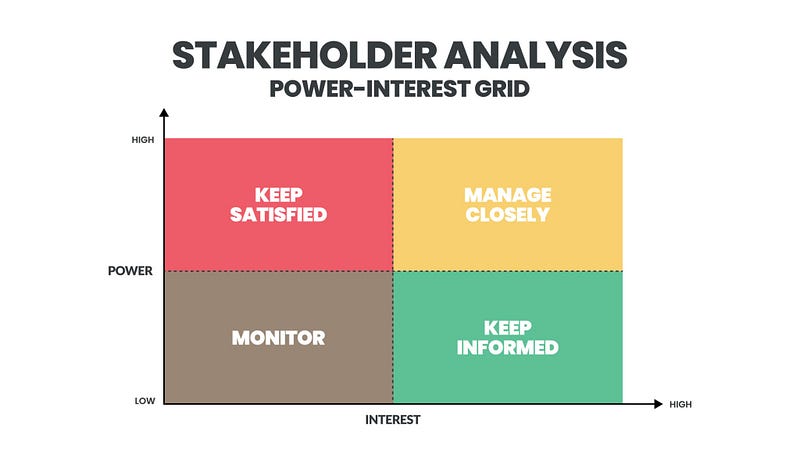 The 5 Deadly Sins of Stakeholder ManagementEven with the best intentions, we fall into traps. These are the five most common behavioral errors Project Managers make, and how to correct them. 1. The “Big Reveal” FallacyThe Mistake: You wait until the work is perfect before showing it. You want to impress them.The Reality: Silence breeds suspicion. While you are working in the dark, they are creating their own narrative about why you are late. The Fix: Show imperfect work early. Iterate in public. It proves momentum. 2. The Broadcast ErrorThe Mistake: Treating every stakeholder the same. You send one generic email to everyone.The Reality: A customized message is a signal of respect. A generic message is noise. The Fix: Segment your audience. The Executive Sponsor needs a different message than the Technical Lead. Tailor the signal to the receiver. 3. The Optimism BiasThe Mistake: Hiding risks to “protect” the relationship. You hope the problem will go away.The Reality: Bad news does not get better with age. It gets expensive. The Fix: Treat risks like data. Share them early and neutrally. (We are monitoring this risk. Here are our options). 4. The Ego Trap (Defensiveness)The Mistake: A stakeholder challenges your plan, and you argue back.The Reality: When you defend, you stop listening. You signal that being “right” is more important than the project outcome. The Fix: Be curious. Ask (Help me understand your concern. What are we missing?) 5. Selection Bias (Ignoring the Quiet Ones)The Mistake: Focusing only on the loud, demanding stakeholders.The Reality: The quiet stakeholders often hold the power to veto. Their silence is not agreement. It is often disengagement. The Fix: Proactively hunt for the quiet voices. Ask (I haven’t heard your thoughts on this yet, and I want to make sure we are not missing your perspective). The Strategic AdvantageUltimately, Stakeholder Management is not about being liked. It is about alignment. When you invest in these relationships early, you change the physics of the project. When a crisis hits (and it will), a trusted stakeholder becomes an ally who helps you solve the problem. An untrusted stakeholder becomes a judge who sentences you for the problem. The difference between those two outcomes is rarely technical. It is almost always relational. Do not overthink this. Look at your current project. Identify one stakeholder you have not truly connected with yet. Maybe it is someone quiet. Maybe it is someone intimidating. Send a simple message today. (I would love to get your perspective on how the project is shaping up. Do you have ten minutes to share your thoughts?) Then, stop talking and listen. You are not just gathering requirements. You are building the safety net for your future self. |
| Do you know the exact moment a project dies? It is rarely a loud explosion. There is no fire. There are no sirens. It usually happens on a Tuesday afternoon, in a boring meeting, with a very polite sentence. "Hey, while we are in there, could we just add a small login button for the marketing team? It shouldn't take long." And you, the Project Manager, the Guardian of the Scope, the Protector of the Timeline, you look at the person asking. They are nice. You want them to like you. You want to be helpful. So you say, "Sure, I think we can squeeze that in." That is the moment the project died. Not because of the login button. But because you just signaled to the entire room that the boundary is not real. You just told them that the scope is not a wall made of bricks. It is a line drawn in the sand, and you have a bucket of water. We need to stop blaming "Scope Creep" on bad requirements documents. We need to stop blaming it on "demanding clients." We need to look in the mirror. Scope Creep is almost always a failure of Leadership. The Comfortable Lie of the "Change Request Form"We love our processes. We love our forms. When a stakeholder asks for something new, the "textbook" answer (and the old PMBOK answer) was to say: "Please fill out a Change Request Form, and the Change Control Board will review it." This sounds professional. It also sounds like a bureaucratic nightmare. But here is the secret: Hiding behind a form is not leadership. It is cowardice. If you are using a form to say "no" for you because you are afraid to say it yourself, you are not managing the project. You are administrating it. Real leadership is the ability to look a stakeholder in the eye and explain why their request, while valid, is dangerous to the shared goal. PMBOK 8 shifts the focus from "controlling scope" (which sounds like policing) to delivering value. It reminds us that every time we add a low-value feature to a project, we are stealing energy from the high-value features. We are diluting the wine with water. And eventually, you are just serving purple water. Why We Are Addicted to "Yes"Why is this so hard? Why do smart, experienced Project Managers let scope explode until the budget is gone? Because "Yes" feels good. "Yes" feels like progress. "Yes" makes people smile. "Yes" validates that we are capable. We have a hero complex. We want to be the ones who can do it all. "No" feels like failure. "No" creates tension. "No" risks conflict. But here is the harsh reality of leadership: Your job is not to be liked. Your job is to be effective. Think of the Iron Triangle (Time, Cost, Scope). It is a closed system. If you say "Yes" to more Scope without asking for more Time or Money, you are not being a hero. You are being a liar. You are lying to the stakeholder by letting them believe they can get something for nothing. You are lying to your team by promising work they cannot deliver without burnout. Leadership is the courage to be the "bad guy" in the short term to be the savior in the long term. The Vacuum Theory of Scope CreepThere is another reason scope creeps, and it has nothing to do with the client. Nature abhors a vacuum. If you, as the leader, do not clearly define the Vision and the Boundaries of the project, the stakeholders will fill that empty space with their own ideas. If you don't build a fence, your neighbors will park their cars on your lawn. Scope Creep is often a symptom of a weak definition of Value. In PMBOK 8 terms, if we don't have a clear Project Charter or a clear understanding of the Business Case, we don't have a filter. When someone asks for a "Blue Button," and you don't have a clear Vision to check it against, you think, "Why not? Blue buttons are nice." But if you have a strong Vision that says, "This project is exclusively about backend optimization," then the answer is easy. "No. The Blue Button is frontend. It does not fit the mission." Leadership is providing the filter. If you are just writing down everything everyone says, you are a stenographer, not a Project Manager. The "Trade-Off" ConversationSo, how do we fix this without being a jerk? We change the conversation from "Yes/No" to "This/That." This is the most powerful leadership tool you have. It is called The Trade-Off. When a stakeholder brings you a new idea (and it will always happen, because the world changes), do not shut them down. Do not wave the Change Request form in their face. Engage with them as a partner. Say this: "That is a great idea. I can see why you want that. However, our box is full. We have a fixed budget and a fixed deadline. If we put this new idea in the box, something else has to come out. What would you like to remove?" This changes the dynamic instantly. You are no longer the enemy preventing them from having their toy. You are the consultant helping them prioritize their investment. Suddenly, the stakeholder has to think. "Is this Blue Button worth more than the Search Feature?" Usually, the answer is no. And the scope creep dies right there. Not because you fought it, but because you forced a leadership decision on their part. You made the cost visible. The Team is Watching YouThere is one more reason why letting scope slide is a failure. Your team is watching. Every time you say "yes" to a random request without fighting for more time or budget, your team loses respect for you. They are the ones who have to work the weekend to build that login button. They are the ones who have to skip dinner with their families because you wanted to look helpful in a meeting. When you fail to hold the boundary, you break the psychological safety of your team. They stop trusting you to protect them. And when the team stops trusting you, the project is truly dead. PMBOK 8 emphasizes Stewardship. You are the steward of the team's energy and the organization's resources. Wasting that energy on low-value scope because you were too polite to push back is poor stewardship. The Art of the "Positive No"You can be a strong leader and still be kind. The "Positive No" looks like this:
That is leadership. It provides structure. It provides safety. Conclusion: Be the Adult in the RoomProject Management is often about being the only adult in a room full of excited children. The stakeholders are excited about the possibilities. The developers are excited about the technology. Everyone wants to add more, do more, create more. It is beautiful. But it is chaotic. Your job is to be the one who looks at the clock, looks at the wallet, and says, "We have to go home now." It is not a fun role. It is not always the popular role. But it is the role that delivers finished projects. So the next time someone asks for "just one small thing," take a breath. Remember that your "Yes" has a cost. Remember that you are the guardian of the Value. Smile. And lead them to a decision, not just an addition. |
| The Paradox of the First Role There is a distinct psychological phenomenon that occurs when a professional steps into their first Project Management role. On Tuesday, they are an individual contributor, responsible only for their own output. On Wednesday, they are suddenly responsible for the output of a complex, temporary, and often chaotic system involving strangers, budgets, and deadlines. It is natural to feel overwhelmed. You sit in meetings where acronyms fly across the table like tennis balls. You look at the team and wonder if they can smell the fear. You worry that at any moment, someone will ask a question you cannot answer, and the floor will open up. This feeling has a name. We often call it Impostor Syndrome. But in reality, it is simply Cognitive Dissonance. It is the gap between who you think you need to be (the expert leader) and who you actually are right now (the novice learner). Most junior managers try to close this gap by pretending. They nod. They take notes. They mask their uncertainty with silence. This is a strategic error. Confidence is not a prerequisite for leadership. It is a byproduct of it. If you are waiting to feel confident before you lead, you will be waiting forever. We need to look at the behavioral science behind how professional confidence is actually constructed. The Science of Self-EfficacyConfidence is not a personality trait. It is a neurobiological feedback loop. Albert Bandura, one of the most influential psychologists of the 20th century, coined the term Self-Efficacy. In simple terms, self-efficacy is the belief in your capacity to execute behaviors necessary to produce specific performance attainments. But here is the catch: Bandura found that you do not get self-efficacy by thinking about it. You get it through “Mastery Experiences.” Every time you face a small stressor (like speaking up in a meeting) and survive it, your brain releases a chemical reward. It rewires itself. It moves from a state of “threat detection” to a state of “competence validation.” This is neuroplasticity in action. If you avoid the hard moments because you are afraid, you are teaching your brain that the situation is dangerous. If you engage with the hard moments, you teach your brain that you are capable. So, the feeling of “not being ready” is not a signal to stop. It is the raw material you need to build the leader you want to become. The Fallacy of “Fake It Till You Make It”For years, bad career advice has told us to “fake it.” We are told to project an image of invulnerability. But in a complex project environment, pretending to know everything is dangerous. It creates Information Asymmetry. If you pretend to understand a technical risk when you do not, you hide critical data from the decision-making process. True confidence is not the absence of doubt. It is the management of doubt. It is the ability to say (I do not know the answer to that, but I know how to find it). This shifts your identity from “The Expert” (which you are not yet) to “The Facilitator” (which you can be immediately). Psychologist Meg Jay discusses the concept of Identity Capital. These are the investments we make in ourselves. Every time you solve a conflict, every time you clarify a requirement, you are depositing capital into your identity. You are building evidence. A Protocol for Building AuthorityIf confidence is an output, what are the inputs? You do not need a personality transplant. You need a behavioral framework. Here are five specific actions that generate confidence in a project environment. 1. The Teleological Shift (Focus on Purpose) Novices obsess over tasks. Leaders obsess over outcomes. When you feel lost in the details, pull back. Ask (What is the mission here? What is the problem we are actually solving?) When you anchor yourself in the “Why” rather than the “How,” you instantly gain clarity. Clarity breeds confidence. 2. Stakeholder Mapping (Focus on People) Projects are social networks. Anxiety often comes from feeling isolated. The cure is connection. Do not just look at the organizational chart. Talk to the humans. Who are they? What are they afraid of? How can you help them? When you build social capital, the project stops being a test of your intelligence and starts being a collaborative effort. 3. Heuristic Planning (Keep It Simple) Complexity destroys confidence. Do not try to build the perfect 1,000-line schedule on day one. Create a “Minimum Viable Plan.” What are the next three big steps? Who owns them? When are they due? A simple plan that is executed is infinitely better than a complex plan that is paralyzed by analysis. 4. Signal Constantly (Over-Communicate) In the absence of information, people invent stories. Usually bad ones. Junior managers often hide when things go wrong. This destroys trust. To build confidence, do the opposite. Signal your status constantly. (Here is where we are. Here is the risk. Here is the plan.) By controlling the flow of information, you control the narrative of the project. 5. Positive Reinforcement Loops (Celebrate) Our brains are wired to notice threats, not wins. You must manually override this. When a milestone is hit, acknowledge it. When a team member solves a bug, thank them. This is not just “being nice.” It is reinforcing the behavior you want to see. It proves to the team (and to yourself) that progress is happening. There is a final trap to avoid. The belief that you must be the smartest person in the room. As a Project Manager, your job is not to be the architect, the developer, and the designer. Your job is to be the conductor. The conductor does not make a sound. They enable the orchestra to make the sound. The most confident thing you can do is ask a question. When you ask (Can you explain that to me in simple terms?) you are not showing weakness. You are showing that you care enough about the result to ensure understanding. This is called Psychological Safety. When the leader admits they are learning, it makes it safe for everyone else to admit they are learning too. The Algorithm of GrowthIf you are reading this and feeling the weight of expectations, remember this simple algorithm: Action → Evidence → Confidence. Most people try to do it backward. They want confidence before the action. It does not work that way. You build the muscle by lifting the weight. You build the confidence by leading the meeting, sending the email, and making the decision, even when your hands are shaking slightly under the table. Do not wait for the feeling of readiness. Pick one small thing today that scares you. A phone call you have been avoiding. A question you have been afraid to ask. Do it. Observe that you survived. That is how you build a Project Manager. One interaction at a time. |
| Does your project dashboard look green? Like, really green. A beautiful, comforting forest green. Your Schedule Performance Index (SPI) is 1.0. Your Cost Performance Index (CPI) is 0.98. The variances are minimal. According to the spreadsheet, you are a master of the universe. You are landing the plane exactly on the runway. So why does your stomach hurt? Why do you have that nagging feeling that something is on fire, even though the data says everything is fine? If you have been doing this job for more than five years, you know that feeling. It is the disconnect between the map (your metrics) and the territory (reality). We need to talk about why Earned Value Management (EVM) is the most dangerous tool in your kit. Not because it is useless. But because it is seductive. It gives us a number. And we love numbers. Numbers look like facts. Numbers look like control. If I can put it in a cell in Excel, it must be true. But often, EVM is just a highly sophisticated way of lying to ourselves. The Illusion of "Earned" ValueLet’s look at the language we use. Earned Value. It implies that because you spent the budget and did the work, you have "earned" something valuable. But have you? Imagine you are building a house. The schedule says that by Month 3, you should have the foundation poured. You pour the foundation. You spend exactly the budget allocated. SPI = 1.0. CPI = 1.0. The report goes to the stakeholders. Green lights everywhere. Champagne pops. But what if the concrete mix was wrong? What if it cracks next week? What if you poured the foundation in the wrong spot because the architect sent an updated drawing to your spam folder? EVM does not know this. EVM is blind to quality. It is blind to utility. It only cares about activity. EVM measures how fast you are burning fuel. It does not measure if you are flying in the right direction. You can have perfect EVM metrics right up until the moment the project drives off a cliff. The Watermelon EffectThis is my favorite metaphor for project status, and PMBOK 8 quietly nods to this problem when it talks about the Performance Domain of Measurement. A project can be a Watermelon. Green on the outside. (Your reports, your EVM data, your dashboard). Red on the inside. (The team is burning out, the tech debt is piling up, the client hates the prototype). Experienced PMs get misled by EVM because we confuse efficiency with effectiveness. You can be incredibly efficient at doing the wrong work. If your team knocks out 50 user stories in a sprint, your velocity looks great. Your EVM looks amazing. You are "earning" value like a machine. But if those 50 stories are for a feature that the market no longer wants, what is your actual value? Zero. Actually, it is negative. Because now you have code to maintain that nobody uses. The "90% Done" LieWe have all seen the task that stays at "90% complete" for three months. Why does this happen? Because EVM is often based on linear thinking. We assume that writing the code is 80% of the effort, and testing is 20%. So when the code is written, we mark it as done. We claim the EV. We boost our CPI. But in knowledge work (which is most projects today), the last 10% is where the dragons live. That is where integration fails. That is where the bugs appear. That is where the stakeholder says, "Oh, I didn't mean that shade of blue." EVM rewards you for starting things. It rewards you for "progress." But it punishes you for the messy, non-linear reality of finishing things. So, we lie. We mark things as complete to keep the graph looking pretty. We convince ourselves that the remaining work is "minor cleanup." We are not lying to be malicious. We are lying because the metric demands to be fed. The metric wants a straight line, and we are terrified of showing a jagged one. Behavioral Science: How Metrics Change BehaviorThere is a rule called Goodhart’s Law. It states: "When a measure becomes a target, it ceases to be a good measure." This is the behavioral trap of EVM. If your organization rewards PMs for having a CPI of 1.0, guess what you are going to do? You are going to protect that CPI with your life. Maybe you delay buying a necessary tool (hurting the team's long-term speed) just to save budget this month. Maybe you push a risky task to next month to keep the variance low. Maybe you cut scope silently. You start managing the metric, not the project. You become a Scoreboard Watcher instead of a Game Player. And while you are staring at the scoreboard, ensuring the numbers look right, the ball is flying right past your head. How to Read Data Without Being a FoolSo, should we throw EVM in the trash? No. That would be irresponsible. We still need to know if we are bleeding cash. We still need a rough idea of our pace. But PMBOK 8 teaches us to treat data as just one signal in a complex system. To stop being misled, you need to Triangulate. Never trust EVM alone. You need to pair it with two other sources of truth. 1. The "Sentiments" Check (The Human Data) If your SPI is perfect, but your lead engineer is drinking three Red Bulls at 9 AM and hasn't smiled in a week, your SPI is a lie. The human system always reacts before the data system. Burnout is a leading indicator of future delay. EVM is a lagging indicator of past spend. Trust the tired eyes of your team more than the Excel sheet. 2. The "Tangible" Check (The Product Data) Ignore the percentage complete. Look at the thing. Can you touch it? Does it work? If a task is "90% done" but you cannot demo it, treat it as 0% done. This is brutal. It will wreck your SPI. But it is honest. Adopting a "binary completion" rule (it is either done or not done, no partial credit) destroys the illusion of progress, but it saves you from the Watermelon effect. 3. The "Context" Check (The Environment Data) This is the big addition in modern project thinking. Your metrics exist inside a context. If your CPI is bad, is it because your team is slow? Or is it because the price of steel went up 20% globally? If your SPI is lagging, is it because you are inefficient? Or is it because you paused to refactor code that will save you months later? Data without context is just noise. The Comfort of AmbiguityThe reason we cling to EVM is that ambiguity is scary. It is terrifying to go to a Steering Committee and say, "Well, we have spent the budget, but we are not sure if the product is good yet." It is much safer to say, "CPI is 0.98." But your job as a senior Project Manager is not to be safe. It is to be accurate. You have to be brave enough to look at a green dashboard and say, "I don't believe this." You have to be brave enough to dig into the red. Because the sooner you find the red—the real problems, the bad quality, the unhappy stakeholders—the sooner you can fix it. A metric is just a flashlight. If you point it at the floor, the floor looks fine. But if you don't point it into the dark corners of the room, you are going to get eaten by the monster hiding there. Don't let the math lull you to sleep. |
| Do you wake up in the middle of the night worrying about an email you sent? Do you replay conversations in the shower, wondering if your tone was too harsh? Do you measure the success of your day by how many people smiled at you? If you nodded your head (or sighed heavily), then we need to have an honest conversation. You are suffering from the most dangerous affliction in project management. You are trying to make everyone happy. And it is going to destroy you. We often think that a "successful project" means a project where everyone agrees, everyone gets what they want, and nobody raises their voice. We treat stakeholder satisfaction like a fragile vase that we have to carry across an icy parking lot. But here is the harsh truth. Universal happiness is impossible. If you are trying to be a Project Manager who pleases everyone, you are not managing a project. You are running a daycare. And you are probably burned out. This is why PMBOK 8 (the latest Project Management Body of Knowledge) signals a massive shift in how we think. It moves us away from "controlling" people and towards "navigating" systems. It gives us permission to stop being people-pleasers and start being value-deliverers. Let’s explore how to build a Sustainable Project Management style. One where you can actually sleep at night. The "Pizza Topping" Paradox Imagine you are ordering pizza for a team of twenty people. If you try to make everyone 100% happy, what do you do? You ask everyone for their favorite topping. One person wants pepperoni. One person is vegan. One person hates tomatoes. One person only eats gluten-free crust but loves extra cheese. If you try to combine all these desires into one solution, you end up with a gluten-free, cheese-less, tomato-less, pepperoni-covered disaster that nobody wants to eat. This is what happens when you prioritize happiness over value. In PMBOK 8, the focus shifts to Value Delivery. Value is not the same as "what the stakeholder asked for right now." Sometimes, delivering value means delivering bad news. Sometimes, it means saying "No." Sometimes, it means building the vegan pizza and telling the pepperoni lover to wait until next time. If your goal is to make everyone smile, you will compromise the integrity of the project until it collapses. And when the project fails, guess what? Nobody is happy. Happiness is a Moving Target (And You Are Out of Ammo) Why is chasing happiness unsustainable? Because of a psychological concept called Hedonic Adaptation, combined with what we call Context Drift. Stakeholders are human. Their "happiness" is not a fixed point on a map. It is a mood. It is influenced by the weather, their morning coffee, the pressure from their own boss, and the stock market. You can deliver a miracle on Tuesday. They will be thrilled. By Friday, that miracle is the "new normal." They have adapted. They are already looking for the next dopamine hit. If you base your self-worth as a PM on their emotional state, you are signing up for an emotional rollercoaster that you cannot control. PMBOK 8 recognizes this. It talks about Complexity and Ambiguity. It admits that the environment changes constantly. If the environment changes, expectations change. You cannot freeze time. So why are you trying to freeze their emotions? The Shift: From "Waiter" to "Doctor" To make your career sustainable, you have to change your mental metaphor. Most PMs act like Waiters. "Is everything okay?" "Can I get you anything else?" "I am so sorry the kitchen is slow!" The goal of a waiter is customer satisfaction in the moment. You need to act like a Doctor. A doctor listens to the patient. A doctor cares about the patient. But if a patient says, "I want candy for dinner," the doctor says, "No. That will kill you. You need vegetables." The patient might be unhappy. They might grumble. But the doctor knows that health (Value) is more important than immediate gratification (Happiness). PMBOK 8 emphasizes Stewardship. A steward looks after the long-term health of the organization and the project. A steward is brave enough to be unpopular for a few days to ensure success for a few years. How to Practice "Sustainable" Management So, how do we actually do this without getting fired? How do we stop people-pleasing but keep our jobs? 1. Stop Managing Emotions, Start Managing Expectations You cannot control how a stakeholder feels. You can only control what they expect. When you promise something unrealistic just to make a meeting end on a high note, you are borrowing happiness from the future. And the interest rate is high. Be boringly honest. "We cannot do X by Friday. We can do Y." They won't smile. But they will trust you. Trust is sustainable. Happiness is temporary. 2. Use "Systems Thinking" as Your Shield PMBOK 8 loves Systems Thinking. This is your best defense against taking things personally. When a stakeholder yells or demands a change, do not think, "They hate me." Think, "What pressure is the system putting on them?" Are they afraid of losing budget? Are they competing with another department? When you look at the system, you stop absorbing the emotion. You become an observer. This protects your energy. 3. Define "Value" Early (And Weaponize It) At the start of the project, agree on what Value looks like. Write it down. Is Value "Speed"? Is Value "Quality"? Is Value "Low Cost"? (It cannot be all three). Later, when a stakeholder wants to change everything (and threatens to be unhappy if you refuse), point to the definition of Value. "I want to make you happy, but we agreed that Speed was our Value. If we add this feature, we lose Speed. Which one do you want?" Put the choice back on them. The Freedom of Being "Good Enough" There is a liberating thought in accepting that you cannot please everyone. It frees you to focus on the work. When you stop scanning the room for frowns, you have more brainpower to solve problems. When you stop apologizing for reality, you project more confidence. Ironically, people respect a leader who has boundaries. Think about the leaders you respect most. Are they the ones who said "yes" to everything? Or are they the ones who had a clear vision and stuck to it, even when it was difficult? Sustainability means surviving. It means finishing the project with your sanity intact. It means going home to your family and having the energy to play with your kids (or your dog, or your PlayStation), instead of staring at the wall in exhaustion. PMBOK 8 gives us the framework. But you have to give yourself the permission. Stop trying to make everyone happy.Start trying to make them successful. There is a big difference. And once you see it, you will never go back. |
|
"My goal is simple. It is complete understanding of the universe, why it is as it is, and why it exists at all." - Stephen Hawking |