



Guessing is not a strategy: How to build decision velocity with AI and real-time data
June 10, 2026 | Live Webinar

Drive additional value with your PMO
Building an Effective PMO—Building Trust
PMO Leaders - Presenting at PMO Symposium®
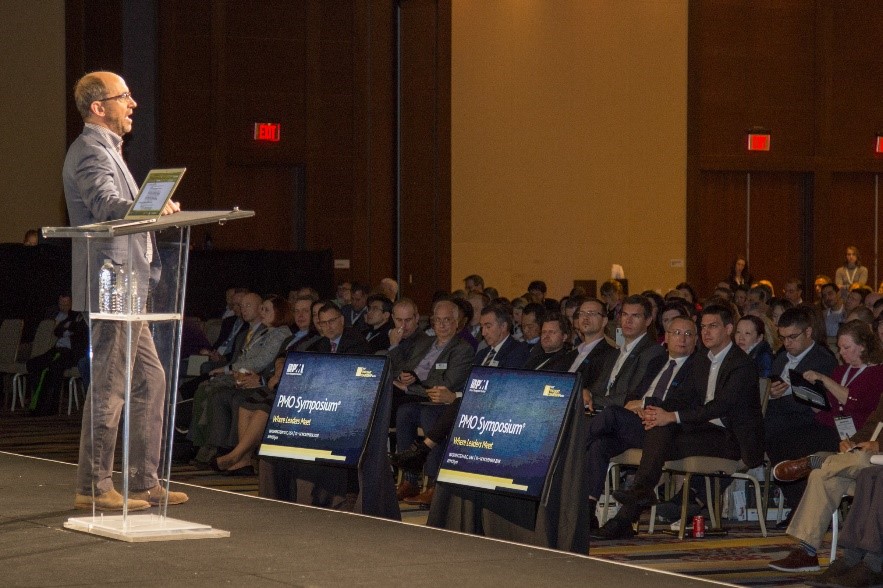
What I Learned From Dick Costolo’s Opening Keynote at the PMO Symposium® 2018
Benefits Realization, Leadership, PMO, PMO Insights, PMO Maturity, PMO Symposium, Portfolio Management, Strategy Execution


| I'd like to briefly review a few areas that might be worth looking at if you would like to enhance the value your PMO provides to your internal or external customers or to your organization overall. We all know we need to constantly evolve, grow, adapt and look for areas to add new value for all our stakeholders. The below suggestions are meant to provide a few ideas for you to consider. Client specific Program Management Offices - in commercial relationships, overseeing one large client contract and Program - often have lifespan of multiple years and undergo significant change in scope and related processes as client scope, services, cost pressure, technology advances or other factors over time enable or require their PMOs to change too.
Regional Client Program Management Offices - overseeing multiple different Client Programs/Contracts with a vertical or regional focus - often have lifespan of multiple years. Over longer periods, the supplier organization typically must adjust to business changes and likely enhances the range of delivery methods, tool-sets, perhaps performs business process re-engineering and outsourcing, and they add new commercial services requiring different project delivery skills and approaches. There is a lot to facilitate and keep straight in such an environment.
Corporate/Enterprise PMOs - supporting the governance of Project, Program and even Portfolio Management processes for an entire corporate organization or division. EPMOs are typically focused on developing, implementing and governing enterprise level methods, standards and processes for project and program management and likely are also overseeing a handful of the largest, most critical initiatives of the organization.
Other types of PMOs - include PMOs overseeing large initiatives internal to an organization - perhaps those assigned to large optimization initiatives, those overseeing M&A transactions or large product development and infrastructure deployment efforts. They might have similarities or represent a mix of the above and based on specific needs benefit from several of the recommended elements. Enhance your PMO: Regardless which type of PMO you are working with today or in the future, I hope you'll find areas of potential inspiration and improvements in this blog, and I encourage you to look for additional ideas in the PMO Quick Tip Guides published by PMI. These small summaries were compiled by a handful of PMO enthusiasts to help you with ideas of this type. They are available here: https://www.pmi.org/pmo-symposium/resources Thanks a lot, until next time, Morten Sorensen, PMP, PgMP, PfMP, ITIL Vice President PMO, Peraton Morten Sorensen has been in global IT and Telecommunications his entire career and has lived in Denmark, Germany and now US. He is Vice President of the Project Management Office at Peraton. Morten is certified in Portfolio Management (PfMP), Program Management (PgMP) and Project Management (PMP) and a frequent speaker on topics of: Strategic Initiative Management, Benefits Realization Management, Portfolio Management and roles of PMOs (Project Management Offices). |
| By Quynh Woodward When establishing a PMO, building trust is seldom on the checklist of things to do. However, for the PMO to be effective, building trust is not an option but an essential element for success. Trust can be the driver for boosting team morale, collaboration and productivity. Trust can bring about more stakeholder engagement, commitment and support. In the PMO world, there are many stakeholders such as senior executives, project managers, business operational leaders and external customers. Building trust with these key stakeholders should not be left on the sidelines. Paul J. Zak, founding director of the Center for Neuroeconomics Studies and professor of Economics, Psychology, and Management at Claremont Graduate University, spent over two decades studying trust in organizations. Dr. Zak found that "compared with people at low-trust companies, people at high-trust companies report 74% less stress, 106% more energy at work, 50% higher productivity, 13% fewer sick days, 76% more engagement, 29% more satisfaction with their lives and 40% less burnout." Looking over the presentations from past PMO symposiums, many presenters highlighted trust as a notable success factor. For the Triglav Group, 2018 PMO of the year finalist, building trust is a key focus in their PMO transformation. The Triglav PMO strives to be the organizational role model for leadership, cooperation and execution. According to the Triglav team, the “PMO can build trust and gain relevance by representing the value of project management based on exact data, outcomes and impact on the business. Trusting and effective working relationships are built by addressing challenges, sharing experiences and acknowledging achievements.” Trust is essential in a team environment because it fosters collaboration, commitment and productivity. John Carter, author of Innovate Product Faster, spoke at the 2018 PMO Symposium and discussed trust as a crucial element to empower teams. For trust to develop, boundary conditions, such as must-have features or expected performance levels, need to be identified upfront to enable effective decision making. If the team is within bounds, executives do not need to intervene unless the team crosses a boundary. According to Mr. Carter, “lean process is enabled by trust. Management now places more trust in product development teams. The greater trust allows the team to have ownership and engagement.” Trust is stronger when there are clear expectations and open communications. But what if you inherit an established team with trust issues? This situation is challenging. One potential way to tackle the challenge is to analyze the root cause by listening to your team, using surveys or creating a safe place for team members to voice their viewpoints. Once the issues are identified, ask the team to discuss and come up with their own solution. In some cases, a third-party mediator may be needed to facilitate a resolution. Trust starts with leadership. As a PMO leader, your teams and your stakeholders are going to analyze your communications and discuss your actions. Your role requires thoughtful transparency and alignment of words with action. According to Dr. Ernie Mendes of UC San Diego Rady, Center for Executive Development, and a 2016 PMO Symposium speaker, “leaders’ abilities to listen, communicate clearly and lead, have the strongest effect on employees’ organizational commitment. When communication channels begin to deteriorate, misunderstandings and misrepresentations abound, and a climate of mistrust sets in.” As PMO leaders, what do you do to promote a culture of trust? |
| By Quynh Woodward In the PMO world, a name can be a topic of great discussion. The “P” in your PMO can provide a lot of information about your purpose. Are you focusing on projects, programs or portfolios? These days, you see many new acronyms for the PMO such as IMO (implementation management office), CDO (client delivery office), PSE (project success enabler), RMO (resource management office), VMO (value management office) and LACE (lean agile center of excellence). Some PMOs may take on a new name to be more specific about their services and mission. Other PMOs may need to revamp their focus due to changing priorities. According to the 2018 PMI® Thought Leadership Series, The Next Generation PMO, 55 percent of PMO leaders indicate that the charter for their PMO changed in the past five years. Most of these changes are created to enable a closer alignment with strategic initiatives. And perhaps, at the root of these name changes is the desire to enhance perception and ensure that the PMO is more in sync with the organizational strategy. Some PMOs are going further by focusing on a brand refresh to showcase their value proposition. Some PMOs are training their teams to be brand ambassadors, including how to introduce themselves and how to enable strategic relationships. It is no longer just about having the right name, but also the right brand message. But how do you make sure that the new name or the brand message is more than just leveraging semantics? At the recent PMO Symposium®, speakers discussed taking steps to assess and clarify the role and value contribution of the PMO. These speakers analyze the PMO value contribution not just through benefits realization, but also through different lenses that the business understands such as customer centricity, agility, flexibility, productivity and quality. Is the PMO helping different business units to commit to the organizational strategy? Is the PMO driving transformation efforts to future-proof the business? Is the PMO helping to inform strategic business decisions? Is the PMO facilitating strategic communications to ensure advancement of critical projects? In addition, it is important to analyze PMO practices to address any misalignment. Is the governance system too challenging to navigate? Is the PMO acting as an additional layer that can hamper the speed of delivery and innovation? Do team members have the skills to deliver strategic initiatives effectively? Can the PMO develop and sustain capabilities to drive stronger business outcomes? It is also necessary to assess stakeholder sentiments to get a good read on the organizational culture. What are the shared values, beliefs and assumptions? Are there ways to build a stronger bridge between the PMO and the business? The PMO needs to understand these aspects to ensure that the value contributions are in alignment with the organization’s goals and priorities. These analyses enable PMO leaders to develop not only the right name and brand message, but also the right roadmap to align their role and activities, improve their capabilities, rouse their team to action, and extend the PMO brand power. While each PMO is unique, and a PMO name change and brand refresh may be appropriate in some cases, it should not be just a sematic exercise, but rather a concerted effort to close the performance expectation gap. Have you thought about the name or the brand of your PMO? Did you change the name of your PMO recently? What did you do to enable a positive perception shift? I’d love to hear your thoughts. |
| By Quynh Woodward PMO leaders are busy people. They focus on their organizational strategic initiatives and goals. They develop robust processes to facilitate value delivery while communicating to stakeholders and engaging their senior executives with critical insights. They nurture the skills and capabilities of their teams to enable success. They have a lot of activities on their plate. Presenting at the PMO Symposium® may require hours of preparation and may not be on the priority list for many PMO leaders. Fortunately, several skilled PMO leaders are taking on that extra effort to share their real-world knowledge. I asked speakers from past PMO Symposium events about their presentation experiences and sought their advice. The following individuals responded to my questions.
What factors influenced your decision to present at the PMO Symposium?
How was your experience as a PMO Symposium presenter?
What advice would you give to other PMO leaders submitting a proposal to present at the event?
The 2019 PMO Symposium call for presentation proposals is open now until 3 May! Don’t miss your chance to take part in the event where leaders meet. PMO leaders interested in sharing PMO practical knowledge and innovative strategies are encouraged to submit a proposal for consideration. Showcase your thought leadership at www.PMI.org/PMOSpeaker. For more information about the event, visit www.pmi.org/pmo-symposium. |
| By Quynh Woodward The performance expectation for a keynote speaker is always high. Keynote speakers set the underlying tone and convey important messages for events. In November 2018, Dick Costolo delivered a spectacular opening at the PMO Symposium held in Washington, D.C., USA.
Dick Costolo was most recently the chief executive officer of Twitter, serving from October 2010 to June 2015, where he took the company from US$0 to US$1.5 billion in annual revenue. According to Mr. Costolo, there are many paths to success, but to enhance your chances, focus on the speed of execution and leadership. Here is a breakdown of his tips for strengthening the “speed of execution” muscle of your PMO:
On a regular basis at your team meetings, ask the following question: “What is it taking us too long to learn and how can we learn that faster?” This question enables teams to reflect on solutions. The “Why is it taking us too long to learn?” question often surfaces commonly held dogmas or practices that are not always useful or true.
As an organization grows, increasingly the default answer to every question is “no.” The bias to yes means that there are many paths to get to “yes” within the organization to avoid hindering creativity. As long as the activities are legal, encourage employees to innovate and try new things. Avoid the most nefarious version of “no,” which is “you have to go ask these other 12 people for permission.” Your team will spend their time asking for permission rather than taking critical action.
The job of leaders is not to prevent mistakes, but to correct mistakes quickly. Protecting the or the desire for everything to run smoothly is a false goal—it leads to measuring people by the mistakes they make rather than by their ability to solve problems.
Rules are set up to simplify life for managers, but they can hinder business results. Instead, replace the critical rules with principles and guidelines, and enable your team to work using their good judgment. Costolo’s Tried-and-True Leadership Principles The principles below are based on what Mr. Costolo learned from Bill Campbell, who was the executive coach to Larry Page, Eric Schmidt and Jeff Bezos, as well as Dick Costolo. Bill Campbell believed that management excellence is about helping people to flourish in their environment, not telling people what to do. Your title makes you a manager. Your team decides if you are a leader. Principle 1 – Communicate context for decisions rather than authority. One of the hardest things for leaders is the communication architecture, especially when you are scaling teams. The way to build trust with your team is to listen, be forthright and communicate context for decisions rather than authority. Explain the why and not just the what. Principle 2 – Push decisions down the stack. Ask yourself: “What’s the highest-leverage thing I could be doing right now?” When in doubt, force yourself to delegate. Set a weekly goal of the percentage of meetings you will stop attending and start delegating. Make sure action items are delegated to your team appropriately. Give people ownership by providing authority and accountability. As a leader, it is not your job to make every decision. It’s to ensure that decisions get made and to resolve issues when your team cannot reach consensus. If you make all the decisions, then you may become the conduit for organizational politics. Principle 3 - Eliminate politics. Avoid being the sole decision maker. A common challenge for new leaders is that they feel obligated to make all decisions. What you may get are pre-meetings before the actual meeting. These pre-meetings are set up to lobby and influence your decision. To eliminate these pre-meetings and politics, you need to encourage debate openly in the meeting room. It’s okay for people to be contentious about a decision. It shows their passion. While social cohesion feels good, getting to the right answer/solution is better. The goal of a manager is not to get to social cohesion, but to get to the right solution. Don’t punish people for debating with you. However, once the debate is done and the decision made, follow Jeff’s Bezos’ advice: “Disagree and commit.” When people cannot agree, don’t get discouraged because contrarians on the team can have great ideas. Send people who do not agree with one another to work together and develop a proposed joint solution. Principle 4 – Understand the culture. Ask your teams: “Tell me something that’s not working well.” Get different perspectives. Take notes and don’t agree or disagree with the person on the spot. Reflect to get an overview of the political culture, and learn about what people believe. Take your insights back to your leadership team and act purposely to eliminate political culture. Mr. Costolo closed out the keynote session with a few of Jeff Bezos’ words of advice:
In one short hour, Mr. Costolo used analogies and simple stories to convey these viewpoints. I'd love to hear your thoughts on Dick Costolo's keynote.
|
|
"Nobody can be exactly like me. Even I have trouble doing it." - Tallulah Bankhead |