


Guessing is not a strategy: How to build decision velocity with AI and real-time data
June 10, 2026 | Live Webinar
| last edited by: Steven Zachary on Dec 27, 2015 8:33 PM | login/register to edit this page | ||
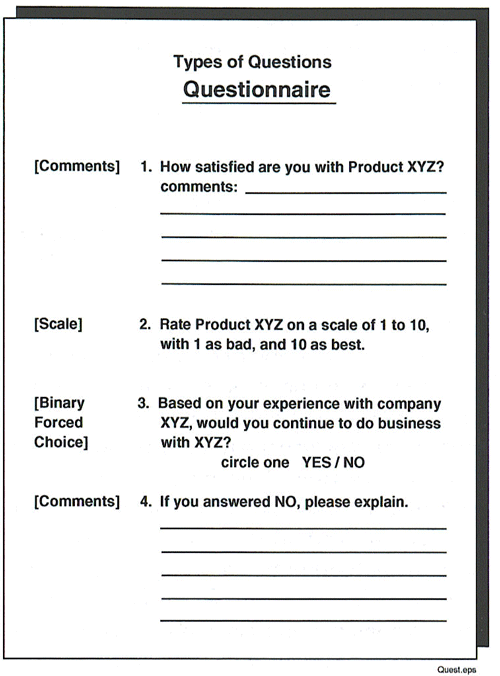
 This technique allows for collecting a large amount of data in a short period of time. There are two types of questions that may be used: "close-ended," where the responses to questions are provided in multiple choice or scale format, and "open-ended," where the respondents are encouraged to speak freely with no structure.
Procedures
InstructionsIn business reengineering, it is critical to understand the viewpoint of the customers of the value stream and their "customer satisfiers." A business reengineering project begins by gathering the customers' view of the performance of the value stream by direct interaction with them. While members of the project team or even management and reference groups may feel they "know" what the customer needs, too often these views are filtered, slightly altered, and even, unintentionally, misrepresented. Questionnaires and surveys are a cost effective way of obtaining the qualitative and quantitative data from customers, regarding their needs and satisfiers. To begin the process, make sure the objectives of the data collection are understood. Canvass project team members, the reference group, subject matter experts, and/or professional market researchers to identify potential target customers. Sometimes there are a variety of customer classes to be surveyed. Selection must be based on project objectives and the focus of the desired information. Developing an appropriate questionnaire may require professional skill. Once target customer groups (internal or external to the enterprise) have been identified, develop a set of questions appropriate to the information desired (e.g., needs, degree of satisfaction with product or service, performance, attitudes, beliefs, etc.). These questions may need to be "beta" tested with a test group or representative customer sample prior to formal launch of the survey. Revise the questions as required or change the method of collection. Experts may be needed to develop the questionnaire to ensure that there are no misunderstandings of any terms used. There are several ways to ask questions on a questionnaire:
Questionnaires and surveys can be conducted by mail, via telephone, through face-to-face point of contact interviews or in combination. Care must be taken to properly administer and track the results. Clear, concise instructions are required (no matter which method of collection is used) for there is no human interaction for clarification once the questionnaire or survey reaches the customer. Analyze the results, using an appropriate analysis technique (e.g., Customer Needs Analysis, Problem Analysis, QFD, etc.). Summarize, as required, and keep customers informed. Surveys are typically distributed repeatedly to collect historical data, spot trends, and to seek continuous improvement in product quality, customer satisfaction, or service effectiveness. Questionnaires can also be used to assess current system usability and technical performance. (See Current Systems Analysis.) Rating scale questions are frequently used and can be very valuable but they are not as simple as they seem. A reliable scale method to follow is the Likert Scale which generally is a 5 or 7 point scale (as opposed to the 10 point scale identified below). Attention is required to address bias in the way the survey is conducted.
Other important aspects to consider in the process include: the rights of respondents, such as confidentiality, at all stages of the process. Authencity: as derived from validity, reliability and triangulation measures. Step 1 is to state very clearly what the pupose of the exercise is, before jumping to writing the questions . If the data collected is going to be subjected to "heavy" math techniques, first select the analytical tool and then make sure the questions are designed to collect the data that the tool needs. Questionnaires are a great tool but sadly are often designed to elict a pre-ordained outcome.
|
|||
| last edited by: Steven Zachary on Dec 27, 2015 8:33 PM | login/register to edit this page | ||
|
"The secret to creativity is knowing how to hide your sources." - Albert Einstein |