Hierarchy of Skills: Laying a Foundation for PM Maturity
Craig A. Hoard, PMP
The March 2003 edition of PMI’s Project Management Journal contains an interesting paper by Pennypacker and Grant[1] dealing with the state of project management maturity. Among their conclusions, the authors find the need for increased standardization of project management processes and an industry standard project management maturity model.
With the infusion of AI into digital platforms, the role of the project professional is expanding yet again. But technology does not deliver transformation; disciplined project and product management does. This PM shares five lessons learned.
Caregiving is adaptive project management in its rawest form. Uncertainty is not the exception; it is the baseline. This practitioner shares how caregiving helped strengthen her PM skills.
“Done” is one of the most powerful words in agile. It brings closure. It marks progress. It gives us the satisfaction of checking a box and moving on. But what happens when “done” becomes hollow, and the value is nowhere in sight?
The paper reflects the current emphasis in the project management literature on process improvement and maturity models. To be sure, project management capabilities maturity is critical to the long-term improvement of project delivery outcomes. However, it is important to ensure that while working to fine-tune project management processes we do not overlook the importance of developing the foundational skills needed by the project manager.
In his best-selling book The 21 Irrefutable Laws of Leadership, John Maxwell makes the assertion that “everything rises and falls on leadership.”[2] Maxwell argues that any endeavor that involves using other people to achieve its goals necessarily requires leadership. The more effective the leadership ability of the person heading up the effort, the better its outcome will be.This is most certainly true when it comes to project management. In my nearly 20 years of experience in the information technology field, I have seen my share of project successes and failures. I have also seen many projects that languished in that particularly unfortunate place called “mediocrity”--never completely failing, but not quite successful either.
I believe, like Maxwell, that the single most significant factor affecting the successfulness of a project is the leadership ability of the project manager. If it is true that everything rises and falls on leadership, it stands to reason that leadership ability is the foundational skill that must be attained for a project manager to be effective. But there are other basic management skills besides leadership that make up the initial prerequisites of the project management skill set. A conceptual model can be borrowed from the field of psychology to help illustrate this idea.
Maslow's Heirarchy of Needs
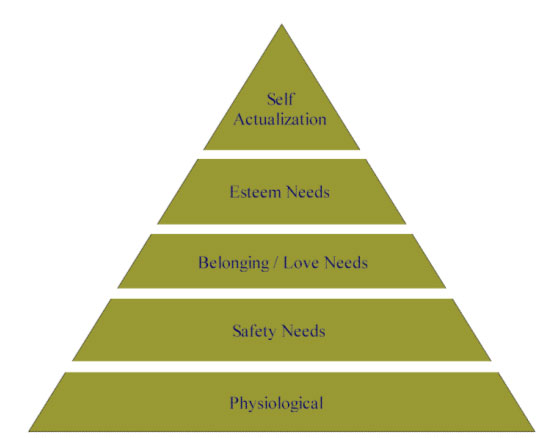
Anyone who has ever taken an introductory course in psychology is familiar with Abraham Maslow’s hierarchy of needs.[3] Maslow theorized that the desire to satisfy various human needs affects an individual’s behavior. He categorized these needs into a hierarchy which is modeled as a pyramid (Figure 1). At the base of the pyramid are physiological needs such as oxygen and nourishment. At the next level up the hierarchy are safety needs including security and freedom from fear.
Continuing up the pyramid is belonging/love needs followed by esteem needs. Finally, at the apex of the pyramid is self-actualization which represents the point at which the individual strives to be all he or she can be. A fundamental component of Maslow’s theory is the idea that an individual can only pursue meeting the needs of a particular level when the needs of the levels below have been satisfied. For example, a person can only address belonging/love needs (e.g. loneliness) when physiological and safety needs (e.g. food, shelter) have been met first.
Figure 1. Maslow's Hierarchy of Needs
The Project Management Hierarchy of Skills
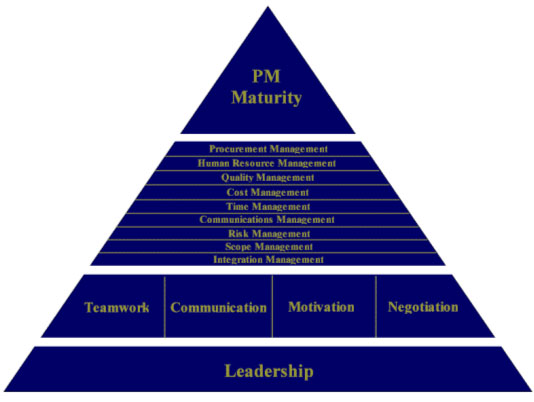
I suggest that project management skills can also be categorized as a hierarchy analogous to Maslow’s hierarchy. We can call this the project management hierarchy of skills (Figure 2). In addition to visually modeling the skills as a pyramid, the same idea that lower level skills must be satisfied before higher level skills can be addressed is also included in the model.
At the bottom level of the hierarchy is leadership. As I have suggested, leadership is the bedrock upon which all else must be built. Without laying a solid foundation of leadership skills, attempts to develop other management skills will be less than effective, if not impossible.
Once the leadership level has been satisfied, the basic management skills level can be addressed. Included at this level are the skills of teamwork, communication, motivation and negotiation. These skills represent the essential skills necessary to work with people in an organizational context.
There are, of course, many important management skills; however, it seems to me that these four are the essential pillars of basic management. Getting a group to work together in such a way that their combined effort achieves more than would be possible working individually (teamwork) is crucial to reaching the goals of the project. Knowing what is going on and making sure that everyone else knows what they should when they should (communication) is essential to project stability. Finding ways to recognize and reward achievement while discouraging undesirable actions (motivation) can transform projects from average to high performance. And dealing with problems in such a way that all parties affected can accept the solution (negotiation) can help to remove obstacles before they become disasters.
Only after the skills at the basic management level have been achieved can the next level--project management skills--be developed. This level is represented by the familiar nine knowledge areas of the PMI Project Management Body of Knowledge: integration, scope, risk, communications, time, cost, quality, human resource and procurement management. At this level the project manager masters the practice of the project management discipline. It is only after this firm foundation of skills has been established that the ultimate goal of project management maturity can finally be effectively pursued.
Figure 2. Project Management Hierarchy of Skills
Conclusion
Peter Drucker has said that real management is the management of people and people are the key to success.[4] Project managers tend to look for ways to improve processes. We try to squeeze just a little more efficiency out of the system or find ways to work a little bit smarter. While spending our energies on improving project delivery mechanisms is a good thing, it is imperative that we do not forget that it is the people on our project teams that are the most valuable asset.
In order to maximize the potential of the human resources of a project, the project manager must be properly prepared. All too often the basic skills necessary for effectively managing people are given light attention while we focus on metrics. In Maslow’s hierarchy, a person cannot achieve self-actualization without satisfying the lower level needs first. Likewise, before we can reach for project management maturity, project managers must be sure to build a solid foundation of fundamental management skills.
Craig A. Hoard, PMP leads the Project Management Practice at the Tampa office of Software Architects, Inc. Mr. Hoard has been a practitioner in the IT field for nearly 20 years and holds B.S. and M.S. degrees in Information Systems from the University of South Florida.He can be reached at [email protected].
References
[1] Pennypacker, J. and Grant, K., 2003, Project Management Maturity: An Industry Benchmark. Project Management Journal 34 (1), 4-11.
[2] Maxwell, J., The 21 Irrefutable Laws of Leadership, Thomas Nelson Publishers, Nashville, 1998.
[3] Drapela, V., A Review of Personality Theories, Charles C. Thomas Publishers, Springfield, 1995.
[4] Pell, A., Managing Through People, Dale Carnegie & Associates, Garden City, 1987.
"Put your hand on a hot stove for a minute, and it seems like an hour. Sit with a pretty girl for an hour, and it seems like a minute. THAT's relativity."