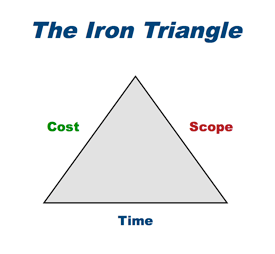
The mathematician George Box is credited with saying, “all models are wrong; some models are useful.” The Triple Constraint is one of the oldest models in the project management discipline. We all know it is wrong. Can it still be useful?
There are many versions of the Triple Constraint. The way I first understood it was this: “You can have it good. You can have it cheap. Or you can have it fast. Pick two.”
There is a certain amount of intuitive validity to this model. If you want the project done well and quickly, it isn’t going to be too cheap. If you want it done cheap and quickly, it isn’t going to be too good. If you want it done well and cheap — the model falls apart here. No matter how much time you give me, I will not be able to produce a good result at a low cost. This version is not very useful.
A second version uses a triangle with the three sides labeled scope, cost and time. This Iron Trianglemodel (see Figure) suggests that changing the length of one side must be accompanied by a change to one of the other sides in order to maintain the triangle. So an increase in cost means either more time to spend the money, or additional scope in the same amount of time.
But this version of the model allows for some less than useful combinations: