





Guessing is not a strategy: How to build decision velocity with AI and real-time data
June 10, 2026 | Live Webinar
Agile is no longer a buzz word, and the immediate returns are what is making it popular. The basic philosophy of the agile approach is to accommodate changes. We know that ideas start pouring in when we actually see the running product. As many people say, one of the main pitfalls with the traditional waterfall model has been that managing changes (i.e., thinking everything through upfront) has always been a challenge. This article briefly talks about agile methodology and its characteristics and provides details about managing software projects with agile practices.
History
In a traditional waterfall model, the project flows from top to bottom just like a waterfall (i.e., the team need to follow a sequence). Requirements, design, implementation, testing, deployment, and maintenance are the steps to befollowed one after another (Figure 1). The team starts with requirements, moves on to the design phase, and comes up with a detailed technical design, and so on. This model has many constraints and one of them is not to keep up with changing requirements. Freezing requirements before the start of implementation has been a continuous challenge. Intensive documentation is one of the key aspects of this model.
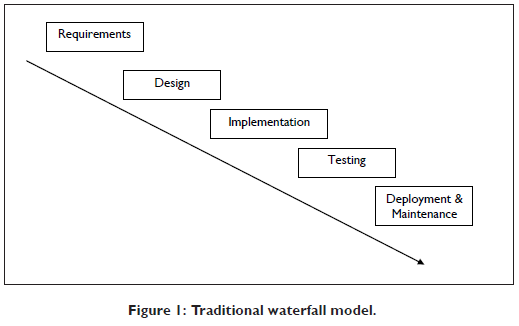
There has been a great deal of brainstorming on various alternative practical approaches to the current needs. The Agile Manifesto (drafted in February 2001…
Please log in or sign up below to read the rest of the article.
|
"If we knew what it was we were doing, it would not be called research, would it?" - Albert Einstein |