





Guessing is not a strategy: How to build decision velocity with AI and real-time data
June 10, 2026 | Live Webinar
Garry L. Booker, PMP, CSM, is a contract project manager and Agile Lead. He lives in Tulsa, Oklahoma.
Many project teams experience an occasional lapse in accountability — important work falls through the cracks — and sometimes the problem becomes a crisis. But what exactly is ‘accountability’, and how do we improve it? Here’s a helpful model based on constancy of purpose, aligned actions and discrete outcomes.
A practical approach to implementing or improving accountability requires three things: 1) positive attitudes and motivations; 2) a good mental model of what accountability really is; and 3) hard evidence about how well our organization follows the model. There are plenty of articles on the first point, so I won’t cover that topic here. What most articles miss, however, are the next two points — the “how-to” side of improving accountability.
I will share a model of accountability that applies well to project teams, work groups and even the entire enterprise. Like a cake with three layers, this model covers high-level shared purpose, mid-level focus on quantifiable results, and low-level focus on daily tasks. As we explore all three layers, I will suggest specific questions you can ask to gather evidence needed to improve accountability in your team or organization. So let’s begin with our accountability model:
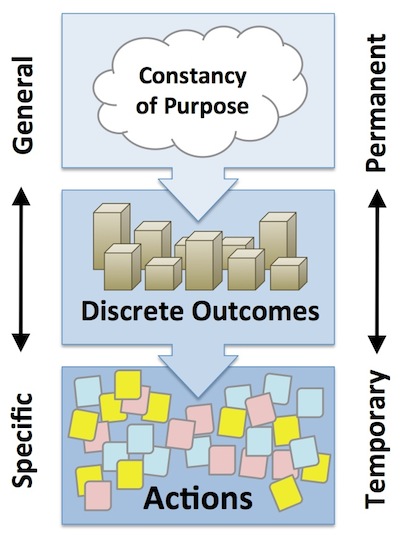
As you can see, the top layer “Constancy of Purpose” is the most general and permanent layer of this …
Please log in or sign up below to read the rest of the article.
|
"To generalize is to be an idiot." - William Blake |