Collaboration as a Productivity Booster

Mike Griffiths is an experienced project manager, author and consultant who works for PMI as a subject matter expert. Before joining PMI, Mike consulted and managed innovation and technology projects throughout Europe, North and South America for 30+ years. He was co-lead for the PMBOK Guide—Seventh Edition, lead for the Agile Practice Guide, and contributor to the PMI-ACP and PMP exam content outlines. Outside of PMI, Mike maintains the websites www.LeadingAnswers.com about leading teams and www.PMillustrated.com, which teaches project management for visual learners.


Have you ever considered that traditional attempts to be responsible managers by undertaking sufficient upfront planning and then directing resources in the execution of defined work packages can actually create toxic work environments and hurt the bottom line?
Command-and-control management is not appropriate for workers who need to collaborate and solve problems. These knowledge workers need work environments where experimentation is rewarded, people are encouraged to pursue their interests, and shared leadership is the preferred model.
Command-and-control organizations are in fact toxic to knowledge workers. They stifle creativity and problem solving by eliminating effective ways for people to communicate improvements back up the chain of command. They demotivate workers with the frustrations of bureaucracy and compliance to standards that divert effort from the true goals. These conditions are harmful to creative teams, and people will either leave or have the passion and creativity squashed out of them until they become unproductive drones who rarely create exceptional value.
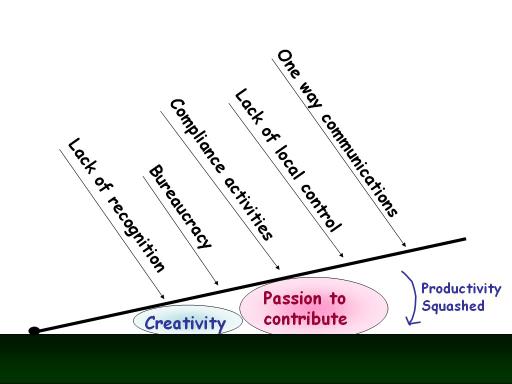
For organizations to compete globally and be successful over the long term, they need to better protect their worker assets. Operating with toxic work environments is like an inefficient car engine burning through precious resources (people) and creating a noxious environment that no one …
Please log in or sign up below to read the rest of the article.
|
If man could be crossed with the cat, it would improve man but deteriorate the cat. - Mark Twain |


