


Categories: Culture
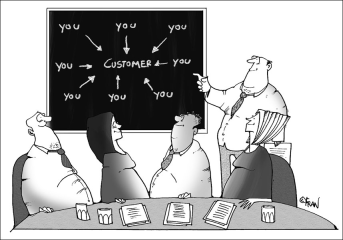 Our minds have been infested by the adage ‘Customers First’ since the day we stepped into the society. We hardly doubted its truth. It is obvious, isn’t it? A company exists to serve the customers well so as to sell services or products to them in return for some profits. In order to achieve this grandiose objective, they have to put their customers in the first place isn’t it?
“No, employees first, customers second!” heralded Vineet Nayar, Vice Chairman and CEO of HCL Technologies, as he kicked off the seminar in Singapore in February 2011. Vineet was there to talk about how value is created in the new knowledge economy and how organizations leveraging information technology across industries can be transformed through disruptive management. This, according to Vineet, builds on top of the philosophy of “Employees First, Customers Second” (EFCS), an innovative management approach that empowers employees, drives passion in them, encouraging individuality and entrepreneurship, and moves the organization forward. Watching Vineet sashaying across the stage, passionately telling stories and giving examples to explain the philosophy of EFSC while characteristically waving his hands in the air to reinforce some of his points, was a great enjoyment. However, I wonder how many people in the audience are ready to embrace such radical management practices of confronting the truth, building trust through transparency, inverting the management pyramid by empowering the employees, and shifting the responsibility of change from top to bottom.
“Oh, wait a minute Vineet. Are you telling us to value someone that we are paying money to more than someone we are getting money from? This sounds crazy!” I heard a murmur in the audience. I must admit that I do have some reservations about the effectiveness of EFCS when I first heard about it. Let’s face it, the thought of ‘Customers First’ is so deeply ingrained in us that most people find it hard to shake off. It is just so common sense. What so good about giving the employees all the focus while paying less attention to the customers? How can this benefit the organization? We know that having a team of talents is half a battle won in this new knowledge economy, but placing them ahead of our valuable customers is another story altogether. Yet, the gargantuan success and growth of HCL Technologies over the past six years since the introduction of EFCS in 2005 is definitely not accidental. As I explored further into this, I started to see some light from another direction.
Let’s turn the table around and ask the question ‘What could be bad about putting Customers First?’ instead. In general, it is perfectly alright to have a customer-centric culture where the focus is on serving the customers well with their needs as top priorities. Things turn bad when people start worshipping the customers and treating them like kings. In such a culture, the employees will do everything to please the customers and satisfy their needs blindly regardless of whether there is real value in doing it. They behave like seamstresses who sew according to instructions instead of couturieres who design for the haute couture. In other words, they have given up the freedom to be creative and the opportunity to lead. Eventually, they are likely to end up as one of the followings.
- Cover girls: No, I am not talking about those anorexic catwalk prima donnas that appear in the front pages of magazines. I am talking about employees who cover up or sugarcoat the reality with their sleek and dashy presentation slides. Some extreme ones might even tweak the figures in the monthly reports just to make them look good. There is only one reason that they are doing these – to avoid causing any unnecessary worries. As a result, the customers will never know the actual situation till it is too late for any constructive remedies when the problems eventually surface up.
- Milquetoasts: They are the pusillanimous mice who succumb under the thunderous roars of the intimidating customers. It is uncommon for them to challenge back or reject any request from the customers. Taking in instructions without demur is what they do best. They are extremely afraid of the customers and will do anything just to avoid provoking them. Consequently, the customers will only get what they have asked for but not what they actually need.
- Bamboozlers: This group is the worst among the three. People in this group are so eager to please the customers that sometimes they tend to oversell and commit on what they cannot deliver. They are the typical snake oil sellers who will not hesitate to sell you a photocopy machine touting that it can also brew you a cup of aromatic espresso. Fooled by cajoling words and inflated reality, customers will usually end up in disappointment realizing that all the commitments are nothing but empty promises.
I have collaborated with HCL Technologies in a couple of projects over the past few years. I wouldn’t say that they are flawless in their EFCS implementation, but at least they have a lot lesser employees that behave like the three types mentioned above compare to other vendors. On the contrary, I am fortunate to have worked with a few great people in HCLT who accept responsibility and take ownership with pride and step up and lead when the situation calls for it. “Employees First, Customers Second”, to me, is no longer just an interesting catch phrase. I am witnessing it in effect.






