“If you can’t explain it simply, you don’t understand it well enough” is a quote commonly attributed to Albert Einstein, though its authenticity is somewhat in doubt. Not to challenge a man whose very name is synonymous with “genius,” but I think there’s another possibility when it comes to reasons why people don’t explain things simply: they don’t want to. It could very well be that these people understand it all too well, and are deliberately choosing to obfuscate. Unfortunately, such people are not rare in the realm of Project Management.
The most dramatic and far-reaching implications of this tendency towards obfuscation has to do with the development of the Scope Baseline. Back when I was training new PMs on basic concepts, I liked to define the “project” as existing off into the future, with its only present-day artifacts consisting of:
- The Schedule Baseline describes the project in terms of units of time,
- The Cost Baseline describes the project in resources required, and
- The Scope Baseline documents the project using words to describe its intended end-state.
The Schedule Baseline can be documented in extremely precise terms, as can the Cost Baseline. But Scope? Imagine the amount of latitude a PM would have if the Cost Baseline was only defined down to the nearest $1M (USD), or the Schedule to the nearest year. Absurd, right? For some reason, having Scope defined at a proportionally higher level doesn’t seem to set off the nonsense detectors the way the other baselines do. As any seasoned (and quite a few newbies) PM can tell you, vaguely-worded Work Packages present a remarkable vulnerability for that deadliest of project pathologies, scope creep. From the customers’ point of view, imprecise wording in the WPs provides an avenue for under-performance, the bane of client representative PMs throughout history. With the stakes of mis-using smart-sounding-but-utterly-nonsensical terms so high, what can we do in PM space to provide early detection when such an affliction is headed our way?
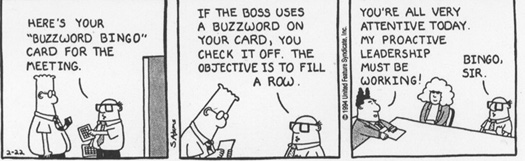
While use of the most common corporate word-salad terms may work for things like company mission or values statements (if you haven’t seen Weird Al Yankovic’s video on the topic, you should), they’re highly detrimental for any statement of scope, whether in Work Packages, Control Account Plans, WBS Dictionaries, or (especially) Baseline Change Proposals. But rather than assert that GTIM Nation should set an extreme hair-triggered response to these terms, I thought it would be better to make a game of it, similar to this famous strip by Scott Adams, with a singular twist:
- If 1 – 2 of the terms from the table show up in a BCP, the Baseline Change Control Board members should roll their eyes (and reject the BCP),
- If 3-4 of the terms appear, question the legitimacy of the author to “do” PM (and crumple up the BCP, laughing as you throw it in to the trash can from across the conference room), and…
- If more than 5 of the terms appear, call out “Bingo!” (then roll up the BCP, place it into the body of a model rocket, go outside where the launch pad has been prepared, and set off the model rocket engine).
Here’s my recommended grid:
|
Brand |
Client Centric |
Core Competencies |
Cross-Platform |
Culture |
|
Functionality |
Holistically |
Impact |
Innovation |
Leverage |
|
Meaningful |
Monetize |
Operationalize |
Organizational |
Oriented |
|
Paradigm Shift |
Proactively |
Robust |
Scalable |
Seamless |
|
Strong Commitment |
Symmetry |
Trajectory |
Transitioning |
Value-added |
As for the use of these terms in a presentation slide deck, I believe they should only be considered ludicrous if they are paired up, such as “leverage scalability,” or “meaningfully seamless.” Another consideration for presentation slides should be the use of text ovals/circles/squares that have ill-defined lines connected to other text ovals/circles/squares. When these kinds of presentations show well-defined relationships, such as is represented by an organization chart, I have no problem with that. It’s only when those lines take on vague characteristics that my baloney detector goes off, such as those slides that conflate lines of communication, process flow, programmatic or organizational hierarchies, and the role of various functions or groups (“quality” comes to mind). Such disjointed presentations point to an incoherent strategy or technical approach, if not deliberate obfuscation.
Think I’m exaggerating? Let’s do a little thought experiment, where we replace a key word or phrase in a famously inspirational quote with a less-precise one, and see what that does to its context.
“Give me liberty, or give me some severe affliction.”
“…that if the British Empire and its Commonwealth last for a thousand years, men will still say, ‘This was their finest early-evening.’"
“Mr. Gorbechev, stop maintaining this wall.”
In closing, I would urge GTIM Nation, as well as all PMs everywhere, to refuse the use of vague language in constructing Scope Baselines or articulating business strategies. I think they should holistically leverage scalable transitioning symmetry to do something else.

 Community Champion