


Ernest Shackleton: Case study of an extreme Agile project leader


| As part of my holiday ritual, I put aside a few books to read just for pleasure that I don't often get a chance to do when bombarded with my usual busy schedule of work and other commitments. These books can be of any variety and often are not directly pertinent to project management or other business related topics. But one book I did read was actually one of the most pertinent books on managing projects I've come across and was completely captivating and engaging to boot. The book was titled "Endurance: Shackleton's Incredible Voyage" by Alfred Lansing:
One of this site's very esteemed blogger, Ty Kiisel, wrote about it last year and very pertinently focused on the team collaboration and cooperation that pulled those men though such a treturous and perilous situation of survivial, that has to be one of the greatest, if not the greatest real life stories of survival ever told. In August 1914, Shackleton and his crew set sail on the Endurance for the South Atlantic. In October 1915, still half a continent away from their objective, the ship was trapped, then crushed in the ice. Twelve hundred miles away from land, drifting on ice packs, Shackleton and his men survived the next five months on a diet of dogs, penguins and seals. When the ship eventually sank they were forced to escape by lifeboat. Shackleton then travelled another 850 miles in an open boat across the stormiest ocean in the world to reach help. Every single man got home safely. Though the story is known, Lansing's book grips you at every moment and just when you think Shackleton and his crew cleared one life ending disaster, another one crops up as they are constantly battling for their lives with decreasing odds of their survival. The wind, the dampness, the bitter cold and the long months of darkness in the winter seem like more than any man should be able to stand. They slept in wet sleeping bags in sub-freezing temperature; ate unappetizing foods; and still managed to keep their hopes alive. While reading the book, I had to constantly remind myself that this was not fiction but events that actually happned even when the situation and the ability of Shackleton and his crew to overcome them seemed even beyond what any fiction could come up with. I leave it up to you to read this fantastic book for the rest of the harrowing, yet optimistic tale, but as I mentioned I came out of reading this book with some rather enlightening project management lessons in leadership, being agile, adaptive and flexible when faced with life critical situations, and knowing how to manage your teams and trust in them.
And though Shackleton is not labeled a project manager, he exihibited all the characteristics of a modern project manager in that he had to secure, manage and track the funding and budget for the project to reach Antartica, secure and manage his team, define the scope and requirements needed to achive the project goals, we as well as execute and control his project. Of course his project failed, but to get his men home safely, he led them across ice, sea and land with all the tools he could muster. This combination of a commitment to a larger purpose while utilizing flexible and imaginative methods to achieve a goal is increasingly important in our tumultuous times and is a skill us project managers and leaders could all learn from and use to ensure success in our project goals. |
Fracture Within the Scrum Community
| For anyone involved with Scrum and who got their ScrumMaster certification from Scrum Alliance may have noticed that the founders of Scrum, namely Ken Schwaber and Jeff Sutherland, no longer sit on the board of that organization. Ken Schwaber has in fact gone off and created another organization and site at Scrum.org. On that site, he goes on to elaborate on why he branched off: An organization can either be mission driven or money driven. Not both. When I started the Scrum Alliance, our mission was to improve the profession of software development. That later became “to transform the world of work.” By 2007, I believe that the quest for money had made the mission secondary at Scrum Alliance. I failed to see the effects that my initiatives would have on the money-making of the Scrum Alliance and its members. If I had mapped the money-making activities of the Scrum Alliance to these initiatives, it would have been obvious to me that the community would resist them...
My goal of strengthening Scrum and improving the profession was in clear conflict with the community’s goals of maximizing revenues and incomes. This came to a head in August 2009 when the Scrum Alliance board of directors unanimously asked for my resignation. The board members saw my mission as detrimental to their mission of supporting the CST franchise.
Tom Mellor, the new chairman of the board, sent out an email announcing my resignation. After that, the board terminated the programs described above. They cancelled, re-announced, and finally rolled out a basic assessment that failed to provide any meaningful measure of understanding. They terminated the ScrumAlliance’s commitments to our partners, Microsoft and Accentient, in developing courses for Scrum developers. They have since introduced a weak Certified Scrum Developer program that is designed to protect the income of the existing CSTs.
It seems what basically happened was that the founders felt the profit motive outshined the community and the spirit of Scrum and that Ken's desire to place emphasis on the development certitification for Scrum was threatening to the existing Certified ScrumMaster and Certifified Scrum Training program and profits.
So there is now a new Scrum.org organization with new Scrum certifications that have a heavy emphasis on the software development aspect of Scrum:
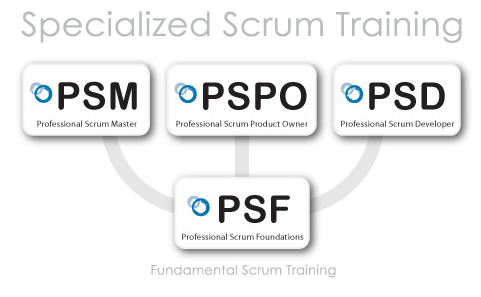
So what does this all mean? What are the implications for those already certified by Scrum Alliance or seeking Scrum certification?
At this point its too early to say, but I don't think the above negates your CSM if you already have one and I plan to continue on updating it so long as it is useful in gaining me industry recognition that I have some Scrum knowledge from formal training as well as real life experience. I do plan to look into the Professional Scrum Developer (PSD) program as I come from a strong software development background with Java and .Net and would like to see how a rigourous 5 day training program for team members would look like. Though I am now mostly on the project management side of Scrum, it would help to see it again from the team perspective.
As far as concerns of this method still being viable with such disruptions, ironically, I actually think it is a good sign since these kinds of disputes occur when a movement becomes very successful which Scrum has. It will mature and consolidate and by that time maybe another movement will take its place. It really doesn't matter to me, as the spirit of Scrum is eternal for those who need a lightweight project management framework to deliver incremental deliverables in an iterative fashion for those who's project are implemented in a highly dynamic and even chaotic first to market like environments.
My goal of strengthening Scrum and improving the profession was in clear conflict with the community’s goals of maximizing revenues and incomes. This came to a head in August 2009 when the Scrum Alliance board of directors unanimously asked for my resignation. The board members saw my mission as detrimental to their mission of supporting the CST franchise.
Tom Mellor, the new chairman of the board, sent out an email announcing my resignation. After that, the board terminated the programs described above. They cancelled, re-announced, and finally rolled out a basic assessment that failed to provide any meaningful measure of understanding. They terminated the ScrumAlliance’s commitments to our partners, Microsoft and Accentient, in developing courses for Scrum developers. They have since introduced a weak Certified Scrum Developer program that is designed to protect the income of the existing CSTs.
|
Scrum for Venture Capital Companies
|
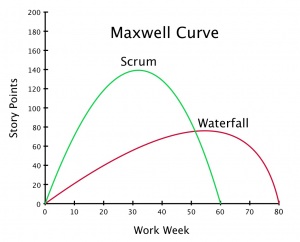
According to the article, adopting Scrum throughout their business processes allowed the group to double their productivity, while working fewer hours. Scrum is used as a best practice framework for their project consulting services, sales, marketing, finance and customer support for their portfolio of companies. As illustrated in the Maxwell Curve, coined by Scott Maxwell who is a principal founder, assuming a team member can take on approximately 20 perfect hours a sprint, the starting velocity for a full work week starts at 80, with the equivalent focus factor of 50% utilization for a 40 hour work week. Unplanned stories are tracked seprately. Due to this, the team at OpenView realized that using perfect hours instead of story points implied that the measured velocity can only increase if:
Additionally, continuous improvements and impediment removal can decrease the amount of time spent on individual stories by shrinking the story size while simultaneously increasing the output of work with no increase in the Sprint's velocity. As time goes on and more iterations are completed, productivity increases which creates a culture of working less hours and no weekends. For venture capital firms, investors will typically drive startup companies to work harder and longer to get a quicker ROI on their investments which leads most companies to work well beyond the 40 hour work week. Scott found that due to Scrum's intensity, the peak of production waned after 50 hours, so he insisted the teams to work at a sustainable pace and avoid night and weekend work. But from his analysis, he did expect that the production of work would double. According to the article, this focus on higher velocity in perfect hours with less actual hours worked, compelled the teams to remove obstacles, overhead and communication gaps and to increase story clarity so as to increase the number of perfect hours completed. This allowed them to acheive double productivity of work while working less hours. This is not to say that they did not experience challenges. Some of the most notable where:
Though I can't verify the truth of their claims to Scrum's productivity increases, I have witnessed similar increases in Scrum projects (or projects using Scrum/Agile-like techniques) I've lead or been involved with and this was when I had the kind of organizational and upper management support that OpenView had articulated in the article. It is interesting to see that Scrum is being adopted outside software development and getting the kinds of productivity gains it is famous for. |
 As I mentioned in a previous
 Agile Integrated Change Control
| Change happens and is a fact of life for anyone involved in a project. How a project manager deals with changes throughout a project determines whether a project succeeds or fails and this needs to be integrated throughout the lifecycle of the project. According to the PMBOK 4th edition, integrated change control "is the process of reviewing all change requests, approving changes and managing changes to the deliverables, organizational process assets, project documents and the project management plan."
For the project manager who has to work within a traditional process driven environment and/or desires to incorporate Agile practices to align with the PMBOK driven one, must keep in mind that integrated change control is not much different in Agile and the PMBOK. Agile at heart is always driven by the desire to run the minimalist process that achieves the most value, thus the change control process must be streamlined and integrated into the daily routine of team members, e.g., the daily stand-up meeting. Process changes must be owned by the team, whereas product changes are owned by customer represented by the Product Owner as is typically done in Scrum.
These changes are documented in the ordered product backlog. During release and iteration planning, these higher ordered items move from the backlog to actually being coded, tested and accepted by the customer at the end each iteration. The customer feedback at the end this iteration become the integrated change process that enable the team to make the necessary adjustments. The product backlog may get re-ordered and re-shuffled for the next iteration. Seen in this light, all members involved with the project become the equivalent of a change control board (CCB) outlined in the PMBOK.
One major change in this practice is how the Agile PM acts more as a "go-between" with the customer and the team. In a traditional PMBOK driven process, the PM would be responsible for driving and managing the changes in the project management plan, whereas in an Agile driven one, he/she acts more as a facilitator for the customer and team to reach a collaborative decision regarding changes to the product backlog items. The process of re-ordering and re-shuffling items in the product backlog with customers and team, make it easier for all concerned to see the tradeoffs involved when something that needs to get added causing something else to get dropped. For very malleable products like software, it would be more flexible to use this then a rigid change control list.
|
Resource Management With Social Media Technology?
|
The posting claims Hello's most important design feature:
Is that an employee's profile is the centerpiece of the platform. In other words, all employee activity — blogs written, community and forum participation, bookmarks posted, wiki input, tags created, etc. — are all tightly linked back to an employee's profile. Therefore, the profile represents an aggregated, real-time view of the employee. For example, if a consultant is reading another consultant's blog, by clicking on the blogger's name, the reader could see all the expertise areas, interests, documents, and activities for that blogger.
An employee's profile shows professional projects and work interests (e.g., bio, resume, documents, and major clients) as well as personal hobbies, interests (e.g., personal tags), and associations. The graphic of an employee's availability is listed within all this information, thus creating a data-rich context for colleagues to think about not only availability, but also fit.
A couple of major issues come to mind for me. One of them is privacy or lack thereof. Of course if you are working for a company you do not own the computer, network and software systems that they provide for you, so by default you do not have a right to the privacy of the data and use of their systems. On the other hand, many of the social media activities that you would engage in are very much the kind of activities that most organizations these days would consider personal use rather than business use. How would an organization know if an employees is perusing a legitimate colleague's Facebook page or getting dirt on a old high school acquaintance? And as an employee, do you want your organization to monitor and aggregate all your social media activities both professional and personal?
The other issue is the hype bandwagon. I'd say we are close to the peak of the techology hype cycle for social media. This mirrors the same phenomenon that occured within the narrower niche of PPM systems. These large web based systems were touted a while back ago as the answer to all project, portfolio and resource management problems for organizations and within the hype cycle, many have now gotten over the "trough of disillusionment" with these systems. No doubt that modern technology based tools are a valuable asset, but the focus has to be on the people and the process first.
This is not to say that incorporating social media to make project and resource management more effective is not worth looking into. I've found using a twitter like feed on a project intranet website a useful way to document minor changes, issues and status on projects, especially ones where rapid development and turnaround is expected. This can compliment daily Scrum meetings quite well if used effectively.
In any event, its interesting to see how one organization is utilizing social media for their project and resource management needs.
|
 No doubt social media and all its technological manifestations is all the rage right now. This "

