


Categories: Philosophy
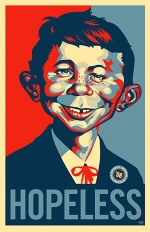 Have you ever found yourself stuck in an extremely screwed up project that sucked up the very last bit of energy in you and hope that there was someone out there to pull you out of the vortex? I have witnessed project leaders and managers succumbed under enormous stress and started praying and hoping for miracles to happen. There is a famous Latin motto “Dum spiro, spero”, which means “While I breathe, I hope”. People cling on to hope easily whenever they are lost or in despair. It seems like hope has become an invisible friend (or fiend) that follows us wherever we go. Just like what the great Victor Hugo once said – “Hope is the word which God has written on the brow of every man”.
It is not difficult to understand why we depend on hope so much. As we have seen, it is a natural part of us to be optimistic. This is especially true when there is nothing left behind and hope is the only grip that we can hang on to. Furthermore, for the worst of it, hope is free and it doesn’t cost us a dime to hope. This costless characteristic of hope turns out to be the glue that got us all stuck and addicted to it, and occasionally abusing it blindly. All these manifestations of hope seem to fit extremely well into a single sentence that William Shakespeare wrote – “The miserable have no other medicine, but only hope”.
Yet, there is nothing wrong with hope. “Hope is a waking dream”, said Aristotle. Without hope, most of us will collapse easily. In fact, it is the sole motivator that gets us moving most of the time. The problem with most of us is, we tend to take it for granted. While it is so easy to hope, we often jump into it too easily and readily without knowing that we will get drowned and never want to get out. In other words, we are extremely obsessed with and addicted to hope. The side effect is we become too passive, intoxicated and paralyzed. What should we do then? In order to address this, I would like to borrow from the philosophy of Albert Einstein – “Learn from yesterday, live for today, hope for tomorrow”.
Fitting this into the context of project management it means that whenever we are stuck with a problem, we should not just sit there and hope for fairy godmother to get us out of the mess without doing anything. What we should do is to find out what went wrong and learn from the mistake. If possible, we should apply the knowledge we have acquired from our past experience to solve the problem. Bear in mind that we should not just sit on the problem. We have to rally everyone we know and utilize every resource we have to work on the problem. Pull all the brains together into a brainstorming session and produce an action plan. Distribute the tasks out and get everyone starts working on the action items assigned. Review the results with the team at end of the day. We may not have solved the problem completely, but at least we have tried to live for today. The last thing we have to do when we have done everything we could to salvage the situation is to have our fingers crossed, tell ourselves that we have already done our best and keep the hope on for tomorrow. Remember, the problem is not with having hope but having too much of it obsessively.
Below is a poem that I wrote to sum it up.

|
Hope-less
Hope is passive. It is naïve. Too much of it, Makes me obsessive.
Yet, without hope, How could I cope? Walking tightrope, In this grope.
I just need one. Not for fun. Keep me on the run, Till I am done… |



 Community Champion

