Unnecessary Necessities
From the PMO Bytes Blog
by Wai Mun Koo

The world of project management through the monocles of culture, design, business, technology, politics, social, education, philosophy and music.
Recent Posts
Dog and Pony Show
Risky Business of Einstein
Hello Heisenberg!
Be A Good Patient
The Missing Piece
Categories
Business,
Culture,
Design,
Education,
General,
Music,
Philosophy,
Politics,
Technology
Date
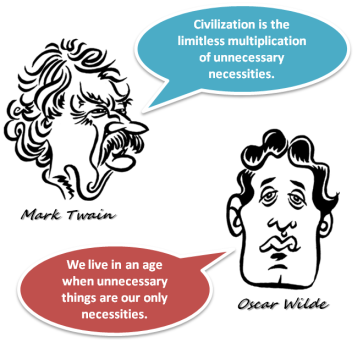 We fill up forms every now and then. We have forms for new project requests, account creation, change requests, leave applications, and even forms for purchasing toilet paper. Have you ever wondered how much time you have spent in your life filling up forms? A research shows that form-filling costs UK business £104 billion a year with average UK worker spending 37 days in year 2010 carrying out administrative tasks. Ridiculous! Wake up, bureaucrats.
I was invited to a meeting to discuss a new change request process. Half way through the meeting, a colleague of mine raised a comment that the existing change request form is too complicated and takes a lot of time to fill in. When being asked if all those fields in the form are indeed necessary, the host of the meeting replied – “Yes, they are mandatory”. Why do we need so many mandatory fields in a form? After a few more rounds of investigative questioning, we found out that Microsoft Excel was the culprit. It happened that someone at the top wanted a report on the volume and status of change requests to be generated out on a monthly basis. Unfortunately, the data need to be categorized before the sleek charts and pivot tables can be plotted in MS Excel. Here we go. This was the reason why those mandatory fields were added – to provide categorization for the data. What a ‘fantastic’ reason? When grilled further on whether those mandatory fields were ever fully utilized to provide meaningful information, the host simply replied that he was not sure as those fields were added by other people many years back. Great! We felt like the children following the pied piper.
Why are we wasting the bulk of our time on things that we hardly use? Should someone regularly review and weed out those unnecessary necessities from the old stale ‘best practices’? I have seen the same phenomenon occurring time and again in projects especially in requirements gathering. How many of you have come across stakeholders who keep demanding for tons of requirements that hardly add any value to the project? Are these unnecessary ‘nice to have’ requirements eroding your budgets and delaying your projects? Are you using any tools like Kano Model or Quality Function Deployment (QFD) to help you categorize and prioritize your project requirements? Do you have a change review board in your project team? If not, what do you do to ensure that the requirements raised by the stakeholders are properly evaluated and validated before investing more time and money on them?
Gathering requirements is not easy, but the task of weeding out the unnecessary necessities is even more challenging.
Posted on: August 08, 2011 05:45 AM |
Permalink
Comments (5)
Please login or join to subscribe to this item

Bill Bigler
Project Scheduler| Booz Allen Hamilton
Centreville, Va, United States
I am doing the review and revising function as I execute my project. Yes, it requires extra time, but I am in the PMO and, although not explicity stated, I believe that this work will make the PMO stronger, more valuable to the PMs and Project Coordinators (PC) in the other parts of this large, project-oriented branch.
For every review and upate, I create a small project because the time between my revision being coordinated at the worker bee level and the branch approval can be weeks. The documents currently in use were developed for the division level and based on a broader project management life cycle. Since this branch has a tailored life cycle, I trying to get the documents to match this slimmer life cycle.
I have only been doing this for a few weeks, but 2 of my revision projects were suggested by a PM and a PC because the documents were cumbersome to fill out as currently written. I hope to eventually have a schedule with a 6-month review cycle for each document.

Wai Mun Koo
PMO Director| Intergraph PP&M
Singapore, Singapore
Bill, you are absolutely doing the right thing in your organization. Periodically reviewing internal processes helps to revive the outdated practices and makes the operation more efficient. It is also a good idea to form a project around this reviewing process since it requires close monitoring on the time, effort and cost spent. It is like spring cleaning, we have to constantly tidy up our house to keep it clean and nice to live in.

Thomas Soam
Project Manager| BDA
Seremban Ns, Ns, Malaysia
Hi Wai & Bill,
Yes, agreeable.In large project we need sample and one glance form so that all the stakholder or managment can have a concise info regarding the status of the project also for future reference.
Some of the principled things to do during the requirements gathering stage of the project:
- one must need to understand the objective of the business requirements, how it will be beneficial to the project and its users (most importantly).
- include in the activity SMART requirements gathering.
- involve Risk Management to identify level of risks (uncertainties and constraints) in the requirements and in the project as a whole.
- verification (to limit/minimize or possibly remove the requirements ambiguities) and Sign-off of the requirements document is also a must if only to put some sanity that development and test team will only engaged themselves to what has been agreed and approved.
- changes in the requirements would also have to pass a certain process of assessment, verification and approval

Kwiyuh Michael Wepngong
 Community Champion
Financial Management Specialist | US Peace Corps
Yaounde, Centre, Cameroon
Quite interesting. It leaves me with a question "When does a necessity become unnecessary"?
Please Login/Register to leave a comment.
|
"The best way to become boring is to say everything."
- Voltaire
|




