


One of the more interesting aspects of Scrum is the colorful and offbeat use of terms, analogies and metaphors. Well known blogger Jeff Atwood, of the site “Coding Horrow”, thinks just the use of the word “Scrum” is too weird:
- It's two additional characters away from a term for male genitalia.
- The term is derived from rugby, an extraordinarily violent sport. During my first year at college, a guy on our hall participated in Rugby. His ongoing injuries, both small and large, became a running joke in the dorm. Eventually even he started to re-evaluate the merits of the sport. As Steve pointed out, Wikipedia defines scrum as ".. the most dangerous phase in rugby, since a collapse or inproper engage can lead to a front row player damaging or even breaking his neck." My indirect experience with rugby leads me to agree. The most dangerous phase of a violent sport is not exactly the sort of thing you want to add to your project.
- When you tell customers your software developers use the Scrum process, they have absolutely no idea what you're talking about.
There’s also been the rise and creation of other vernacular oddities and particularities within the Scrum movement such as “FlaccidScrum”, “ScumBut..”, etc. to name a few. But one that I find particularly interesting is the metaphor of the “chicken and the pig” to describe stakeholder roles in Scrum.
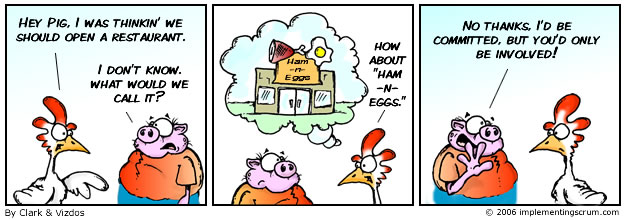
This is supposedly based on a joke mentioned in the book “Agile Software Development with Scrum” published by Schwaber and Beedle in 2001 that started the movement.
The pigs are the people who “sacrifice” themselves and put it all on the line for the project to succeed, whereas the chickens are the necessary overhead that only needs to be involved with the project on a need-to-know basis that do not have to be directly involved with a Scrum. They do not need to be involved in the daily meetings since they are not accountable or committed to the project and will get their say when they view a working demo at the end of a Sprint to influence the next one.
Some people, such as blogger Jeff Atwood mentioned above, think using such derogatory and sarcastic terms will make it harder for organizations to adopt Scrum, though the evidence seems to state the contrary with ever growing adoption of Scrum/Agile.
The pigs are the people who “sacrifice” themselves and put it all on the line for the project to succeed, whereas the chickens are the necessary overhead that only needs to be involved with the project on a need-to-know basis that do not have to be directly involved with a Scrum. They do not need to be involved in the daily meetings since they are not accountable or committed to the project and will get their say when they view a working demo at the end of a Sprint to influence the next one.
Some people, such as blogger Jeff Atwood mentioned above, think using such derogatory and sarcastic terms will make it harder for organizations to adopt Scrum, though the evidence seems to state the contrary with ever growing adoption of Scrum/Agile.
From my understanding, the concept of the pig and chicken is just Scrum’s metaphor for what is otherwise known in project management field as the “direct” and “indirect” stakeholders of the project cycle.
This short and memorable story allows the point to hit home without the use of management jargon. The whole chicken and pig division idea is about giving greater decision making power and responsibility during a project stage to the people who are directly involved and committed to the final delivery (pigs), while limiting interference coming from sometimes powerful external players (chickens).
Sprints are aimed at delivering a fully functional working demo from spec to ready-to-use product, instead of some sort of interim deliverable. Since the team provides a lot of input into deciding what goes into Sprint, this implies a collectively agreed upon commitment to delivering the change. That creates a contract between the team and outside world.
Changing the roles during the Sprint can endanger this contract and is why chickens are forbidden to be involved directly in a Sprint. If a pig becomes a chicken he or she is no longer responsible for seeing the Sprint to completion putting the burden of dealing with any shortcomings in their work onto the shoulders of remaining team members.
If a chicken becomes a pig during a Sprint they cannot realistically commit themselves to something that has been agreed before they came on board. Hence it’s best when the roles stay unchanged for the duration of a Sprint. Seen in this light, this is an relevant metaphor for the important segmentation of roles for direct and indirect stakeholders of a Scrum Sprint.
This short and memorable story allows the point to hit home without the use of management jargon. The whole chicken and pig division idea is about giving greater decision making power and responsibility during a project stage to the people who are directly involved and committed to the final delivery (pigs), while limiting interference coming from sometimes powerful external players (chickens).
Sprints are aimed at delivering a fully functional working demo from spec to ready-to-use product, instead of some sort of interim deliverable. Since the team provides a lot of input into deciding what goes into Sprint, this implies a collectively agreed upon commitment to delivering the change. That creates a contract between the team and outside world.
Changing the roles during the Sprint can endanger this contract and is why chickens are forbidden to be involved directly in a Sprint. If a pig becomes a chicken he or she is no longer responsible for seeing the Sprint to completion putting the burden of dealing with any shortcomings in their work onto the shoulders of remaining team members.
If a chicken becomes a pig during a Sprint they cannot realistically commit themselves to something that has been agreed before they came on board. Hence it’s best when the roles stay unchanged for the duration of a Sprint. Seen in this light, this is an relevant metaphor for the important segmentation of roles for direct and indirect stakeholders of a Scrum Sprint.
Posted on: September 30, 2011 09:52 PM |
Permalink




