


Categories: Philosophy
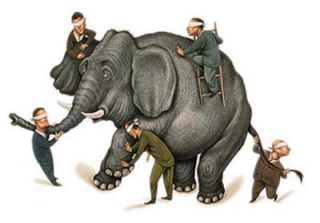 Okay, I know most of you have heard about this parable. But for the sake of those that have not, here is a version of it.
Four blind men encounter an elephant. One grabs the leg and concludes it is a tree trunk. One holds the tail thinking it is a whip. Another touches the elephant's trunk and decides it's a hose and the fourth man pats the side concluding it's a wall. The wise man tells them, "All of you are right."
There are several versions of the parable; three blind men and six blind men etc. Regardless of the number of blind men, all of them tell the same thing – each blind man has his own version of the elephant that is different from the others. None of them is totally right and none is completely wrong, for each of them sees only a facet of truth. This is a classic epistemological relativism problem in that points of view have no absolute truth or validity, having only relative, subjective value according to differences in perception and consideration usually due to limited information available.
We have seen this happening time and again in projects, especially global projects.
You spoke with stakeholders from different cultural background each with different stakes and priorities in the project. Each presented his ‘idealistic’ view on what the end product of the project should be. All of them were so sure that their version should be the ultimate ‘right’ version. None seemed willing to budge. The debate went on… You were a month late in the project and no sign of progress. You were stuck in the never-ending stakeholders’ debate. Pressure piled up. Frustration and resentment grew. And yes, there you were. ‘The wise man’, that was what they called you. You were expected to see the truth and to lead the blind men out of the blind alley. But wait a minute, “Does the truth exist?” you asked yourself.
What makes you so sure that your version of truth is ‘better’ than those of the stakeholders? Isn’t your version also a perceived version of reality? Are you overestimating yourself and complicating the whole problem? Perhaps, the truth does exist. It could be possible that no one is able to describe it correctly due to lack of information and exposure. It is just like we are aware of god, but each of us has our own definition of what god means to us.
Maybe you should stop wasting time finding the ultimate truth. Not that you will never find it, perhaps with some luck you will, but does it worth the effort? Remember the consequences of analysis paralysis? As a seasoned project manager, you might just want to collate the opinions, ideas and requirements from the stakeholders, prioritize and synthesize them and move on. Now, that’s pragmatism!





