Together Everyone Achieves More
From the PMO Bytes Blog
by Wai Mun Koo

The world of project management through the monocles of culture, design, business, technology, politics, social, education, philosophy and music.
Recent Posts
Dog and Pony Show
Risky Business of Einstein
Hello Heisenberg!
Be A Good Patient
The Missing Piece
Categories
Business,
Culture,
Design,
Education,
General,
Music,
Philosophy,
Politics,
Technology
Date
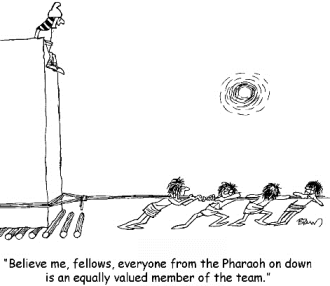 Have you ever been questioned, or even challenged, on why some members in the project team, albeit contributing less, are sharing the same glorious achievement of the team? Or do you have to deal with some smart alecks with heads so BIG that they refuse to work with the average Joes in a team? If you do, welcome to team management.
Vince Lombardi once said – “The achievements of an organization are the results of the combined effort of each individual.” Sure enough, we all understand the importance of teamwork. Just like we know we can’t grab a ball with one finger, we need all our fingers to do that. However, gathering people into a group is easy; getting them to work together is another thing. Issues related to team dynamics and equity will swarm over and break the team in no time if not managed properly. The key challenge for good teamwork is therefore, well, how to make the team work as a team. No wonder it wasn’t coincidental for Henry Ford to say “Coming together is a beginning. Keeping together is progress. Working together is success.”
We’ve heard enough of teamwork. So, what’s the problem?
Maybe, let’s try to take a look at it from the perspective of a fable – “The Belly and the Members”. The moral of the fable is we should never overlook or undervalue the effort and contribution of any member in the team no matter how big or small the role the person plays. It may appear that the belly in the fable is doing nothing other than indulging itself in food while letting other parts of the body doing all the hard work. However, without the belly to consume the food, the body and the other parts of it will soon become too weak to function properly. Just like a linchpin may be small, but it is the only thing that keeps the wheels together. We have seen the replays of the conflict between the belly and the body parts in real life. What can we do so that Together Everyone Achieves More as a TEAM? Below are some suggestions that may help you to improve the situation.
-
Understand the purpose of a team: H. E. Luccock says – “No one can whistle a symphony. It takes a whole orchestra to play it.” A team exists for a purpose. Seek out that purpose and make sure people understand that they get together to achieve a common goal and not the other way round. A team does not exist to serve the objectives of some ambitious team members.
-
Say no to heroism: There are people out there who like to do things in their own ways without sharing a thought for others. They are the lone rangers who see themselves as the best and scoff at others’ capabilities. They enjoy the limelight of individual’s glory. Sniff out such people in the team. Keep tabs on them. Ensure they don’t act like John Rambo. There is no room for heroism in a team.
-
Realize the power of quantity: “A snowflake is one of God's most fragile creations, but look what they can do when they stick together!” Although this is a no-brainer, many people are still oblivious to the power of teamwork. There is a limit on what a person alone can contribute. Help the team to understand the value of cooperation. Until everyone sees the benefits of working as a team, people are still operating alone rather than cooperating with one another.
-
Clarify roles and responsibilities: Conflicts like the one between the belly and the body parts in the fable usually arise when the roles and responsibilities of the team members are not clearly drawn. People get confused and start to doubt the contribution of others if they have no clue on who is doing what. Things get worse if there are overlaps in the areas of responsibility. In order to avoid this, you have to define the roles and responsibilities clearly and ensure there is no overlap. Run them through with the team and have them properly documented and disseminated out.
-
Build bonding and trust: The good thing about working in a team is you know that you are not alone. You can always rely on your teammates to give you a helping hand when you are about to fall. However, this does not happen automatically on the first day the team is formed. You will need strong bonding and high level of trust within the team for this to come about. As a leader, you should devote some good amount of time in fostering trust within the team as this is the foundation where excellent teams build on. Among the many things you may do, you should encourage openness and transparency since the key to trust is nothing but honesty.
Posted on: October 31, 2011 10:06 PM |
Permalink
Comments (8)
Please login or join to subscribe to this item

Sam Motes
Manager II Business Sys, Operational Excellence| BA Systems Inc.
Ellenton, Fl, United States
Good article. On point 2 on heroism it isn''t always a since of superiority you have to look for but sometimes you have people who put themselves in this position due to to drive for protectionism. In economic times like we have been going through over the last few years individuals feel that if they are the only person skilled in something critical to the organization that their job is safe from layoff or off shoring. So you don''t only have to watch out for the John Rambo but also the
Ned Ludd among your ranks as well.

Mark Price Perry
Business Driven PMO Evangelist| BOT International
Orlando, Fl, United States
Great post. I especially like point #5. Strong bonding and unquestionabe trust are required for just about any team. Otherwise, you just have a group of people.

Wayne Mack
Retired| Retired
South Riding, Va, United States
Point number 2 on heroism is one I struggle with. Many projects will require above normal effort at some point and I greatly cherish those who go above and beyond to help the project meet it's goals. When starting new projects, I will actively seek out staff who have provided this type of heroic effort in the past.
Where "heroism" becomes destructive is when team members defer work to the last minute or over-commit, then work heroically to solve a problem of their own creating.
On the flip side, I also seek out those dependable, give a solid 8 hours of work, but then go back to their outside life staff. These people are the ones who ensure that normal work is worked normally. Most projects, however, require both heroes and steady workers.
Mark Price Perry
Business Driven PMO Evangelist| BOT International
Orlando, Fl, United States
Wayne, great point on "heroism". Many folks advocate private recognition of heroic activity like project rescue where one person's reward my also call to attention another person's short-comings and public recognition of heroic activity that is for efforts that tend to inprove the skills of others or fix a process defect, etc. Not all heroics (in the moment) is bad - to the contgrary in fact, but hero worship can often become problematic.

Wai Mun Koo
PMO Director| Intergraph PP&M
Singapore, Singapore
Thank you everyone for your great comments.
There is nothing wrong for people to step up beyond their normal duties to contribute more, but Mark as the right word - hero-worshipping should be avoided. We should recognize and reward individual's contribution, but should try to avoid inflating the person's ego to a level that he or she breaks away from the team. On the other hand, I would wonder why we need a hero in a team or project in the first place. We need a leader to lead and mentor the team, not a hero unless we see every project as something so bad that we need a hero to salvage it.
Sam, good point on the protectionalism. I've see a few myself. Couldn't agree more. :-)
In this day and age of the IT workplace the heroes described are those who display abilities to do ordinary tasks and complete them in extraordinary ways within the same timeframe and less costs. Face it, bottom line rules and doing only what is required is now promoted as more desireable than "right" all the time. For those who want to do the right thing regardless of the date on a calendar, they don't get that appreciation. They get "You don't need to do that" and "Quit wasting time".
What am I saying is that some pleople want to contribute more but after getting the same 2 by 4 up side the head so many time it leaves them scarred, jaded, and montivated to do just enough. Face it, Don Quixote is long dead. He died on the lance of corporate greed and career builders squeezing every penny out of every process to reduce costs. I want $5 savings today even if it costs me $10 in 5 months to fix the problems.
Thanks for sharing Wai!
The manifestation of leadership potential and capability can be seen as heroism, however I welcome it's appearance within the team as there are many occasions where leadership is needed from within the team and I appreciate it as this can give me as the leader another perspective as to how to address the challenge.
I totally agree with Wayne and Mark regarding ''''heroism'''' and I believe as a leader you need critical resources to participate as workers and potential leaders, both motivated to contribute towards the tasks of the project. I believe in growing and enabling someone on my team as my recommendation to lead as I move forward.
It's been my experience that you have to manage managers, but it's best to seek, grow, and work with leaders who are not timid in facing the challenges of corporate enterprise project teams today. The corporate culture has more influence on the "heroism" you describe, and in my experience heroes are manufactured and enabled by managers, not leaders.

Kwiyuh Michael Wepngong
 Community Champion
Financial Management Specialist | US Peace Corps
Yaounde, Centre, Cameroon
Working together achieves more
Please Login/Register to leave a comment.
|
"If they have moving sidewalks in the future, when you get on them, I think you should have to assume sort of a walking shape so as not to frighten the dogs."
- Jack Handey
|




