


Categories: Politics
 On a gloomy Monday morning in October, in a prison cell-like conference room in northern part of Singapore, a group of people gathered around a whiteboard each with a marker pen of different color in their hands. Their expressions were deadpan. Their eyes fixated on a RACI chart in the center of the whiteboard. The atmosphere was intense. A heated debate had just ended a moment ago. The group could not reach an agreement on the ‘R’, ‘A’, ‘C’ and ‘I’ assignments for the RACI chart.
RACI chart, in general, describes the participation by various roles in completing tasks or deliverables for a project; nothing more, nothing less. However, most of us are pretty lousy when it comes to using the RACI chart correctly. I am not sure since when we have become so ‘RACIst’. It did not happen overnight for sure. Like it or not, we have long been abusing the use of RACI chart. We are using it more for defining political boundaries than as a tool for clarifying roles and responsibilities. A RACI chart, to us, is a power map – one that defines who are in control and who are being controlled. It defines the territories each marked in different color and alphabet. As a result, we have to struggle through the ‘RACI chart battle’ every now and then due to this aberrant ‘RACIsm’ in us.
The RACI Chart Battle
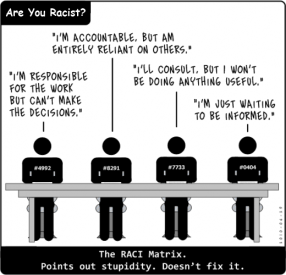
Most people vie for the ‘A’ in every task as it symbolizes authority and control. They want the authority to approve as many tasks as possible yet, most often than not, they have all forgotten about the accountability part of it. The fights on this piece are the most intense. Each ‘A’ won is a critical map pin that can help them to extend their political boundaries. The more map pins the merrier, nothing else matters. On the other hand, people are also trying their best to push away the ‘R’ assignments. They see the 'R' as bane that belongs to no one else but the pathetic scapegoats. It is easy to pay lip service, but when it comes to actually doing the job, nobody really likes to be held responsible for it. This is partly due to the fact that people that are responsible to get the job done are usually not given the right or sufficient authority that is required for the execution. Then there is this ‘egocentric’ group. They want to have a say and their voices to be heard in every single meeting and discussion. They aim for the ‘C’ in every task and want you to seek their advices in everything you do. Attention is what they want to get from you. As the saying goes, ‘too many cooks spoil the broth’. In fact, if you have to consult a long list of people before arriving at a decision in your project, you would probably have a hard time in getting things done efficiently. Last but not least, we have the Kiasu group. They are the nosy type who afraid of being ‘kept in the dark’. Although they have nothing to do with anything, they often demand others to keep them in the loop of everything. People in this group have huge appetites for reports. You should not be surprised to find them subscribed to hundreds of newsletters but hardly read one. To them, information is power, relevant or not is the least of their concerns. They feel insecure and get panicky if they are out of the loop. Apart from the bloodshed, the battle usually leaves us with a useless RACI chart that is full of wrong and redundant responsibility assignments. Time wasted and relationships worsened. What do we gain here?
Battles like this have plagued many projects in the past. It is time for us to put things back in the right perspective by reestablishing RACI chart back to its original form and let it be what it should be. If you have not been through a RACI chart battle yet, then well, congratulations! However, if you have gone through one or participated and contributed in some of those battles, you should seriously consider pulling yourself out. Do your homework and use RACI chart correctly for the right purpose. Stop being a ‘RACIst’!





 Community Champion

