


This blog is In summary of my previous blogs and an addition regarding a view of the full project life cycle.
Imagine you are leading a project and your instinct tells you there is a flaw in the business case; is there something missing in the investment analysis. What do you do?
I have discussed the subject of investment analysis with many project managers. There is a view that the project economics are not normally the responsibility of the project manager, but I would argue that it would be very helpful for project managers to understand the drivers of value that underpin a project.
I’d like to start my explanation by talking about the projected cash flow and the ‘J ‘curve below, which shows a typical cash flow and is the basis of economic evaluation.
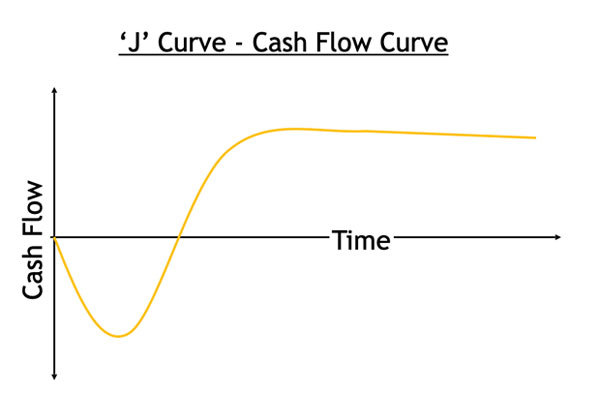
There are two parts to the cash flow: the outflow investment – the expense and then the inflow of revenue – the return.
All economic analysis is based on the cash flow. Where I worked we had two main economic indicators that were calculated for each project and used as part of the business case.
1. NPV (net present value)- discounted cash flow at a prescribed cost of capital – discount rate.
2. IRR (rate of return) – effective interest rate of the cash flows
Let’s take look at the assumptions behind the value calculation. These are key to understanding the business case, which is only as good as the assumptions that underly it. These assumptions can neatly be summed up looking out for the SCORE. Remember the SCORE as I explain investment analysis.

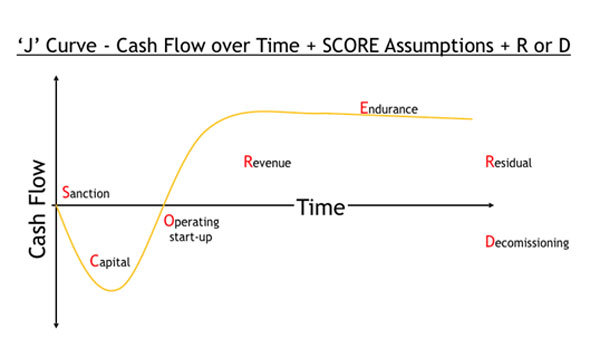
There are five key factors to consider – these are labelled on the diagram and make up the SCORE:
S for Sanction of the project
C for Capital cost
O for Operating start-up
R for Revenue stream
E for Endurance of the asset
The SCORE is a nice an acronym because it implies a reference point and benchmark of the key assumptions which need to be delivered by the project plan.
I have a worked example using some simple assumptions:
Sanction – 10% cost of capital
Capital cost – £100 – £50 per year over 2 years
Operating start-up – 2 years
Revenue – £20 per year for 10 years = £200 total
Endurance – 10 years

We also have NPV defined as the sum of the discounted cash flow IRR as the interest rate of the net cash flow with the following results.
NPV = £15 – the current value of the cash flow at the cost of capital
IRR = 13% – the effective interest rate of the cash flow.
What do you think? This is certainly a reasonable investment as long as we are confident in the assumptions.
How to enhance your SCORE
In presenting this subject at several lectures and webinars and having great learning discussions with the audience, it is clear the SCORE model can be enhanced by considering the impact of life cycle and decommissioning considerations for a project.
In looking fully at life cycle, it is important to take operating cost into account – these are part of the R - Revenue assumptions. In addition, there is the residual value or cost at the end of the projected project life. In the diagram below I’ve added R = Residual and D = Decommissioning to the model.
Residual value is often in my experience offset by remediation costs, which combined with the time value of money can make the impact negligible. For example, with a petrol station there is the value of the land, which can be considerable and is offset by the possible remediation costs, particularly if it is an old site. The offsetting of costs and revenue is not a reason to ignore the end of project situation but with a full life cycle and sustainability perspective it makes it important to consider the end game.
There are of course projects related to decommissioning or retiring an asset where the costs are more immediate, for example, the decommissioning of oil and gas platforms in the North Sea on fields that have been depleted and are coming to the end of their natural life.
Also, don’t forget another up-front cost, working capital – working capital is one of the key assumptions to spot to calculate residual value at the end of the project.
So, to my earlier challenge – what would you do if you sensed a flaw in the business case for your project? An understanding of the SCORE can make a big difference.
You can read more on SCORE investment analysis in Tim’s series of blogs on the Major Projects Association (MPA) Knowledge Hub.




