


So after you've celebrated that new job or promotion, the reality of what you've gotten into sets in. Now what? Where do I start? Who do I talk to? What are the most important things I need to address? Who can I impact if I do something wrong? Who can impact me if they do something wrong? The question list goes on, adding to the stress of taking the new job. Random execution not only translates to focusing on the wrong things, but also dramatically impacts your credibility with your manager, team, and stakeholders. The answer is not to arrogantly come into the job with all the answers, but to come in with a plan to understand the environment, draw conclusions on the most important things to focus on, and develop an execution plan to act on those conclusions. The answer is a 100-day plan.
First things first, your plan may not take exactly 100 days to complete. Depending on your situation it may take fewer days, or, if you are stepping into a major crisis, you may have to expedite the plan or do it concurrently with addressing the crisis. Generally speaking, your plan should not take more than 100 days to complete. The rationale is simple; you want to be viewed as someone who takes deliberate, thoughtful action, not someone who takes forever to figure out what needs to be done. If you can get it done faster and do quality work then by all means do so; just be deliberate in your action.
My 100-day plan focuses on six steps as shown in the graphic below, followed by more detail:
- Develop a 100-Day What/Who/When/Asks Plan
- Identify Who Informs, Concurs, and Decides
- Understand What Works, Is Broken, and Could Be Better
- Develop a What I Learned Summary
- Create a What Actions Do We Need To Take? List
- Develop an Execution What/Who/When/Asks Plan
Note: click on each graphic to see a larger, easier to read picture
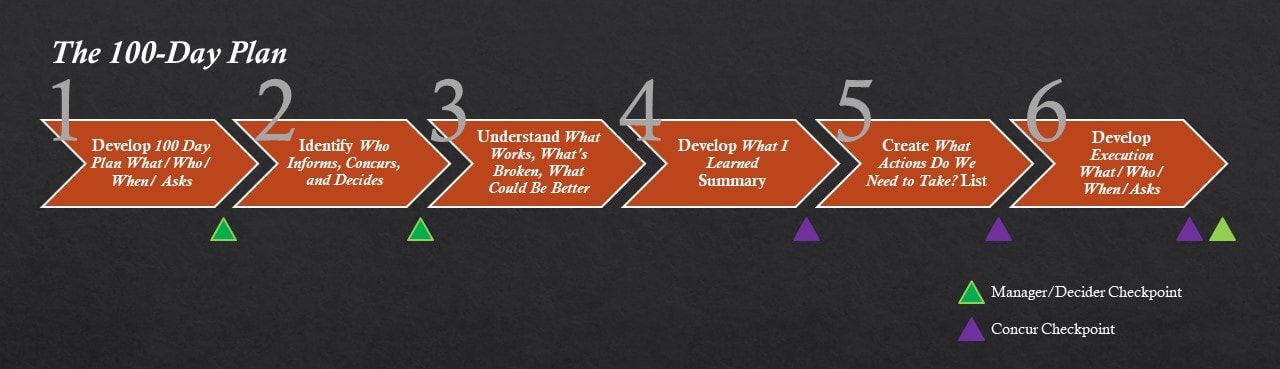
The 100-day plan's purpose is designed to help you do the following:
- Understand who the key stakeholders are in and around your organization and the roles they play
- Identify what is working, not working, and could be working better in your area of responsibility
- Summarize what needs to be done and when it needs to be done by
- Communicate a clear execution plan of the most important things to focus on, who needs to do them, and when they need to be done by.
- Establish credibility with your manager, team, and other stakeholders as someone who listens and seeks to understand before taking action.
Following is an explanation of each of the six steps comprising the 100-day plan with an example of how the deliverable should look.
Step 1: Develop 100 Day What/ Who/ When/ Asks Plan

Step 1 is articulate your 100-day plan tasks, who will be performing those tasks, and when you anticipate the tasks being complete. Being "aggressively realistic" is important here; meaning you move the work forward as quickly as you reasonably can while ensuring a quality end product. Once you've determined the what, who, and when of your tasks, articulate any specific requests to your management to help you get the plan executed. Does your plan require travel which requires expense approval? Do you need your manager to provide an introductory email to some stakeholders informing them of your new position and that you'll be contacting them? Think through what those "asks" are then do a plan review with your manager for concurrence and approval.
Step 2: Identify Who Informs, Concurs, and Decides
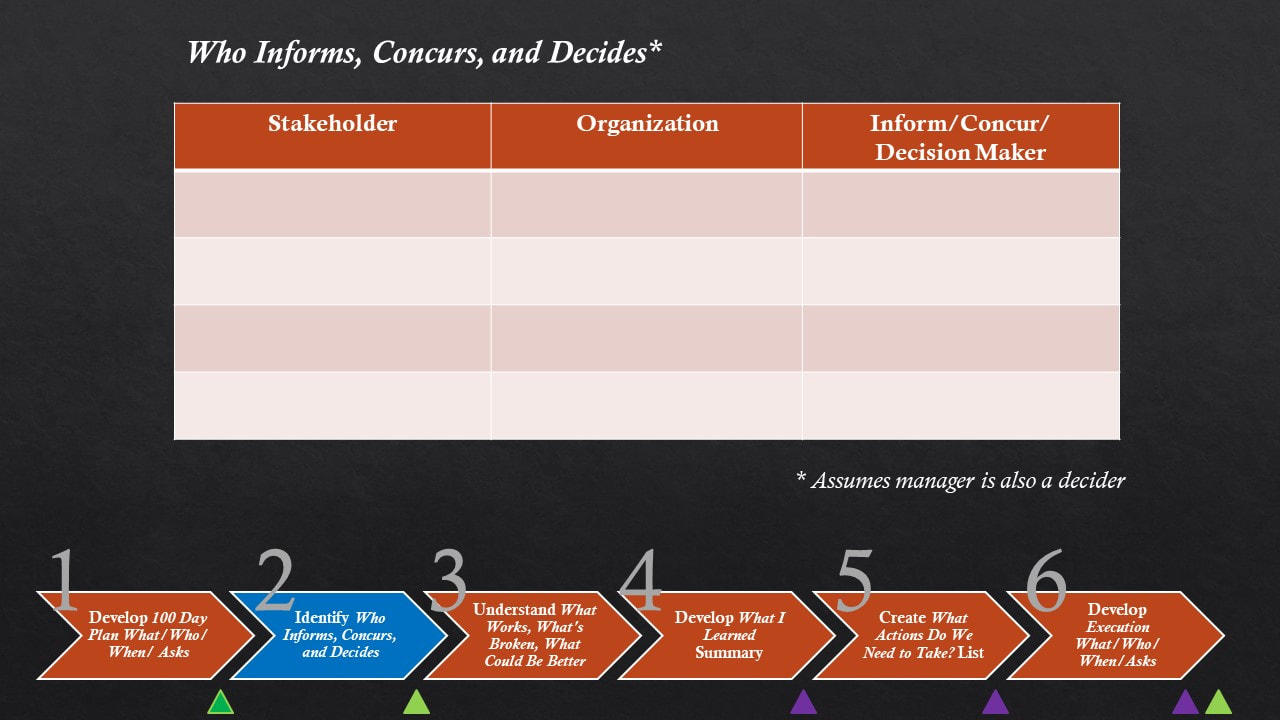
Step 2 is the development of an internal and external list of stakeholders who you want to interview as part of your current-state understanding. Internal stakeholders are those who are within your direct organization including direct reports, extended team members, and other people who impact or are impacted by the work your organization does. External stakeholders are those outside your organization who may or may not be impacted by your work but can provide good information on the current state. External stakeholders also can include experts outside of your company who provide information on industry trends, best practices, or other data points which could help give information about your future direction. For each stakeholder you should identify whether the stakeholder informs you (provides advice but is not directly impacted by your execution plan), concurs with you (doesn't formally approve your execution plan but you want/need their buy-in), or is a decision maker (formally approves your execution plan). I also think it's important to do a checkpoint with your manager as she/he may have additional stakeholders who are functionally or politically important to include, along with their appropriate inform/concur/decide status.
Step 3: Understand What Works, Is Broken, and Could Be Better

Step 3 is about interviewing your stakeholders to understand what is currently working, what's broken, and what might be working but could work better. This step is vital to not only understanding the current state but to establish a reputation with team members and stakeholders as someone who listens prior to taking action. I've found it helpful to focus on four areas in your works/broken/better discussion: organization strategy, people, processes, and technology. Depending on your situation these areas may be different. The last question I like to ask is, "If you were sitting in my chair, what are the top three things you would you do?" This is particularly effective not only in understanding items stakeholders think are important, but the priority they place on those things they identify. You may customize what you talk about depending on your stakeholder, but it's better to have a structure to work from then alter as needed, rather than totally winging it. Remember to interview your manager to understand his/her top priorities and perspectives.
Step 4: Develop What I Learned Summary
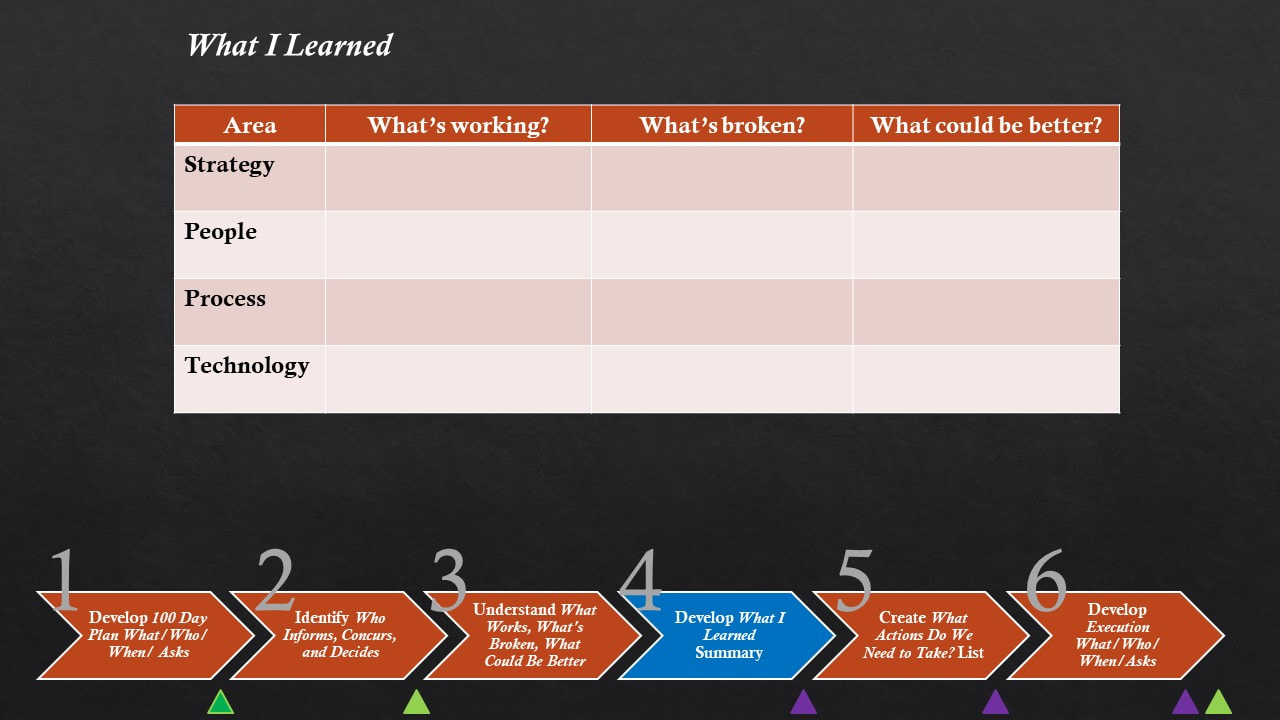
Step 4 is about taking what you've learned through your discussions and documenting trends and important facts that will influence execution plan actions. This is not an audit trail of everything you heard in every discussion; if you do that then you're likely to come out of the exercise with an unwieldy an non-actionable list. Conciseness and clarity are important here as this sets the stage for what you will focus on in your execution plan. You'll also want to do a checkpoint with your concur stakeholders to confirm you are focused on the right working/broken/better items and underscore that you've listened to what others have told you. Again, this is a crucial credibility builder with those you will be working with.
Step 5: Create What Actions Do We Need to Take? List
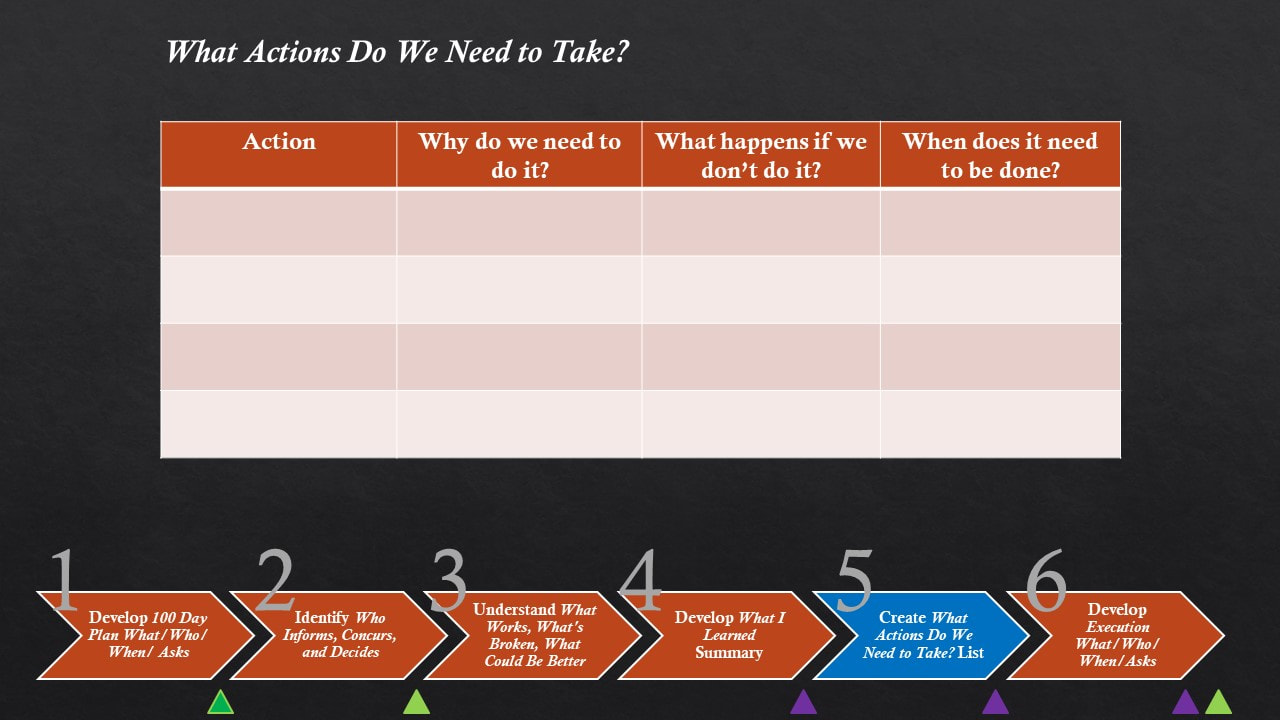
Step 5 begins the translation of what you've learned into what needs to be done to fix what's broken, improve upon what can be done better, and not disturb things that are working well. Each action includes three descriptive pieces of information: why it needs to be done, what the consequence if it isn't done, and when it needs to be done. Through articulating these factors you begin to develop a prioritized list of actions that comprise your execution plan. Do a checkpoint with your concur stakeholders prior to completing your execution plan.
Step 6: Develop Execution What/ Who/ When/ Asks Plan

Step 6 is about taking the actions in step 5 and creating a what/who/when plan which facilitates you working on the most important actions and getting them done first. It's totally reasonable to divide your actions up into phases, with your first phase of actions having a more detailed plan and subsequent phases being done once the first phase is complete. I can't stress enough the importance of focusing on the most important items from step 5 first and not getting distracted with trying to plan out all of your actions. In this step you'll do a concur checkpoint to ensure their buy-in prior to doing a decision maker checkpoint. You want to make best efforts to secure concur stakeholder buy-in and avoid having dissenting stakeholders discredit your conclusions and plan.
As mentioned throughout, your situation may require compression or expansion of the above steps. What doesn't change is the understand/conclude/act cycle that you'll need to go through to understand what you're getting into and determine what you need to address, while building trust and credibility with your stakeholders and management. Next time you take on a new job, use this model as a framework to help you execute a practical 100-day plan to get you off to a good start.
Want the PowerPoint slides used in this article? Message me.







