









Guessing is not a strategy: How to build decision velocity with AI and real-time data
June 10, 2026 | Live Webinar

Quotes by George Freeman from over the years -- updated version
Has Anxiety been Sustained or Overruled in your Life?
Strategic Lessons Learned – the Rejects
What you feel vs. What you know -- the domain of self regulation
Project Management Satire Night
Agile, Career Development, Communications Management, Information Technology, Leadership, Project Management, Stakeholder Management, Strategy, Strategy


|
Although I’ve posted quotes in the past, I decided to update them, removing some and adding others. I kept the list to fifty and would like to know which ones trigger memories from your past experiences and which ones you view as inspirational or humorous. These quotes are born from experiences over my 44 years in IT and project management, and most have one or more stories behind them, so let me know if any need clarification, and I will respond with some background. I hope you enjoy them! Project Management Advice
Governance, Leadership and Accountability
Failure
Teamwork and Knowledge
Risk Management
Deadlines and Estimating
Change Management
Self Regulation
Theory
|
|
In March of this year, I wrote an article called “The Risk of Sustained Anxiety,” where I addressed the purpose and impact of anxiety, along with thoughts on how to mitigate its effects in our lives. And now that we have endured six months of covidian time, I thought I would ask, “has anxiety been sustained or overruled in your life?”
|
| For those of you who suffered through my Webinar “Strategic Lessons Learned From a Battle-Hardened Project Manager,” I mentioned that I had excluded quite a few lessons from the presentation due to running out of time. Well, although that is a true statement, the real issue of “time” was that they were not prime-time ready. So, since blogs are about bearing personal truth, I thought I would show you some of the rejects, and based on the response of the one or two that read my postings, maybe I’ll show more at a later time. After all, this is about “rejection therapy,” that is, overcoming my fear and desensitizing myself to the blog statistics page.
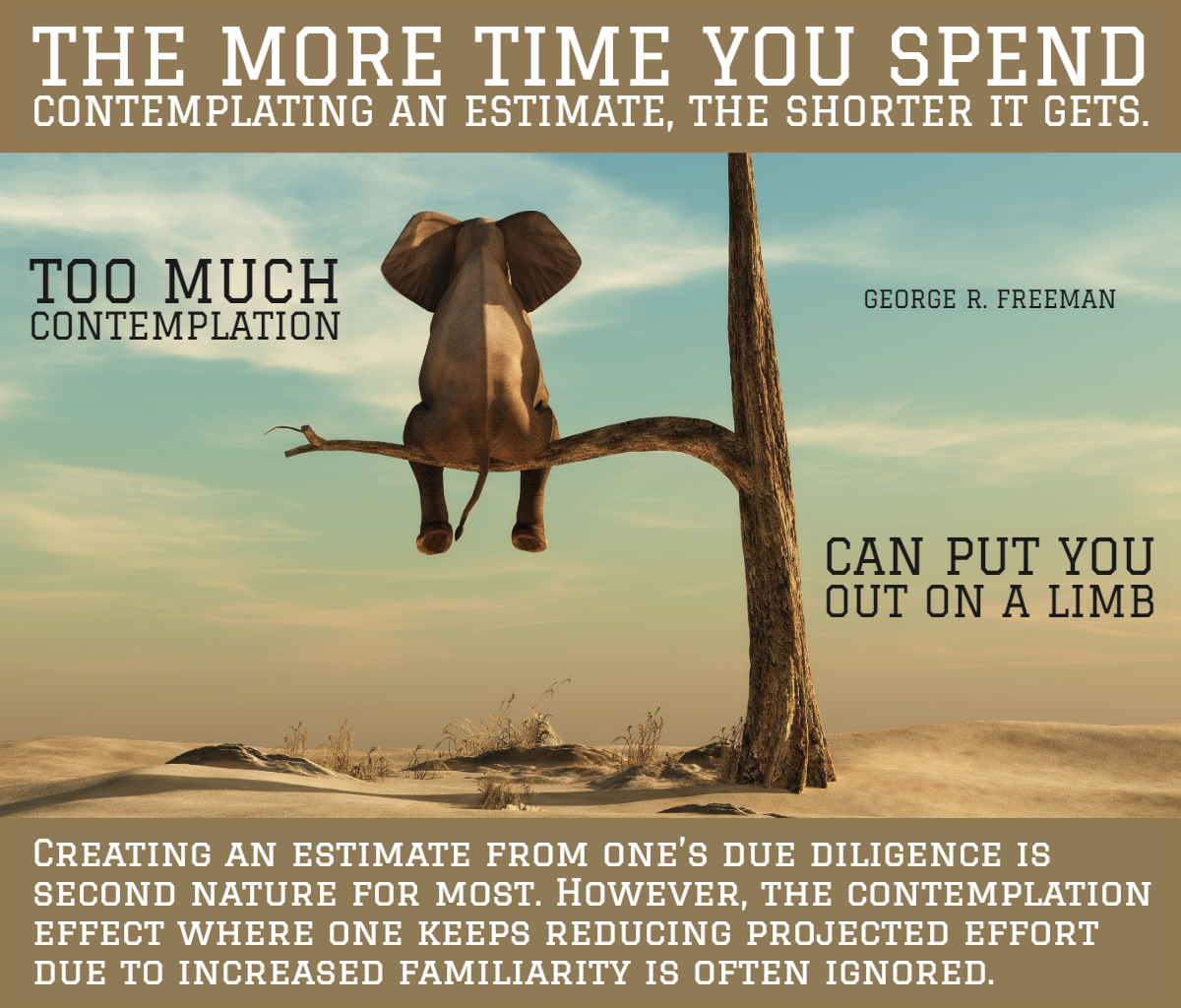
OUT ON A LIMB
As project managers we push for effort estimates on all tasks; however, we treat the estimates differently based on the approach used (e.g. waterfall, hybrid or agile). Have you ever noticed this effect, wherein a team or individual incrementally decreases their effort estimate as they become more familiar with the subject matter? Such situations are likely to put you out on the limb, and when the perceived float turns to bloat, the mass determines your fate – oh, snap.
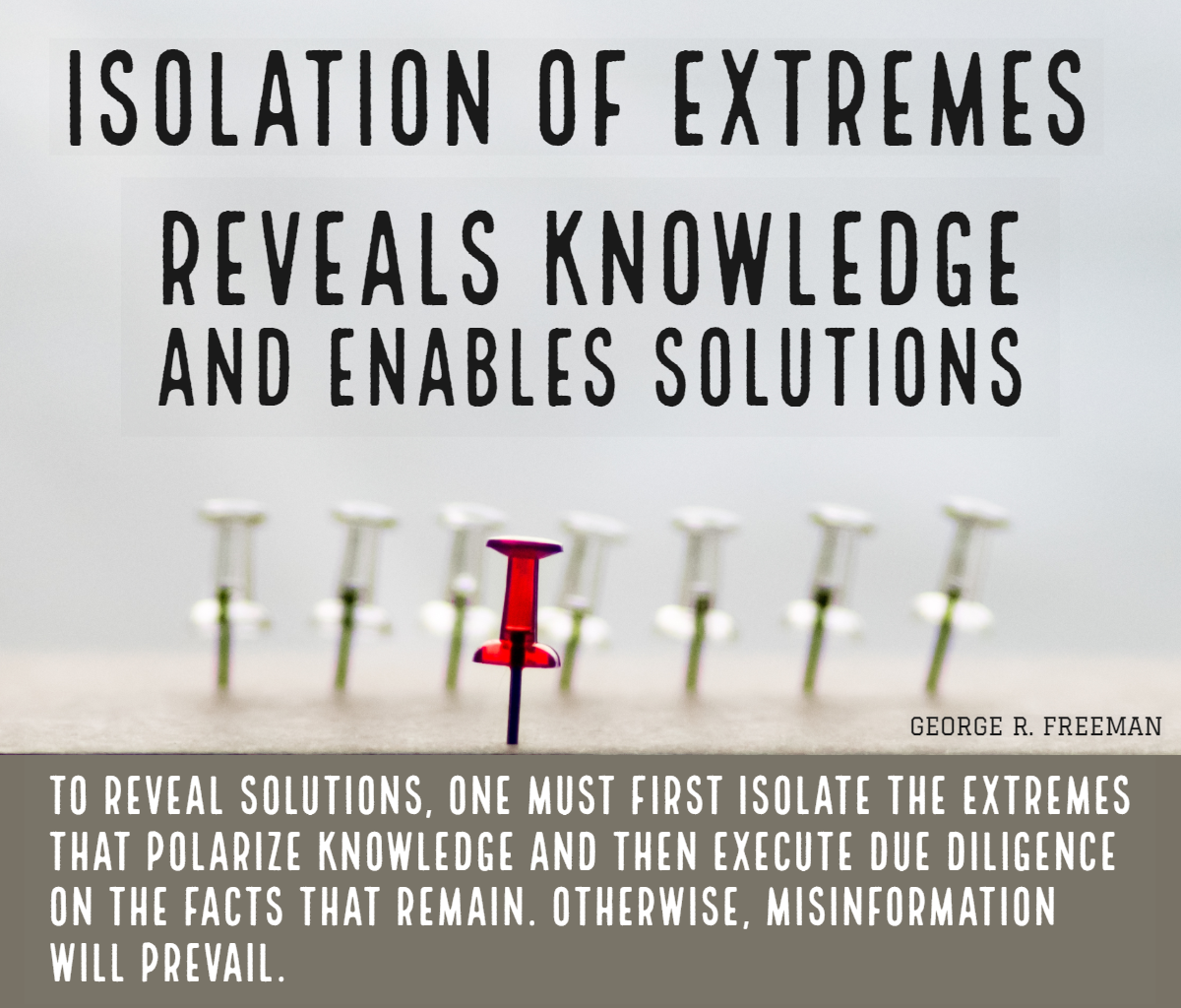
ISOLATION OF EXTREMES
Behind every policy or process is an “army of exceptions” that guard the predominate facts against exposure to the light. This naturally occurring phenomenon requires an offensive strategy called the “tactic of isolation.” Start your engagement by locating the central core of understanding and then make your advance on your target, rejecting every exception that encroaches on your position. – Knowledge will be revealed with the objective is no longer concealed.
CLOSINGSo, before I embarrass myself any further, let me know if you have an interest in postings of this type. It would also be interesting to hear some of your “strategic lessons,” and/or your thoughts related to the subject matter of the ones I posted above. |
|
Mindfulness is a popular topic in our profession based on the responses we see from articles, webinars, books, and speaker engagements. However, for many, the topic does not resonate well due to preconceived notions or interpersonal concerns related to the subject matter. In this posting, I’m going to explore some of these concerns and share some insights that I hope will assist others who are exploring or having issues with “the domain of self-regulation.” Please note: I am not an expert in this field, and although I’m a fan of mindfulness-based strategies, my goal here is to provide personal insights only - with no judgments made to anyone's belief, approach, or thoughts on this subject.
THE GENESIS FOR THIS POSTINGI just came back from a symposium where the realm of interrogating one’s emotions was front and center across multiple keynote speakers. I enjoyed and appreciated the content and the exercises provided and found it relevant to our profession. However, for some, the content and activities were, let’s say – uncomfortable. Although it is not too unusual to see social anxiety grip a percentage of participants during speaker driven exercises, my table was quite social, that is, until the content and exercises went into self-regulation territory. At that point, most of the table reached for their keys to lock their personal “pandora’s box.” Despite recognizing this, I asked the person to my left, “do you want to share,” and the answer was an expressive “No.” I then looked at the person to my right, and the facial expression stated, “say one word, and there will be severe consequences.” I then turned my gaze toward the speaker to provide my table mates some relief, waited an uncomfortable minute, and then noticed the individual on my left had exited the conference hall with all of their gear. This response was understandable to me, as my journey into this realm has had challenges as well on both the professional and personal front. After getting home that evening, I reflected on the interactions I had during the day and remembered; I have a blog, one that I rarely use, maybe I should post on this subject. I then did my best to convince myself otherwise, but lost the battle – so here we go.
THE STIGMA OF SELF-REGULATIONMost of the individuals I have come in contact with (or have read about) that appreciate self-regulation based strategies do so because they have received value in their personal life from practicing it. Most of those individuals also admit that they were initially reluctant to the idea at first, but then warmed up to it after “giving it a chance” and seeing positive results. So, why do some reject or pushback on strategies of this type? Well, for one, it is a loaded proposition on face value, consider the following “over thoughts”:
These thoughts by themselves are neither right nor wrong; they are instead, thoughts that require cognitive challenging. Although a correct statement, it is not that simple for those who have endured emotional trauma or abuse, or for those who have deficits in their emotional management toolkit. In either case, these types of thoughts can easily trigger feelings from the past that one is not prepared to address, especially in public forums. For these individuals, self-regulation strategies can easily become stigmatized as the psyche recognizes it as a trigger-area for uncomfortable or unbearable feelings. To state it another way, consuming this type of content outside of a controlled environment can create anxiety and other symptoms that the strategy is purposed to treat – creating an unfortunate paradox. I’m not saying that we should stop the self-regulation movement within our profession, I’m instead saying that we need to be empathetic and careful when we deliver content on the subject. Self-regulation is a journey that never ends, and for some, it’s a journey that never begins. Let’s recognize this fact and be sensitive to it.
SELF-REGULATION – A PERSONAL PERSPECTIVEIn the realm of self-regulation, my personal goal is to implement a strategy that mitigates the transference of stress into my life in both professional and personal settings. To accomplish this goal, I must first be mindful; that is, I must be aware and focused on the moment at hand. When this is true, I can then implement tooling to accomplish my goal. The approach I have adopted encapsulates (at least for me) the quintessential question of self-regulation into a challenge-based response cognitive-tool. This insight is not unique but has served me well in my journey. To wield this tool, you ask yourself the following question when confronted with a concern:
Once you ask yourself this question, you can then internally reply with:
This millisecond of clarity affords one a “regulated moment in time” where opportunities outweigh the challenges. For most, this approach is simply a choice that one needs to “step into.” However, for some, the dots do not connect without engaging a professional to help them through the process.
WRAP-UPThis subject for most (and absolutely for me) is a personal one, and I must say it feels a bit uncomfortable posting on it. However, let me close by giving a big “thank you” to the Mindfulness and self-regulation evangelist we have in our profession. You are doing important work not just for the profession, but also for the human condition. |
|
INTRODUCTIONIrony is a tool within satire that highlights the distance between the way individuals speak/feel about a topic and the broad issues that are presented by the topic. It’s a way to pose questions and have challenge-based conversations because it purposely “stirs the pot” on all sides of the concern and/or issue. I have put together three examples of it below, and am interested in how it is received. If you have kept up with my articles and postings, you know that I’m interested in sharing transformative thought, in hopes of preparing the next generation to have the technical, business and interpersonal skills to tackle today’s dynamically changing environments. So, please recognize that I’m not making a positioned statement on any topic; I’m simply interested in seeing if this type of “device” can create productive conversations in project management. I’ll ask a few questions at the end.
WHEN STAKEHOLDER MANAGEMENT REQUIRES AND INTERVENTIONThere’s a time in every Project Manager’s life when one too many change requests takes you over the edge and requires you to give a literal meaning to the word "stake-holder".
Mr. Happy - the project manager is presenting signs of a disorder I call the PIT (i.e., Project Induced Trauma), and evidently missed the webinar on Mindfulness. Who do you have empathy for?
A SOFTWARE DEVELOPERS INTERPRETATION OF AGILITYWhen a software developer believes the “NO Accountability” movement has won the hearts and minds of the Enterprise, then it’s time for him/her to wake up and start their day.
John – the software developer is on cloud-nine taking in his coffee with no concern to accountability, as his form of agility has vanquished the need for 1) project managers, 2) Documentation, 3) Estimations and 4) Planning. Although these NO’s are partial truths, why do their legends persist?
AGILE AND HYBRID ON A BONDING EXCURSION – WATERFALL AHEAD!
Agile and Hybrid were whitewater rafting one day (on a bonding excursion) when they noticed a sign stating “Danger: Waterfall Ahead.” Agile, recognizing a teachable moment, told Hybrid that the rigid structure of the upcoming Waterfall posed an extreme danger to the general public, but that they had full indemnification from injury due to their flexibility. Hybrid, recognizing Agile’s emotionally driven statement, expressed the risk this opinion would have on their immediate wellbeing. Undeterred, Agile (still in the teachable moment) insisted that they accept this risk and move forward, while Hybrid - hearing a rumbling in the distance, recommended an immediate strategy of avoidance. How does this story end? Agile purists (as a whole) view waterfall approaches as the epitome of project evil and immediately take the contra view on a given subject if they sense anything that gives validity to a waterfall (e.g., a sign stating - waterfall ahead) – oh, now I get it.
WRAP UPWhat are your thoughts on the actual subject material; did it make you ponder your position and/or reflect on its relevance or non-relevance in your practice; and finally, do you think this type of device has value in our community? |
|
I saw someone on the street eating M&M's with a spoon. - Jerry Seinfeld |