Project Management

The Battle-Hardened PM

by
The Battle-Hardened PM examines traditional subjects in project management from non-traditional perspectives, in hopes of inspiring both the current and next generation of PMs to move beyond their limits.

About this Blog

RSS

Recent Posts

Quotes by George Freeman from over the years -- updated version

Has Anxiety been Sustained or Overruled in your Life?

Strategic Lessons Learned – the Rejects

What you feel vs. What you know -- the domain of self regulation

Project Management Satire Night

Categories

Agile, Career Development, Communications Management, Information Technology, Leadership, Project Management, Stakeholder Management, Strategy, Strategy

Date

Quotes by George Freeman from over the years -- updated version

linkedin twitter facebook Request to reuse this  

Although I’ve posted quotes in the past, I decided to update them, removing some and adding others. I kept the list to fifty and would like to know which ones trigger memories from your past experiences and which ones you view as inspirational or humorous. 

These quotes are born from experiences over my 44 years in IT and project management, and most have one or more stories behind them, so let me know if any need clarification, and I will respond with some background.

I hope you enjoy them!
 

Project Management Advice

  • The sparse use of the word “no” is often frowned upon as a leader; the abundant use of this simple word allows you to pursue other career opportunities.
  • Bringing a project in for a landing demands a “soul count” when one builds a rocket ship instead of the fixed-wing aircraft specified in the charter.
  • Daily stretching of your triple constraint provides the needed flexibility that keeps you clear of your steering committee’s inquisition.
  • If it is unclear whether you are directing or wearing the reins of a project, then bite down as there might be a “bit” of truth to your concern.
  • Keep your finger on the pulse of the project (i.e., the triple constraint) so that you can be the first to know when your project starts to come under stress.
  • Indelibly searing your brand into your being often impedes your passage into new grazing lands.
  • Time is a commodity, so make your purchases when the price is right.


Governance, Leadership and Accountability

  • Rescinding one’s principles for the sake of compromise finds future objections overruled.
  • When the ability to make things happen becomes intrinsic, it’s time to wake up and start your day.
  • Projects without accountability and aligned objectives render an economy of their own—whose currency is avoidance.
  • Leadership practiced through philosophy alone renders little; leadership practiced through meeting human needs gains much.
  • Executive stakeholders who avoid placing “political cover” over their projects will surrender their stakes for a “grilling” in the corporate square.
  • Before you speak, have confidence in your subject and be resolved to the potential of being wrong, as “being wrong” is just part of the process of getting it right.
  • One knows past success when resources compete to jump on board your project when said project does not yet exist.
  • The realms where stakeholders and resources seek your advice are those where you have delivered personal value to them and asked for nothing in return.
  • Issues become rampant when a project’s target ceases to represent an objective but instead becomes a bullseye on one’s back.
  • Uncovering and addressing ulterior motives in the ranks of your project team renders them mute; leaving them unchecked ensures their execution to your loss.
  • Transparency leads to facts and enables accountability; Facts lead to the discovery of truth; and Truth authorizes trust!


Failure

  • Success overstated is often the obfuscation of failure.
  • Promoting tolerance of failure increases the opportunities for success.
  • A project void of “open challenge” finds its product destined for the shelf.
  • When failure “is not an option,” the definition of success becomes amazingly versatile.
  • The path to success feels like the “bring of failure” when entrenched in project warfare.
  • To succeed where others have failed, one must reject complacency, contradict the accepted, and embrace the unknown.


Teamwork and Knowledge

  • Rationed knowledge starves realization.
  • Isolation of extremes reveals knowledge and enables solutions.
  • Faith in one’s team accelerates results and breaks down barriers to success.
  • Leadership is unbounded when trust has been requested and willingly granted by your team.
  • Reaching true consensus requires the absence of assumptions and the acceptance of fallibility.
  • Collaboration is easily defined and spoken to but will be elusive if one does not practice it themselves.
  • The “lack of knowledge” finds validity for a momentary pause, but sustained ignorance abdicates one’s position.
  • What you are willing to do in the trenches for your team establishes a care fund that pays dividends in perpetuity.
  • When applied to the flame of innovation, knowledge becomes an accelerant that produces the energy one needs to succeed.
  • Empathy is a form of understanding, understanding is a form of knowledge, and this one we all know: Knowledge drives projects. Therefore, empathy is valuable not just to the nature of relationships but to the nature of projects.


Risk Management

  • Managing and embracing risk finds reward; rejecting risk is an illusion.
  • Risk aversion appears rational until you have a successful project with no adoption.
  • Risk is a moldable substance and finds reward when the sculptor renders their work from a model of success.


Deadlines and Estimating

  • The more time you spend contemplating an estimate, the shorter it gets.
  • Cracking the proverbial whip without evidence of your own flogging produces little value.
  • Deadlines do not get the respect they deserve, so be sure to salute them as they pass you by.


Change Management

  • “Political Waste” is a byproduct of unmanaged change.
  • One’s tolerance for change often reflects one’s confidence in delivering.
  • A management change is quite often the best form of change management.


Self Regulation

  • To put anxiety into the back seat where it belongs, you need to step into the driver’s seat.
  • Anxiety is an emotion, and with all emotions, it’s essential to understand the difference between what you feel and what you know.
  • When we are mindful, we bring our attention to the experiences of the present moment under a state of calm. When we have anxiety, we give our attention to future experiences that are unknown, under a state of fear. The contrast is evident; anxiety is the opposite of mindfulness.


Theory

  • Any approach absent from theory finds its basis leveled when openly challenged.
  • The secret to understanding the future is deciphering the patterns demanded from the past.
  • All things, animate and inanimate, exist within a lifecycle, a pattern, that demands fulfillment.
  • Lifecycle patterns exist for replication, at least until you are dealing with project management, which, in that case, all bets are off.
Posted on: October 11, 2024 04:32 PM | Permalink | Comments (6)

Project Management Satire Night

linkedin twitter facebook Request to reuse this  

Project Management Satire Night

INTRODUCTION

Irony is a tool within satire that highlights the distance between the way individuals speak/feel about a topic and the broad issues that are presented by the topic.  It’s a way to pose questions and have challenge-based conversations because it purposely “stirs the pot” on all sides of the concern and/or issue.

I have put together three examples of it below, and am interested in how it is received.  If you have kept up with my articles and postings, you know that I’m interested in sharing transformative thought, in hopes of preparing the next generation to have the technical, business and interpersonal skills to tackle today’s dynamically changing environments. 

So, please recognize that I’m not making a positioned statement on any topic; I’m simply interested in seeing if this type of “device” can create productive conversations in project management.  I’ll ask a few questions at the end.


WHEN STAKEHOLDER MANAGEMENT REQUIRES AND INTERVENTION

There’s a time in every Project Manager’s life when one too many change requests takes you over the edge and requires you to give a literal meaning to the word "stake-holder".

When Stakeholder Management Requires and Intervention

Mr. Happy - the project manager is presenting signs of a disorder I call the PIT (i.e., Project Induced Trauma), and evidently missed the webinar on Mindfulness.  Who do you have empathy for?


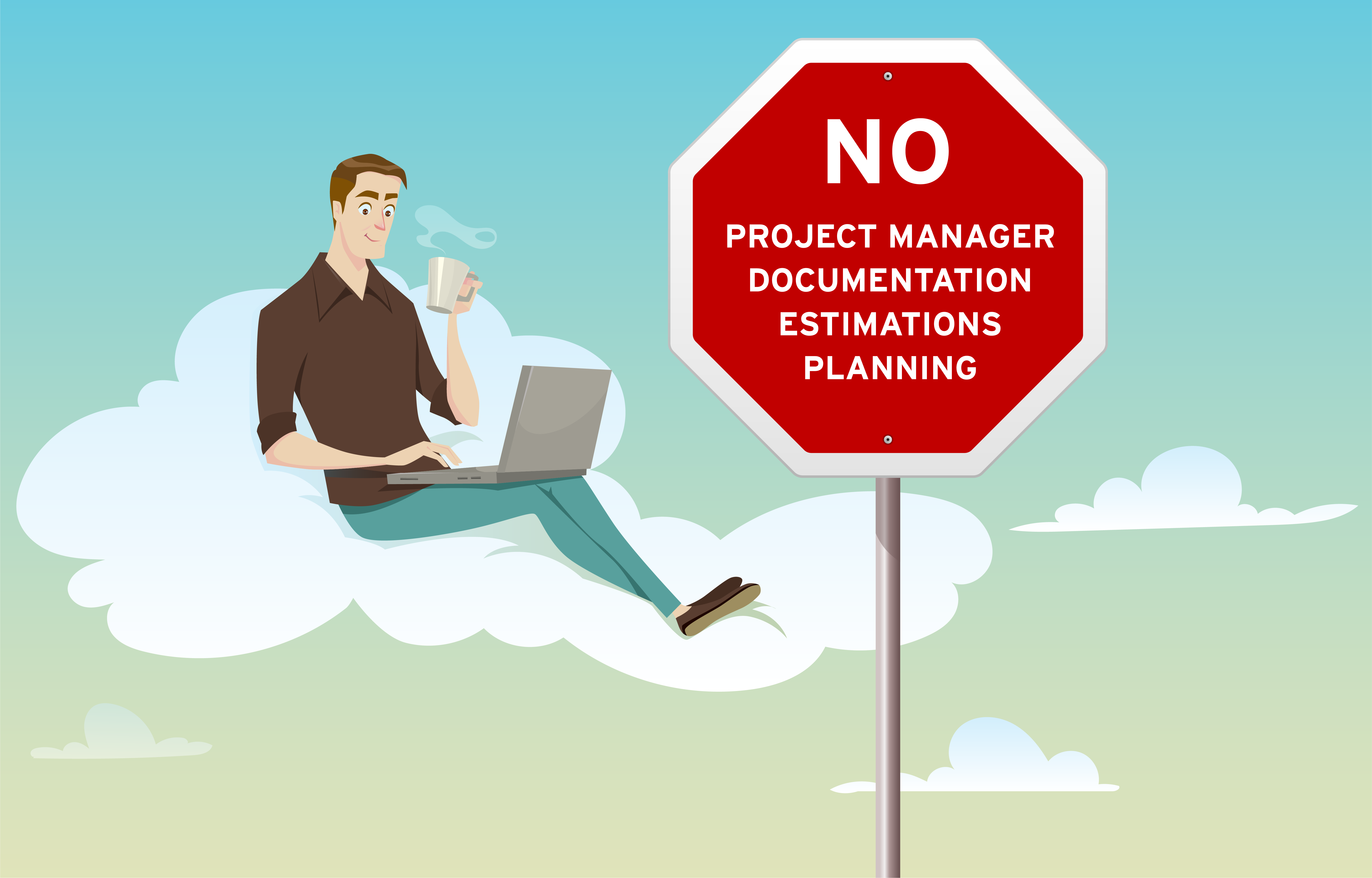
A SOFTWARE DEVELOPERS INTERPRETATION OF AGILITY

When a software developer believes the “NO Accountability” movement has won the hearts and minds of the Enterprise, then it’s time for him/her to wake up and start their day.

A Software Developers Interpretation of Agility

John – the software developer is on cloud-nine taking in his coffee with no concern to accountability, as his form of agility has vanquished the need for 1) project managers, 2) Documentation, 3) Estimations and 4) Planning.  Although these NO’s are partial truths, why do their legends persist?


AGILE AND HYBRID ON A BONDING EXCURSION – WATERFALL AHEAD!

Agile and Hybrid on a bonding excursion – Waterfall ahead!

Agile and Hybrid were whitewater rafting one day (on a bonding excursion) when they noticed a sign stating “Danger: Waterfall Ahead.” Agile, recognizing a teachable moment, told Hybrid that the rigid structure of the upcoming Waterfall posed an extreme danger to the general public, but that they had full indemnification from injury due to their flexibility.

Hybrid, recognizing Agile’s emotionally driven statement, expressed the risk this opinion would have on their immediate wellbeing. Undeterred, Agile (still in the teachable moment) insisted that they accept this risk and move forward, while Hybrid - hearing a rumbling in the distance, recommended an immediate strategy of avoidance.

How does this story end?

Agile purists (as a whole) view waterfall approaches as the epitome of project evil and immediately take the contra view on a given subject if they sense anything that gives validity to a waterfall (e.g., a sign stating - waterfall ahead) – oh, now I get it.


WRAP UP

What are your thoughts on the actual subject material; did it make you ponder your position and/or reflect on its relevance or non-relevance in your practice; and finally, do you think this type of device has value in our community?

Posted on: August 05, 2019 11:50 PM | Permalink | Comments (7)

Surviving the Bends

linkedin twitter facebook Request to reuse this  

As many project managers do, I swim from the abyss to the surface every three years to renew my PMP Certification.  For most, this is a gradual ascent causing no repercussions, but in my last cycle the dive computer malfunctioned, leaving me no choice but to rapidly ascend.  As I breached the surface and tore off my mask, the dive team pulled me into the boat where I immediately logged into my PMI account to read the current CCR (Continuing Certification Requirements) handbook.

As the Talent Triangle and minimum PDU requirements came into focus, I felt the "bends" coming over me like a wet blanket.  Looking for support, I directed my gaze towards my crew only to see them shaking their heads and taking in the entertainment as if this was a prescheduled team-building event.  Having little recourse, I entered into a hyperbaric podcast chamber to repair my self-inflected wounds, where, after receiving my educational PDU’s, I promised to never “bends” that way again. 

BREAKING THE CYCLE

So here I am, correcting past patterns and giving back to the profession via this new BLOG called "The Battle-Hardened PM" where we will dive into examine traditional subjects in project management from non-traditional perspectives, in hopes of inspiring both the current and next generation of PM’s to move beyond their limits. 

The first BLOG series will be on “Reaching your Project Management Potential”, where we will examine the following questions:

  1. Who are you as a project manager?
  2. Where do you want to go in your career?
  3. How do I get there?

We will look at these questions in pragmatic challenge-based ways, so as to complement the traditional views that are most often written about and discussed. 

It is my desire that this BLOG be a forum for discussions whether you are in agreement or not, so be sure to make your thoughts known.  If you are interested in “non-traditional perspectives” then check out my article on the Knowledge Shelf called  Strategic Lessons Learned from a Battle-Hardened Project Manager.

Stay Tuned!

Posted on: June 05, 2018 03:48 PM | Permalink | Comments (7)
ADVERTISEMENTS

"Talk sense to a fool and he calls you foolish."

- Euripides

ADVERTISEMENT

Sponsors