


Do Your IT Projects Produce?


Situation: You deal with highly repeatable processes and new components in most project cycles.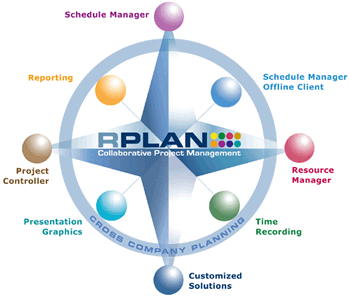 RPlan is a project management tool which is very popular in automotive manufacturing, with clients such as GM, Daimler, VW, AUDI, Porsche, BMW, Renault, Getrag-Ford, Airbus, Rolls-Royce and more. The tool is designed to address a variety of challenges common both project and product management. These days automotive projects involve a lot of IT and IT projects are often faced as product development efforts. So I thought it would be a good idea to speak with Actano's CEO, Thomas Salva to understand what makes their tool set special and why those differentiators are important in the IT space. RPlan is a project management tool which is very popular in automotive manufacturing, with clients such as GM, Daimler, VW, AUDI, Porsche, BMW, Renault, Getrag-Ford, Airbus, Rolls-Royce and more. The tool is designed to address a variety of challenges common both project and product management. These days automotive projects involve a lot of IT and IT projects are often faced as product development efforts. So I thought it would be a good idea to speak with Actano's CEO, Thomas Salva to understand what makes their tool set special and why those differentiators are important in the IT space.Q. How is project management different in a product-focused environment? How do project and product management work together most effectively? In a product-focused environment projects are not and can not be treated as a “unique endeavors,” but must follow standard processes to make the most of scarce resources. A defined development process, that comprehends the characteristics of the product, the organization that will execute the projects, and the program management processes and control points, is essential. RPlan provides standard structures and templates that provide the consistent and efficient basis for project planning, and allow the project manager to focus on the aspects of the product that make it unique to the market. One major difference in product focused environment like automotive vehicle development is the need to coordinate component planning. In a "new" vehicle design there are components to be developed "from scratch", carryover from vehicles in production and components in various stages of development. The last of which is complicated to manage, due to their interdependence with the "new" components, often so-called lead vehicles are delayed or canceled entirely. This causes “Sturm und Drang”, i.e. the need to seek scheduling alternatives to still meet launch dates. RPlan supports this process with “what-if” scenarios and their ramifications. A very high degree of collaboration is required between project and product management to insure that the corporate goals for part commonality, vehicle launch dates and costs are adhered to, while providing a successful product to the market. RPlan provides the global, web based platform to manage the complex schedule interdependencies via SynchroLinks (task/resource interlinking across projects and programs) combined with resource loading, leveling and costs. Q. Most of RPlan’s clients are global. What are the top 3 things to be mindful of when working with large distributed teams? What can be automated? What needs to managed via human interaction? Cultural differences, e.g. in terms of how concrete a schedule actually is. Differing priorities/goals between the global and regional organizations that must be harmonized if global PD is to function effectively and lastly language barriers, e.g. terminology must be uniform so that all partners truly have the same understanding for each English term, when it’s translated back into their native tongue. Reports can be automated, typically there is a set of standard metrics that management requires weekly reports on (e.g. baseline budget $/Euros, effort and timeline vs. actuals). This is capability that RPlan provides out-of-the-box via integrated Crystal Reports. Human interaction is required in resolving scheduling conflicts. Here RPlan provides multiple means of communicating a delay to the stakeholders, including a link directly to the schedules/tasks/resources involved and "what-if" capabilities to provide options to remedy the situation. Q. What are the focus of project presentations in the automotive industry? What do they always include? Are they fairly standardized or very unique to the project that you are working on? Project presentation for complex programs such as automotive development can vary widely, but general focus on either overall project status or the status of key project metrics. Communication of the project schedule is a critical need, as program team members are typically balancing resources across multiple projects. RPlan provides the capability to generate project timelines directly into Microsoft PowerPoint. Standard formats provide consistent communication, with the ability to annotate and draw focus to areas requiring attention. Project managers also need the ability to dive into the detail supporting the overall status. The supporting information must be organized in such a way that the metrics supporting the key control points defined in the product development process are easily identifiable. RPlan provides the ability to manage all the information and to create presentation reports that integrate the key cost, schedule and resource metrics. Q. RPlan has been very effective in the automotive industry, based on its strengths in collaboration, project information management, and bottom-up schedule management. How do you see those strengths being applied in the broader IT market? Many of the same requirements carry-over to IT: complex interdependencies of modules and components in SW development, reuse of components across projects, and the need to adhere to standard processes and structures. Typically SW development is now also spread out globally. Several of our customers in automotive are now also using RPlan for their SW development activities (e.g. BMW) Q. If you had to name one key differentiator for the RPlan toolset, what would it be? What makes it special? What does that mean to the organization and people using it? Collaboration! RPlan's architecture, ease of use and flexibility make it ideal for complex, distributed and dynamic project environments where world-wide collaboration of all of the stakeholders is the key to achieving the project goals. Visibility and transparency of project information insure stakeholders always have access to current information, and are working to the same plan. Project team members are able to focus on accomplishing the tasks and objective they own, with a clear line of sight into tasks and issues that impact them. The RPlan product coupled with ACTANO's 20 years of experience in providing project management best practices will insure the customer’s organization reaps the ROI in the shortest time and the users experience a significant productivity gain and less migraines. |
Project Manager - Should You Really BE THE CHANGE?
Categories:
Decision Making
Categories: Decision Making
Situation: You've been thinking about the big picture. Over the last couple of years, I've listened to PMI's CEO, Greg Balestrero talk A LOT about sustainability at PMI Global Congresses and other venues. In fact, I believe it gets more air time than any other topic he speaks on. While I'm a big proponent of "getting more green" in everything we do, I've been surprised with the way that he connects it to project management and to our responsibilities as project managers. In his mind, it should be central to what we all do - not a "nice to have". Something he said in a recent press release caught my eye, summarizing his view on the topic. Over the last couple of years, I've listened to PMI's CEO, Greg Balestrero talk A LOT about sustainability at PMI Global Congresses and other venues. In fact, I believe it gets more air time than any other topic he speaks on. While I'm a big proponent of "getting more green" in everything we do, I've been surprised with the way that he connects it to project management and to our responsibilities as project managers. In his mind, it should be central to what we all do - not a "nice to have". Something he said in a recent press release caught my eye, summarizing his view on the topic."Integrating economic, social and environmental value into all portfolios, So I followed up and asked him a few questions at the PMI Global Congress in Orlando. Again, I know we should all do what we can as individuals to promote sustainability, However, can and should project management practitioners integrate economic, social, and environmental value into [their projects, programs and portfolios]? After a brief conversation, I believe I understand his perspective a bit better. I'll put it in my own words and see what you think. It's not: - that all projects need to focus on sustainability. - that you need to add cost to your projects to ensure they have a positive impact on sustainabilty. - that sustainability is something that should be considered ahead of the project requirements you already have to deal with. Here's my version of the case for making sustainabilty a key part of your project management approach As an ethical Project Manager, you need to think about longer term financial and environmental results and factor the benefits of sustainability into your ROI analysis and execution plans. If you consider sustainable approaches, materials, etc. for every single project. They may only make sense SOME of the time, but with your help, they will at least be considered. In this way you can ensure that sustainable approaches that make sense are used. Making sustainability part of what you do implies you must make it your business to learn about and introduce sustainable approaches to your work. If you don't, chances are that no one else will. For this reason, Project Manager - you need to be the change. The actions that you could take to make this happen include: - unearth potential sustainable approaches within the context of your project. - understand how specific sustainable approaches relate to the financial success of your project so that you can propose them as appropriate. - find out if a sustainable approach to your project could help your company from a PR perspective. What do you think? Is this something you have time for and feel is important? Should it be a key focus for PMI? Should it be a key personal focus for you? |
You Are SO HOT Right Now!
Situation: You need a little "pick me up". This morning, CNN Money announced the top 50 jobs in America - IT Project Manager was #5! How great is that? Give yourself a pat on the back for choosing a great profession to be a part of. |
New From PMI - Read an Article, Take a Quiz!
| Situation: You’re looking for new and interesting ways to earn PDUs PMI has created a new type of learning module that helps you learn about very specific areas within Project Management, testing your understanding of the material with a short quiz at the end of the exercise. Here are some examples of topics addressed. 
PMI Publication Quizzes are based on PMI-published articles and papers available at the PMI.org Marketplace. Customers purchase the quiz together with one or two related articles and papers. Credential holders will read the article(s) and then complete a short quiz to earn PDUs. PMI volunteers work in conjunction with the PMI Professional Development Group to create the quizzes. Recently we spoke with Brian Weiss, Vice President of Product Management at PMI to get a better understanding of what these quizzes are and how you can best use them as a part of your continuing PM education efforts.
Q. Who came up with the idea to create this offering? What was the impetus behind it? This idea, like many of the ideas that become products or services at PMI®, was introduced by one of our staff members. We encourage our employees to be diligent about creating opportunities that support our members and credential holders. Because we have nearly 500,000 members and credential holders in more than 185 countries around the world, we are always looking for new and creative ways to reach out to these individuals and support their continuing education. The Publications Quizzes program was designed to provide a convenient and affordable way for credential holders to earn the last few remaining Professional Development Units (PDUs) that are needed to maintain their credential. Q. Can you tell us a bit about where this fits within the spectrum of options that PMPs have to maintain their certification? When and how are these quizzes best utilized? The Publication Quizzes program complements our other PDU-generating programs. They can be used to augment the total PDUs needed to attain a credential – for PMP®, a total of 60 PDUs is needed and for our other credentials (excluding CAPM), a total of 30 PDUs is needed. If, for example, a credential holder realizes he needs a few more credits to reach his target PDUs, the PMI® Publication Quizzes provide him with an opportunity to conveniently earn those remaining credits. We also recognize there are members and credential holders in regions of the world without an abundance of Registered Education Providers from which they can earn PDUs. The PMI® Publications Quizzes program offers these individuals an easily accessible way to earn some of their required PDUs. Q. Does the availability of this offering change how PDUs will be recognized for self study? In other words, a PMP has historically been able to just invest time reading articles and earn PDUs that way (versus reading, then taking a quiz as they do here). Will that option continue to exist? Yes, the option to earn PDUs by reading a book or article will continue to exist. For those activities, the PDUs are recorded as Category 2 – Self Directed Learning (2-SDL). In this category, a maximum of 15 PDUs that can be earned per cycle. PDUs earned from Publication Quizzes are recorded as Category 3. In this category, no more than one third of the total credential requirements may be earned per cycle through Publication Quizzes. For example, PMP® credential holders can earn a maximum of 20 PDUs from PMI Publication Quizzes, while other credential holders can earn a maximum of 10 PDUs. Q. Does PMI plan to do the same thing with other media (beyond articles), such as webinars or podasts? We are always seeking opportunities to provide the best tools to our members and credential holders, and this program was designed with the ability to expand content and platforms used for the quizzes. We can include webinars and podcasts, but can also look to books, such as those in the PMI® Bookstore and content found on the PMI® Virtual Communities’ web pages. Q. According to the web site, just about anyone can take the quizzes (PMI members, non-member credential holders and non-credential holders). How do you envision non-credential holders using the quizzes? The over-arching purpose of the program is to provide an educational opportunity for practitioners to increase their knowledge of project management. As with any sound educational program, a testing of what was learned serves to reinforce learning and build confidence for the learner. Non-credential holders or those interested in obtaining their credentials are also permitted to use the quizzes to test and increase their knowledge. Q. Tell us a little about what’s next for PMI in terms of new offerings. As mentioned earlier, we continue to expand our offerings and provide additional member value. One major area of focus has been on developing our virtual learning offerings – ranging from beginners to advanced practitioners. In that vein, we recently launched the Virtual Communities Project (VCP) initiative, which provides an opportunity for members, and the greater project management community, to network and exchange knowledge and ideas. PMI’s virtual communities have search capability across PMI.org and feature blogs, forums and wikis, which are updated on a regular basis, to create the ultimate project management collaborative community. We have received overwhelmingly positive feedback about this initiative and will continue to enrich and expand content within these communities. Through our global program SeminarsWorld®, we also provide an opportunity for our members to gain real-world experiences via live workshops. We will continue to add new programs in that arena, as well as create new courses for our eSeminarsWorld program. In the future, we will expand our offerings to include courses that feature simulation exercises and discussion threads, which offer yet another way to engage participants and increase learning and retention. #?-:nbsp; |
Better Resource Management = Better Forecasts?
| Situation: You’re looking to streamline resource management and schedule updates.
Q. Prior to Resource Workbench, what were the top three types of information users were asking for related to resources? What was most important to them? What pain were they feeling? While the priority varies from customer to customer, most of the organizations we work with struggle with three main issues around resources 1) What are my resources working on? For many customers, just getting the initial inventory of resource allocations to their projects and maintenance activities is the first step. This activity often highlights that in addition to having more projects in the portfolio than they thought they had, resources are also over-allocated to work on these projects. Once the picture of how resources are assigned across projects becomes clear, many of our customers realize that their project schedules are unrealistic (unless people really can work 120 hours a week). 2) Do I have the capacity to handle all of this planned work? As organizations go through periodic portfolio planning reviews and their annual planning process, the requests from their business users or customers invariably outpace the capacity of the organization. These customers need to compare high level forecasts for resource needs on upcoming projects to balance them against capacity of the organization. Usually, this just involves defining the types of resources needed (DBA, Developer, Analyst, etc), the timeframe, and the expected hours and/or FTEs. With this data for both projects and maintenance activities, customers can adjust the master schedule of their projects to align with their capacity, or they can augment specific roles in the organization to increase capacity before a gap is encountered. 3) How can I easily adjust forecasts? Many of our customers rely on team managers or a centralized resource management function to balance resource allocations against future work, both strategic projects and day-to-day maintenance activities. On a weekly or monthly basis, managers will adjust their forecasts (expected assignments) based on shifting business priorities or changes to project scope and/or schedules. These forecasts can then be compared to the actual hours and costs for the work to help in improved forecasting in future periods. In cases where the IT organization charges back work to the business, the accuracy of the forecasts is important for credibility – without chargebacks, the data is important to justify the headcount of IT.
While Innotas has always handled the first two cases well, it was a bit difficult for managers to quickly update forecasts. As with most PPM applications, the project or application was the central focus, which works great for project managers. For resource managers with resources working on multiple projects, this meant the manager was required to open up lots of projects, find the proper assignments, and adjust. This required lots of screens and lots of clicks. Our new Resource Workbench is designed for team or resource managers to give them a simple, single screen interface to see all of their resources and their assignments so that forecasts can be updated much like you would do when looking at a single spreadsheet. It also provides the resource managers with a simple way to find new work that needs to be assigned, whether it is coming in through a formal resource request or a more informal process. We expect this will make adjustments of forecasts for a typical resource manager at least 50% faster in Innotas. Our Bottom Up scheduling capability allows project managers who own their resources or know who will be working on the project to simply just assign those people to the project. Setup is straight-forward. Each resource has a role, and that role is used to build the summary at the project level for use with our Capacity and Demand screen. We provide a standard catalog of roles for IT organizations to start with, and of course they can configure that, or if they do not need the role information, they can simply use a single role across all resources. Configurable skills, competencies, years of experience, etc, are all supported as well for advanced searching and reporting, but it is not required. In the end, the level of setup required really depends on the complexity of the reporting that the customer wants to do.
Q. Beyond the tool, how does this information change the way that Project Managers interact with their Sponsors, Team, and Stakeholders? How does it affect the PPM view of things? The biggest change for project managers is that they will have more up to date data to report on when it comes to resource forecasts and comparisons against actuals because resource managers can realistically update the data more frequently. For many of our customers, this will also mean that the PM can “offload” the task of updating forecasts to the resource managers – many times, the project managers do the data entry. Q. What is the most interesting thing you’ve learned about managing resources during this process? At the surface, it appears that customers manage resources in many different ways, but once you drill into the details, the use cases are all very similar. The main differences I see in IT organizations come down to whether or not they utilize a centralized resource manager for shared services resources.
Q. What’s the next set of functionality you plan to implement related to resource management and why? Following on the heels of the resource workbench will be some interactive functionality for looking at different options for the portfolio against capacity. We will allow portfolio managers to compare a set of options (projects and maintenance activities) against their capacity to determine which mix provides the best value and will fit within capacity. |



