


Can You "Create Power" by Focusing on the Big PIcture?


Situation: You want to be more influential in your PM role. In my last posting, I discussed the Triple Constraint and whether its a good success standard or even a good focal point for project managers today. In this posting, I wanted to touch on a follow-on concept that Aaron Shenhar described in his PMI Chapter presentation. He said that "Project Managers have a terrific opportunity to Create Power by focusing on higher level issues versus technical project success". In my last posting, I discussed the Triple Constraint and whether its a good success standard or even a good focal point for project managers today. In this posting, I wanted to touch on a follow-on concept that Aaron Shenhar described in his PMI Chapter presentation. He said that "Project Managers have a terrific opportunity to Create Power by focusing on higher level issues versus technical project success". PM as Strategist He said that if PMs focus on creating competitive advantage by thoroughly understanding that aspect of the project and keeping the project focused on achieving that advantage - they are more likely to acheive real success. PM as Visionary He also said that "spirit" is important in that the PM must create excitement by articulating a clear view of the future - effectively a "project vision". I would say that to put this into action you need: - To be sure your project is a "competitive advantage" project. - To have your head high enough above the weeds to clearly see the big picture and completely understand the competitive advantage. (Investing a significant amount of time with upper management both in the beginning and throughout the project. - Ensure you have the right sponsor. What other things are key to making this work? |
Posted on: May 24, 2008 03:34 PM
| Permalink |
Comments (0)
Is the Triple Constraint the WRONG way to Define Success?
| Situation: You want to take a broader view of managing projects. My new favorite author spoke at our local PMI chapter meeting last night. Aaron Shenhar's book, Reinventing Project Management gives you a LOT of food for thought, but I think that one of his points is truly a breakthrough concept in our field. It cuts to the core of why there is so much controversy around PMBOK-based approaches and Agile approaches. In his presentation, given mostly to PMPs mind you, he says, "PMI has given us a great foundation. However, it's time to leave that foundation and go to the next level."  During his talk, he described a number of reasons why the standard approach to projects must change. A lot of it sounded rather "Agile" in nature. For instance, he talked about the Triple Constraint theory as being a key impediment to successfully delivering projects - because it incorrectly defines the success criteria. He said, success should not be defined just in terms of Scope, Cost, and Time - which are strictly efficiency-based. The focus should be more on business results and customer satisfaction. During his talk, he described a number of reasons why the standard approach to projects must change. A lot of it sounded rather "Agile" in nature. For instance, he talked about the Triple Constraint theory as being a key impediment to successfully delivering projects - because it incorrectly defines the success criteria. He said, success should not be defined just in terms of Scope, Cost, and Time - which are strictly efficiency-based. The focus should be more on business results and customer satisfaction.His definition of success is broken down into the following categories: - Efficiency (criteria similar to the triple constraint) - Customer (criteria = customer satisfiers) - Team (criteria = customer satisfiers) - Business Needs (criteria = things like ROI, strategic fit, and competitive advantage) - Future Needs (criteria = future value, like in the case of new technology where much of the value is yet to be defined)  His theory (he describes it as 'project manager as mini-CEO') is "If you approach projects with this broader set of success criteria, you will be a better project manager, because the results will be better." It's hard to argue with that. His theory (he describes it as 'project manager as mini-CEO') is "If you approach projects with this broader set of success criteria, you will be a better project manager, because the results will be better." It's hard to argue with that. It feels to me like he is calling for us to combine what PMI is starting to address separately as leadership skills with the PM approach in general. How do you define project success? If the Triple Constraint good the way it is or should some of these higher level issues always be considered when managing projects? |
Posted on: May 21, 2008 01:52 PM
| Permalink |
Comments (41)
Scrappy Project Management
Situation: You're tired of guiding new PMs with templates.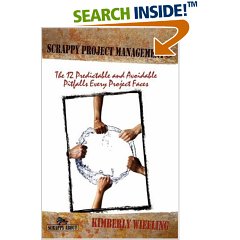 Kim Wiefling is a scrappy project manager - no doubt about it. Whether you're listening to a voice mail from her, reading an email she sent, or browsing through her book. She's the kind of person that calls it like it is - and that's what I like about her book, Scrappy Project Management. Kim Wiefling is a scrappy project manager - no doubt about it. Whether you're listening to a voice mail from her, reading an email she sent, or browsing through her book. She's the kind of person that calls it like it is - and that's what I like about her book, Scrappy Project Management.It's not about templates or process (not that I have anything against those). Each chapter focuses on a rookie mistake that every new PM makes before they have enough experience to set them straight. Here's a list of the chapter titles:
I know, I know - but it's worth a shot... |
Posted on: May 12, 2008 05:17 PM
| Permalink |
Comments (1)
What Really Makes You a Leader?
| Situation: You're in a mood to Show off your leadership skills... There are LOTS of great discussions happening right now in the new Leadership GIG. As a part of that, I thought it would be interesting to get your opinion on what is the most important predictor of leadership potential. If you have a moment now, just click on the graphic below to tell everyone what you think. 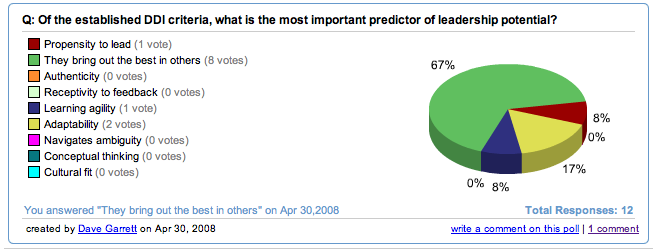 |
Posted on: May 12, 2008 11:42 AM
| Permalink |
Comments (6)
Straw Polls on gantthead
Situation: Staying "off the poll" is the least of your worries. Ever wonder what people think about a given PM topic? Now you can create a poll and find out! Of if you are just in a mood to express your opinion take an open poll and let everyone know you you feel. Ever wonder what people think about a given PM topic? Now you can create a poll and find out! Of if you are just in a mood to express your opinion take an open poll and let everyone know you you feel. Here's a great example of a poll in progress: Q: When you are trying to create incentives to promote teamwork, what is the most important question you could ask yourself? I like to think people will use these for settling heated project management disputes, research for articles, and just to have fun. Remember, participating in polls increases your headcount - so vote early and vote often! |
Posted on: May 05, 2008 07:56 PM
| Permalink |
Comments (0)


