


Managing An Entire PORTFOLIO of Requirements


Situation: You Have a Need (perhaps an ITSM push?) for Highly Integrated Change Management. MKS Integrity helps you manage software development at every level of the process, even giving you a portfolio view of what's going on based what's really happening on the ground at the task level on all portfolio projects. IT Service Management is still very hot across the industry right now and software like the MKS toolset plays a huge role in supporting those efforts. Recently, Doug Akers, Tactical Product Manager for MKS spent some time with us answering some questions about the tool and what makes it unique. As will most tools, it is broadly applicable across IT and gets a lot of traction in engineering organizations who are delivering many similar products - industries like Telecommunications, automotive, medical devices, and embedded systems. MKS Integrity helps you manage software development at every level of the process, even giving you a portfolio view of what's going on based what's really happening on the ground at the task level on all portfolio projects. IT Service Management is still very hot across the industry right now and software like the MKS toolset plays a huge role in supporting those efforts. Recently, Doug Akers, Tactical Product Manager for MKS spent some time with us answering some questions about the tool and what makes it unique. As will most tools, it is broadly applicable across IT and gets a lot of traction in engineering organizations who are delivering many similar products - industries like Telecommunications, automotive, medical devices, and embedded systems. Q. What differentiates MKS from other requirements management software vendors? Less in terms of technical features, but what do customers say they like better about it? Customers, in my experience, tend to like the connected nature of the MKS Integrity solution and the fact that everything is right there at their fingertips. There is a huge difference between integrations and a truly integrated solution and I think the demands of visibility, transparency and communication that fall out of our solution are proving to be differentiators for our customers and their ability to deliver projects on time. An integrated offering is still many tools, and users have to weed through the complexity of those tools while with MKS Integrity, it’s all one platform, one interface, one way of working. Test management, source control and requirements management all use the same platform capabilities and all benefit from the versioning, reuse, change management and process control that is part of that platform. Q. Tell us about the “unified approach” to requirements management. Traditionally, the tools across the application lifecycle have been very siloed, very purpose built – you have your RM tools, your versioning tools, your testing tools – and although these tools work for their discipline they also put up barriers to collaboration, optimization and the ability of the organization to be productive. There is tremendous benefit to the developer when they can easily click up the tree to see the requirements driving their tasks – it gives them context for their work and allows them to deliver more optimal solutions that meet the business needs. You can’t get that in a siloed world and you can’t get that easily with traceability alone, which is a commodity feature in today’s RM market. A unified ALM platform that addresses RM, as MKS Integrity does, enhances traceability with concepts like transparency and visibility at all levels of the organization. The unified approach gives you a lot of free stuff too that maybe weren’t high on your list. Single administration, single security, integrated process across groups………… Q. “Reuse” is a hot topic lately. How are project documents and code reused using MKS Integrity for RM? How is that different from competitive tools? Reuse is a widely abused term, what does it really mean in practice? I mean, open Microsoft Word and copy/paste a paragraph from one document into another, is that reuse? Some competitive tools would try to tell you it is. MKS, as a company, has a very strong foundation in the software configuration management arena – MKS Integrity has been doing version control and configuration management for more than 20 years. All we did to address the needs of our customers was apply those concepts to the RM space – we’re treating a requirement the way we treat source code though with a business user interface. Requirements are truly versioned, branched and shared across projects, across documents, across the organization and their genealogy is preserved and leveraged. It’s real reuse, not just copy and paste. Q. How do users connect requirements and other life-cycle artifacts such as test cases, defects, release definitions, UML or design models, etc.? How does that compare to establishing relationships between requirements? MKS Integrity, to over simplify things, tracks items and has relationships between these items. It doesn’t matter whether these items are test cases, defects, requirements or source code objects they all benefit and leverage the same set of platform capabilities. Traceability is a fancy term for connecting artifacts across the application lifecycle. In the MKS solution, making those connections between requirements or to artifacts in other disciplines is a simple drag and drop gesture if the system doesn’t already take care of it for you, which in many cases it does. Q. What words of advice would you give to someone struggling with requirements management issues? Don’t eat the elephant all at once… but know that you have an elephant to eat. There are several RM issues that I find within the organizations I talk to – anything from not being able to effectively capture requirements, not being able to know when things change, to not being able to leverage the investments they do make in good requirements – and underlying all of them is process. Process is not a tool dependent thing, it’s a business dependent problem and you will want a tool that can enforce your process rather than a process that conforms to the limitations of a tool. |
Posted on: February 09, 2008 09:18 AM
| Permalink |
Comments (2)
Task Manage Yourself
Categories:
Personal Productivity
Categories: Personal Productivity
Situation: You Need a Simple Tweak to Help Organize Your Day...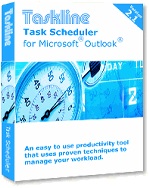 I saw this one reviewed on C-NET. Sometimes you have so many things on your "to-do" list that you finish one item and have to sit for a bit running through the rest of your list wondering puzzling through what to do next. Taskline is a simple Outlook add-in that helps you organize your tasks and reminders into a list that pretty much surfaces "here's what you do next". I saw this one reviewed on C-NET. Sometimes you have so many things on your "to-do" list that you finish one item and have to sit for a bit running through the rest of your list wondering puzzling through what to do next. Taskline is a simple Outlook add-in that helps you organize your tasks and reminders into a list that pretty much surfaces "here's what you do next". |
Posted on: February 09, 2008 08:47 AM
| Permalink |
Comments (0)
A Simple Extranet to Use With Clients
| Situation: You Need a Very Simple Shared Workspace for Quick Documentation-intensive Projects Comindwork is yet another simple SaaS "project management" program. It allows you to manage requirements and issues in a fairly simple environment. It's also a centralized location to store documents or collaboratively create wikis related to your work. Documents can be versioned. There is also a blog capability  There is no gantt or pert charting. so it's not the greatest tool for visualizing anything beyond the most simple efforts. It makes a lot of PMs nervous to see how the terms "project" and "project management" are being thrown around these days related to just about any simple set of tasks. However, many projects are very important and very simple at the same time - and a structured approach is always a god idea. There is no gantt or pert charting. so it's not the greatest tool for visualizing anything beyond the most simple efforts. It makes a lot of PMs nervous to see how the terms "project" and "project management" are being thrown around these days related to just about any simple set of tasks. However, many projects are very important and very simple at the same time - and a structured approach is always a god idea. |
Posted on: January 30, 2008 10:38 PM
| Permalink |
Comments (1)
Translations, Site Copying, and Virtual Copy/Paste
| Situation: You're curious about some of the latest Web 2.0 Gadgets... I've heard so very many people say, "it's the little things that count". So here are a few gadgets that do some interesting "little things". Easily make web sites available offline WebMynd is a service that records all of the sites you search to your hard drive, making them quickly available and available offline. So if you have a lot of online reading to do and have to catch a plane - this could be really useful. More details are avialable in this TechCrunch posting. Translate text from a foreign language The world still keeps getting smaller every day. So more of your business contacts probably speak other languages. Microsoft Windows Live has recently released a translator similar to Google Translate and Altavista's BabelFish. You can paste in some text or just point them at a web page and tada! - a fairly readable translation will pop out of the other end. Keep everything you ever cut and pasted For you data packrats out there, ControlC links up with your clipboard and maintains an encrypted online copy  of everything you "Ctrl+C" for later use. The idea is that its an easy way not just to keep things "just in case", but also a great way to bookmark specific content that you want to point others to - say through a link in an email. of everything you "Ctrl+C" for later use. The idea is that its an easy way not just to keep things "just in case", but also a great way to bookmark specific content that you want to point others to - say through a link in an email.So there you go - mildly interesting online tools. Hopefully there's something here you can use. |
Posted on: January 30, 2008 04:48 PM
| Permalink |
Comments (2)
IT Leaders Love Gantthead!
Categories:
Web-based Tools
Categories: Web-based Tools
| Situation: You love gantthead as much as George does... One of your fellow gantthead's gave us a nice little press hit this morning. In his IT Week Leader Profile, George Henderson listed gantthead as one of his favorite business sites. He also says some interesting things about challenging the status quo and going green. I love seeing this sort thing - so I thought I'd share. |
Posted on: January 22, 2008 10:18 AM
| Permalink |
Comments (0)


