


How Should You Tell Your Story?


| Situation: A "story" would really help your cause, but you're not quite sure how to make it work.
First establish a purpose... Why are you telling a story? (a few possibilities)
Choosing a story to tell
Is this your story?
Is this their story?
Is this story right for now?
Will anyone care or remember it?
I think that the points above are critical when picking a story to tell and thinking it through. If you would like to go a bit deeper - tuning your story and rating your delivery of it, check out our new Project Management Story Telling Checklist. Happy story-telling! |

Who do I have to please?
Categories:
Advice
Categories: Advice
| Situation: Every problem can make you feel like you have to please a thousand different people who all want different things. However, the problem isn’t only “who do I please?” It is also, “which needs are truly important?”
Warning Signs
What will happen if I do nothing? Trying to please everyone means that you will end up pleasing no one. This is how a lot of folks lose their jobs or get moved to a position that doesn’t require managing people. Solution You need a clear set of goals and a real understanding of how everyone’s needs affect what you’re doing. In short, you need:
What should I do? When you don’t know who to please, you need to identify a sponsor as the one person you need to please most. Then, you need to develop a scope document, which essen- tially outlines how you will please that person and accomplish something really valuable to the organization. There are two sets of people you need to be concerned with when managing a project: sponsors and stakeholders. The sponsor is the one you ultimately answer to. He or she should work with you to define “success” in a way that also pleases stakeholders. the new application. Tons of effort would need to be spent beyond the application itself, but the efforts needed to be done to make everything work together. It was clear to Susie that none of the additional needs could be addressed without causing massive delays and increased costs to the project. Rather than send the email she had composed in her head, telling everyone to forget their needs and wants, Susie took a deep breath and tried to figure out what to do next.
Focusing Your Efforts 5(a) Sponsor Gather what you have in terms of goals and support materials, and make sure you have the best description of what the project aims to do before looking for a spon- sor. Then identify your sponsor “candidates.” In this context, the best sponsor will most likely be someone you know or at least know of. It may or may not be the person to whom you’ve been reporting status. Think about:
To identify a sponsor, think about these questions:
The sponsor is a “buck stops here” person. He or she is a business leader within the organization who:
Think about the first three bullet points for a moment. Someone in the business above you has likely committed to executive management that your project will be a success. His or her reputation probably depends on it. You just need to make the sponsorship role clear and official, so that there is a single person (or small group) that can define success and resolve conflicts. Once the right person has agreed to be your sponsor, work with them to identify stakeholders and plan to address their needs. Also, work with them to set and document the project scope. 5(b) Stakeholders The project’s stakeholders are probably all of the people who have been asking you for things. They have a vested interest in the project, and would like to make their priorities yours. This isn’t a bad thing, but you can’t please everyone. Identify and group stakeholders with the help of your sponsor. Understand whose needs you can and cannot serve, which needs are incompatible with each other, and any conflicts those needs may present. To understand what you are dealing with, you want to first separate stakeholders into groups. Ask yourself, are stakeholders:
Grouping stakeholders will give you a better idea of what you are dealing with. You can’t give people everything that they want, but hopefully you can give them what they need by working with the sponsor to create an effective scope document. 5(c) Scope document Then you will work with your sponsor to create a scope document. The scope document defines what you are doing and NOT doing. At a minimum, it defines:
The scope document can include other items and take various forms. Often, it is a business case or project charter, but the important part is that your participating in the project is documented, agreed upon, and reflective of the sponsor’s definition of success. |
 (This is a partial chapter excerpt from the book,
Are You a Good Boss?
Categories:
Management Approaches
Categories: Management Approaches
| Situation: You want a way to verify what you already know is true.
Do any of these describe you?
Not all bosses are created equal, however, and there are certain trends that make for better bosses. Forty years of combined experience – one of us with 35 as a professional management consultant and the other with 5 as a fresh and reflective worker – have uncovered prime examples of good bosses. To enlighten the modern workplace and workforce, here are five examples of good bosses (and they are not mutually exclusive): 2) The Empowerer – a boss that lets employees run their own show and lets them learn by making some mistakes. To a degree of trust and support, this boss cultivates leadership in their team. Working together, they identify tasks and create a plan, but let the employees decide the nuts & bolts of how it actually gets done. The Empowerer doesn’t delegate aimlessly, creating a sense of subordination in their team, but rather engages their employees from the ground up in a focused manner. Employees are inspired to take on leadership roles and collaborate both with their boss and with others. The Empowerer is a good boss because they can simultaneously ignite productivity, personal development, and satisfaction among their employees. 3) The Mentor – a boss that teaches, coaches and guides. This boss doesn’t necessarily need to be older, but a tad wiser or simply just willing to share. They seek to understand their employees’ experiences and identify which ones need or want mentoring. The relationship with their employees is constructive, meaning both criticism and praise are offered with the intentions of growing the employees set of skills. An offer to mentor is either explicitly offered or subtly developed over time. The goal is both in current interest and looking towards the future, always geared to enhance the employees’ skills. The Mentor is a good boss because they ensure a future for the employee and the company while inspiring immediate productivity and engagement. 4) The Cool Dude (or Dudette) – a boss that has fun and lets their employees have fun. This boss maintains a certain aura of authority while creating a likeable and lively atmosphere. They let their employees enjoy their time at work and find time for small diversions, within the confines that the job still gets done…and done well. At those instances, this boss rewards their employees with time off or special workplace events within the realm of a respectable workplace culture. The Cool Dude or Dudette is a good boss because they understand that all employees are people, that all people need some kind of fun, and that happy employees are healthy, productive, and engaged.
5) The Creator – a boss who inspires invention and creativity. This boss pushes the limits of their employees to ignite innovation. They challenge intellect and question the status quo, so that new products and ideas are developed from within. The Creator embodies the spirit of imagination and is never overly demanding. Creativity and invention come from a unique mindset, so this boss correctly identifies those in their team that are keen to this way of thinking. As such, The Creator is a good boss because they are motivational and collaborative. |
 Jim Finkelstein recently wrote a book entitled "
How many Project Managers are in the US and Canada?
Categories:
Research
Categories: Research
|
Situation: You love obscure facts about Project Management.
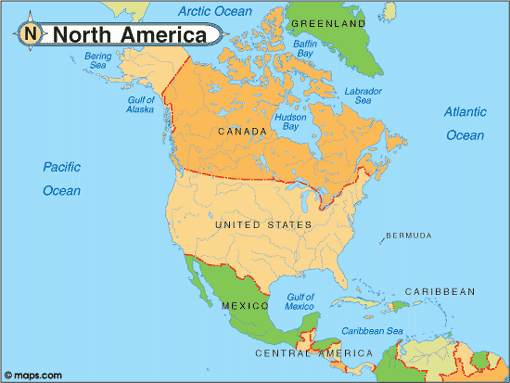
Oddly enough, we get asked this a lot. However there aren't a lot of good numbers to go by. PMI estimates that there 16.5 million Project Managers in the world. Both PMI and Gantthead have relationships with a bit more than 600K each, with roughly a 13% overlap. 66.8% of PMI members are based in North America. 53.9% of gantthead members are based in North America. So that implies that there may be 8.7M-11M Project Managers in North America. Of course, these percentages shrink every year as the industry (and everything else in the world) becomes more global - but that's our "guesstimate". |
The most important part of my job as a Project Manager is ...
Categories:
Personal Productivity
Categories: Personal Productivity
| Situation: You're curious about what your peers put at the top of the priority list. Sometimes we post fill-in-the-blank questions to our facebook fan page. People have fun with them and sometimes the answers can be telling. A recent posting asked facebook fans to say what the most important part of their job is. I thought it was interesting that 12 of the 38 responses directly mentioned communication as most important. Many of the other common management issues came through, but none quite so strongly. I wonder if that's because we really feel that way (and there is a lot of support for this) or whether communications is such a hot topic at the moment in our field. Here are the results...
|




