


Managing Your Most Important Project


| Situation: You'd like to manage you life as well as you manage your projects.
I met Joseph Phillips a couple of years ago. He's a PM trainer and author that has an unusual passion for everything
Q. In the book you open with a chapter describing how you came up with your "lifelong project" concept. Could you tell us a bit about that here? When the concept of The Lifelong Project dawned on me achieving goals was the farthest thing from my mind. I was at one of the lowest points of my life and having fleeting thoughts of ending it all. I was wrestling with the life I’d created and the life I really wanted. I reasoned that if all I had was project management then I’d make project management work for me. I took what I knew on project management, created some lofty goals, and then addressed each goal like a requirement in my project. In one year I went from the misery of self-defeat to experiencing some incredible joy and momentum in my life.
Q. Can you tell us a bit about others who have benefitted from reading it? I’ve presented The Lifelong Project for PMI chapters, churches, and other groups around the world. I’ve met many men and women who’ve told me, sometimes in tears, that they were considering suicide. Each promised me that what I shared convinced them to try life anew. While I don’t claim to be any guru I’m humbled and thrilled to have said something to connect with these people. I’ve also heard from readers that have shared their goals of weight loss, changing careers, returning to school, and renewing a passion for life.
Of all the people that may ever read The Lifelong Project I’m always the person who needs it the most. I wrote this book with myself in mind, but do believe that if I can do it then others can too. It’s been an incredible blessing and joyful experience to see people reading the book, to hear from participants, and to share my vision with others.
Q. Many people object to the structure that PM approaches lend to actual projects in our work lives. I would think that at least as many people would say the same about applying PM to the lives. What would you tell someone who feels that way? To use the Lifelong Project concept, to treat the next year of your life as a project, does require some faith in the logic of project management and the joy that’s waiting in your life. If a person willingly doubts the ability to use project management to achieve goals then they’re giving themselves permission to fail. You can’t manage a project while believing that the processes, standards, and approaches of project management won’t work and then be surprised that the project failed. Goals and joy in life work the same way – you must be committed to achieving the goal in order to achieve the goals.
It’s tempting to compartmentalize our lives; to create a work compartment, a family compartment, a career compartment, and more. The truth is, life is what it is. There are no compartments, no separation of work, family, joy, and pain. Life, like project management, is integrated by all of its components. When you have a toothache your tooth may hurt the most but the rest of your body aches too. It’s no different – when you’re miserable in your work it affects your joy, your family, your mental and spiritual well-being.
Q. When planning and executing your life, what would you say is the most applicable aspect of PM? What aspects of PM of translate poorly? Project management is really all about changing: you’re changing the current state to some desired future state. To reach that future state you need to identify the future state in whole, create requirements, create a scope, create a WBS, and so on. In The Lifelong Project I walk readers through the same basic processes. Project management in work or in our personal lives is simply project management – it doesn’t matter if you’re managing an IT project, a construction project, or even a health care project, the principles are the same.
Having said that, what does translate poorly is the unmentioned project management component of accountability. In your career as a project manager you’re accountable to management and customers, while in life there is a looser form of accountability. No one’s going to fire you from your life because you abandon goals, shirk off tasks, or mentally beat yourself up. One characteristic I stress, and have learned by doing, is finding someone to make yourself accountable to in your Lifelong Project. Friends, family members, even a blog are all good approaches to sharing our goals and asking others to keep us accountable to the goals and requirements we’ve created. Accountability is inherent to our careers, but not so much in the choices and decisions we make in our lives.
Q. To me, your book felt like "Covey's Seven Habits" for Project Managers. In other words, if you are familiar with PM concepts, the book helps you apply those concepts to building a better life. Was it your intent to focus on the PM market? What do you see as the differences between your approach and Covey's? First, I’m thrilled to be compared to Steven Covey’s book – it’s a favorite of mine. Because I’ve written so many books and have taught project management for the past decade it was a logical goal to write a book on goal setting for myself and then other project managers. The book isn’t technical to the extent as a traditional project management book, it’s brief and speaks about project management in simple terms so anyone can read it and grasp the concept. When you consider that most people, project managers or not, are working on a project it’s not a stretch for readers that aren’t project managers to apply these principles and propel their life forward.
The primary difference between The Lifelong Project and Covey’s Seven Habits of Highly Effective People is that I’m using the principles of project management to get things done. I stick to the known terms and business logic that we all use to move from concept to creation.
Q. What is the greatest benefit you've seen from applying the approaches outlined in your book? I’ve found joy again. There’s joy in creating and working towards goals and this book has helped me create and achieve goals and rekindle my passion for writing, teaching, and getting involved with life. Since I wrote this book I’ve dropped nearly fifty pounds of weight, ran the Chicago Marathon twice, travelled around Europe, and changed the way I think about myself and others. |
 PM. A couple of months ago he sent me his latest book,
 Are You Stuck?
|
Situation: Your project is a huge change for your organization and you've reached a point where you're faced with a serious challenge.
Q. I guess we are all familiar with the feeling of a project we are responsible for getting “stuck” but what does “stuckness” mean to you? A change initiative becomes stuck when it loses direction and/or momentum towards its intended result and there is no viable mitigation plan in place. “Stuckness” is a normal phenomenon that occurs on a frequent basis during all major change initiatives, regardless of the implementation approach used.From time to time, even the most accomplished change agents applying the most capable execution methodology not only become stuck, but are unable to find a viable resolution. There is no pejorative associated with being stuck, provided the blockage is addressed in a timely manner. Becoming unstuck involves recognizing when progress has stopped or is in jeopardy, correctly diagnosing what the contributing factors are, and engaging the proper mitigating actions so progress can once again take place.
You’re right. Change management, in the sense that we talk about it––orchestrating the human landscape around large-scale initiatives––is typically undervalued and underutilized. Our firm tends to deal with the more complex endeavors, the sort that are transformational for a company. Projects of this nature have many moving parts. Even well-meaning team leaders get overwhelmed with the immediate challenges and often believe that they can address the human side of change later. We worked recently with a major corporation that was three years into an SAP implementation and six months away from going live. It was then that things began to fall apart. People weren’t prepared for the SAP express train that was coming at them at full speed. Several factors were hitting all at once. No one had looked at the organization’s true capacity to absorb this set of changes along with the array of other major shifts that were taking place. In addition, the leaders were no longer aligned on what the change meant for their business, if they ever, in fact, were. Although things began to visibly unravel only a few months before we were called in, the underlying symptoms of an implementation disaster had been brewing for a long time. It was stuckness three years in the making. Or, take another example. A few years ago we worked with a hospital system that planned to open a new intensive care unit (ICU). It incorporated many new ideas in health care––how nurses monitored patients, how care givers worked as teams and how the family was involved. The design and construction took years. Throughout the process there was little attention given to––and no inclusion of—the nursing staff. Less than ninety days from the planned opening, the nurses raised their concerns for patient health in such a new model. The declared their belief that the unit would not open on time and that if it did, they would not work there. Both of these had good outcomes after we helped to create the proper interventions, but neither situation needed to become as problematic as it did. The common elements in both were implementation teams that were very focused on the technical aspects (hardware, software, construction, and so forth) and who were not paying attention to the fact that for the intended outcomes to take hold, certain key people needed to change. Most situations brought to us are like these two examples, they are about getting unstuck. Only about 30% of the time we are engaged early and work with implementation teams to properly navigate the change process and avoid getting stuck. This doesn’t mean that they avoid risk or challenges. There is no major change without risk. These teams are prepared for and anticipate most of the problems. They act quickly and avoid getting stuck for extensive periods. The greater portion of our work is with teams and initiatives that have been stuck for some time. As far as being stuck serving as a motivator, unfortunately, in some respects, it is. Remember, it happens to even the most seasoned change practitioners. The issue isn’t about getting stuck. To some degree, stuckness occurs every day. The point is what takes place when progress is in jeopardy. The most important thing is to recognize risks early and to do something about them. We have a saying in managing change that when it comes to declaring status, “red is good”. This is counter-cultural in most organizations. People typically treat red as bad and don’t want to report their projects as having problems. This is how you get three years into an SAP implementation and then hit a wall. A “red is good” culture is one where problems are expected and the motivation is to address them as quickly as possible. In this way stuckness doesn’t have to get to a critical level before anyone will ask for help––being stuck at any level is a reason to reach out.
A. There is a stuckness that everybody reading this will have experienced. It is the most common stuck of all. It’s called getting started. Every project leader has been there. The Irish writer George Bernard Shaw said, “take care to be born well” and it applies to projects as well as people. The project lead that rushes or is too casual about start up will always regret it later. Getting the right elements in the plan and the right people on the team is how you avoid being stuck later. How many projects do you see that have one or more false starts? Another common sticking point is the alignment of the senior team. The enthusiasm to get started often masks the absence of true clarity about what the change really means. Sometimes it’s not just enthusiasm but a desire to avoid conflict. There is no substitute for getting the right leaders in a room and ensuring that they are clear and aligned on what the change is and what it will really take to accomplished the intended outcomes. This dialog should address the reason for change, the desired state in the future, how success will be determined and some principles that will guide the change. If the senior team is aligned on these, then the change will proceed more smoothly. Finally, groups and individuals have a finite capacity for change. Many times that upper limit is far greater than anyone imagined. Nonetheless, there are limits to how much disruption people can absorb at any one time. Unfortunately, many organizations act like they can add change on top of change and it will all take hold. Often those driving the change are unaware of all of the other demands being placed on people. This is a dangerous sticking point in that it is usually thought that the change being implemented was the problem when in reality, it was the aggregate of all the projects hitting at once. There are many ways of addressing an organization’s remaining capacity for change, but a simple one is just recognizing and mapping the integration points between the different projects and how many people are at ground zero for multiple initiatives.
There are no easy sticking points. That’s why we call it stuckness––it means key aspects of the implementation process aren’t progressing as they should. For that to be true, something important is blocked. Now, that said, there are some blockage points you’d prefer to have if you had to be stuck on something. Not having enough resilient people to staff an important change is not an easy fix, but one that is manageable––train the people you have in how to strengthen their preexisting resilience and/or hire people that are highly resilient to start with. Another one is learning to address the debilitating disenchantment that many people suffer when a change is harder to accomplish than they expected. Teaching people that during significant change, “uninformed optimism” always precedes “informed pessimism” is not an overly difficult task. Once this is done, they usually feel more self confident knowing that it’s normal for people to feel some degree of “buyer’s remorse” after the honeymoon is over and the implementation process gets into the really hard stuff.
Some of the more challenging reasons why projects become stuck include: leaders who say they want dramatic change but are unwilling or unable to apply the resolve, resources, and/or commitment needed to achieve their stated objectives, or endeavors where long-standing cultural norms run counter to what is needed to fully execute the change. As far as when outside resources should be called on for help…that one is easy. Don’t look beyond the boundaries of your own organization if you have the knowledge, skill and experience to handle the challenges with internal resources. So, the issue is how difficult will it be to unstick your project once it has lost direction and/or momentum, and do you have the people on the inside who can adequately address that level of challenge? This may sound simple enough but many leaders underestimate the degree of implementation difficulty their projects entail. To keep it simple, I’ll offer three questions that can be used to assess the challenge involved in executing an initiative. • How much change does the initiative represent? (Is it incremental or transformation in its intent?) • What kind of fulfillment must be reached to deliver on the promises made? (Can you get by with merely installing the change or do you have to fully realize whatever promises were made?) • How crucial is the success of this initiative relative to all the other major initiatives in place or planned? (Is it a good idea that this project succeeds or is it a business imperative?) To the degree an initiative is transformational in nature, it must be fully realized and is a business imperative, it will be essential that the leaders and their change agents have the highest level of change-related knowledge, skill and experience. If inside personnel don’t possess the capabilities required, either call on outside resources or accept that the intended outcomes will be less than promised.
There have been many. The longer you have been doing this work, the more sticky situations you accumulate. One that comes to mind is some work with a senior team. It was a seasoned and battle hardened group. In their history they had navigated many changes, and yet found themselves faced with one that dwarfed all that had come before. They literally were faced with reinventing their company. What they failed to see was that it also required them to reinvent themselves. They understood intellectually, but when faced with choices they needed to make, consistently they failed to make them. I tried every tool that thirty-five plus years of practice has equipped me with. I went so far as to declare to the leader that I did not have what it required to shift them. I was in the rare situation of having him ask me to stick with it. The breakthrough came in two meetings with them. At the first meeting, we were willing to be vulnerable enough to put our failings on the table and discuss them openly. It helped that I went first. The second meeting was an exploration of what we were each willing to do about it. A colleague of mine who was with me at this time describes it with the phrase "the darkest time is just before the dawn". That was precisely the experience. Getting past this stuck moment unleashed an energy and a willingness to embrace the change. This illustrates the positive role that being stuck plays. Sometimes, it feels like being stuck is needed to breakthrough to the next level of performance. This is another reason why it cannot be ignored or even taken lightly.
Q. Can you give us a general approach to getting "unstuck"? Is there a process people can follow? (aspects of the problem they can look at, etc.) There is a generic model. The subject is the situation that you find yourself in at any point. The process starts with identification, then interpretation, then planning and finally influence. It is a cycle, as you continue to observe to see if the intervention had the desired effect. We call this model the Intervention Sequence. Key to the model is a set of lenses that are used in observation and interpretation. These lenses highlight the most common sticking points. There are numerous lenses that may be of value. For example, it may help to look through a lens of the roles that people should be playing in the process, or a lens to determine the alignment of the leadership team, etc. At the event later this month I will apply this approach with two practitioners in real situations. They both have strategic initiatives and they have real challenges. They are stuck. It will be enlightening and, I expect, entertaining to everyone who is attending. I hope that many of your readers will have a chance to join me for it.
Want to hear more? Sign up for Daryl's webinar on getting "unstuck". |

MS Project 2010 - Will You Upgrade?
| Situation: You are on The Fence about the New Version of MS Project.
I have to admit, when I first began looking at the new version of Project, I expected a number of new features that I am most excited about the flexibility that has been built into the tool. Until now, the typical new PM went through a cycle that looked like this. They had MS Project 2007 and Excel. They tried MS Project, but found the contraints it imposes (task/subtask relationships, effort, etc.) made the process of creating a schedule too complex. More specifically, MS Project was telling them what they were doing wrong by not allowing them to do the wrong thing - really just alluding to a problem without being specific or telling them what to do about it. For example, a summary task would just be composed of the durations of the tasks below them. You couldn't enter in a value for the summary task that disagreed with what you had entered below. Often, PMs would just get turned off and use Excel - which places no contraints on anything because its not a project management tool. The new version of MS Project allows to you to actually make mistakes, tells you what is wrong, then offers ways to fix the schedule. This is a HUGE leap forward. There are a lot of reasons to check out this new version: - Better integration with the rest of Office (as you would expect) - Sharepoint Syncing - etc. Probably the best way to explore the whole thing is to attend the MS Office Product Launch online on 5/12. Once you attend the event, please come back here and let me know what you thought. |

Have You Considered Adoption? (of Project Management Tools)
| Situation: You feel challenged by user adoption of PM tools. User adoption is one of the toughest challenges related to PM and PPM software. Users “live” in email, MS Word, etc. and  will only use other applications if there is some sort of carrot and/or stick involved. The folks at Clarizen feel that they have developed some unique angles on user adoption and introduced me to one of their customers. Jim Herries, Program Manager, Business Products at ESRI, to find out more. will only use other applications if there is some sort of carrot and/or stick involved. The folks at Clarizen feel that they have developed some unique angles on user adoption and introduced me to one of their customers. Jim Herries, Program Manager, Business Products at ESRI, to find out more. Q. Prior to your most recent implementation, what were your experiences with PM software adoption? Prior to Clarizen, we used Microsoft Project but team adoption was not sufficient enough to meet the demands and expectations we set on our company and products. Our team consists of 50 people across eleven cities and thirteen time zones – without constant guidance and monitoring, it was difficult to communicate effectively between teams to meet deadlines and deliver products on time. Microsoft Project limited our team’s potential – even the most effective project manager can spend time and resources on creating a plan and, for various reasons, fall victim to not executing the plan effectively and efficiently. Clarizen’s focus on execution won us over – the features and functionality that the solution provides ensures that our teams followed the plans that they spend time creating. Q. What were some negative lessons learned from those experiences? (“I’ll never do that again” sort of stuff) We frequently saw the project plan fall behind reality, and reality had this annoying habit of winning out over the project plan every time. We saw the project plan become outdated, despite all the planning and best efforts of the contributors. Weekly status meetings could take an inordinate amount of time rehashing decisions already made but not reflected in the plan. Stakeholders could become disillusioned with the entire project management process and begin to see it as an enemy to progress.
1. Choose a solution that does not require extensive training. Employees are already set in their ways and comfortable with past methods of planning and working on a project, even if the methods are not effective. By implementing a solution that is user-intuitive and easy to understand, team members are more willing to exchange their old tricks for better solutions that save time and resources. Online demos, tours and resources for training, that are insightful to the everyday user, are also helpful if a project leader is not available to train an entire team. 2. Choose solutions that integrate with everyday tools. Clarizen’s integration with Microsoft Outlook, for instance, ensures that team members who are hesitant to use the new solution will jump right in because it is a comfortable medium. Our teams and various project constituents receive email updates pertaining to their activities, and with multiple projects going on simultaneously among team members in offices across the country, this feature facilitates clear communication on deliverables and deadlines without overwhelming the team with unnecessary details. 3. Choose Software-as-a-Service (SaaS) solutions because it is constantly available from any web browser, allowing project managers and leads to communicate, update, add tasks, etc., from anywhere in the world. This reliability for on-demand and real time updates becomes critical to day-to-day activities and long term success. Clarizen’s “Roadmap” feature allows PMs to easily monitor the status of the project with a real-time view of where items stand, behind or ahead of schedule. This allows us to be nimble and alter the plan as needed. By inputting and tracking the milestones of each phase of the project in the Roadmap, our team is keenly focused on each step, helping create and follow a meaningful plan. Q. If you were to offer one specific approach or technique to help with PM software adoption, what would it be? (going through it step by step would be great) It is difficult to shift a team’s mindset when first implementing a solution – team members must receive explanations about how the software will make their lives easier by enabling communication and task completion accountability. As our team started using Clarizen, we no longer needed to spend time convincing people of the benefits because they became apparent. Ensuring internal executive sponsorship is fundamental to succeed but just as important is grassroots adoption and end-user buy-in. Prior to making the go-ahead decision, having more end users involved increases adoption and commitment from the extended team. As a program manager, I have told people that if I see their concerns reflected in the plan, I will back them publicly. If they choose to run their part of the overall project without benefit of the project plan, then they are expected to be on time, on budget, no issues, no excuses. The point is that we use the software to surface and address issues. Q. How did the Clarizen software suite facilitate better user adoption? Was it more about the software’s functionality or your approach to implementing it? Clarizen is intuitive to our user needs and this eased the process of getting our team up to speed on the solution. Since February 2009 when our software development team started using Clarizen, our level of team effectiveness has improved drastically. Now PMs structure meetings around Clarizen, which helps them remain focused on primary issues and not get sidetracked by updating status items. This level of focus and efficiency alone has reduced time, money and resources spent on a project, ultimately encouraging company-wide adoption. Particularly, the PMs benefit from the scalability of the interface, allowing them to see issues and delays in schedule in a matter of seconds. This level of accountability has improved meetings exponentially and resulted in more meaningful discussions about the status and progress of a project. Because we are able to focus less on updating the team and more on developing products, we are hitting all our release dates. Subsequently, the team is pleased and clearly working more efficiently because the projects are going much better overall. Even those who were skeptical about using the tool at first are now eager to use it. |
Do Your IT Projects Produce?
Situation: You deal with highly repeatable processes and new components in most project cycles.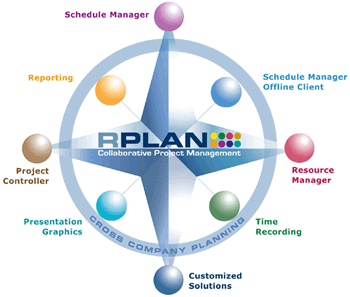 RPlan is a project management tool which is very popular in automotive manufacturing, with clients such as GM, Daimler, VW, AUDI, Porsche, BMW, Renault, Getrag-Ford, Airbus, Rolls-Royce and more. The tool is designed to address a variety of challenges common both project and product management. These days automotive projects involve a lot of IT and IT projects are often faced as product development efforts. So I thought it would be a good idea to speak with Actano's CEO, Thomas Salva to understand what makes their tool set special and why those differentiators are important in the IT space. RPlan is a project management tool which is very popular in automotive manufacturing, with clients such as GM, Daimler, VW, AUDI, Porsche, BMW, Renault, Getrag-Ford, Airbus, Rolls-Royce and more. The tool is designed to address a variety of challenges common both project and product management. These days automotive projects involve a lot of IT and IT projects are often faced as product development efforts. So I thought it would be a good idea to speak with Actano's CEO, Thomas Salva to understand what makes their tool set special and why those differentiators are important in the IT space.Q. How is project management different in a product-focused environment? How do project and product management work together most effectively? In a product-focused environment projects are not and can not be treated as a “unique endeavors,” but must follow standard processes to make the most of scarce resources. A defined development process, that comprehends the characteristics of the product, the organization that will execute the projects, and the program management processes and control points, is essential. RPlan provides standard structures and templates that provide the consistent and efficient basis for project planning, and allow the project manager to focus on the aspects of the product that make it unique to the market. One major difference in product focused environment like automotive vehicle development is the need to coordinate component planning. In a "new" vehicle design there are components to be developed "from scratch", carryover from vehicles in production and components in various stages of development. The last of which is complicated to manage, due to their interdependence with the "new" components, often so-called lead vehicles are delayed or canceled entirely. This causes “Sturm und Drang”, i.e. the need to seek scheduling alternatives to still meet launch dates. RPlan supports this process with “what-if” scenarios and their ramifications. A very high degree of collaboration is required between project and product management to insure that the corporate goals for part commonality, vehicle launch dates and costs are adhered to, while providing a successful product to the market. RPlan provides the global, web based platform to manage the complex schedule interdependencies via SynchroLinks (task/resource interlinking across projects and programs) combined with resource loading, leveling and costs. Q. Most of RPlan’s clients are global. What are the top 3 things to be mindful of when working with large distributed teams? What can be automated? What needs to managed via human interaction? Cultural differences, e.g. in terms of how concrete a schedule actually is. Differing priorities/goals between the global and regional organizations that must be harmonized if global PD is to function effectively and lastly language barriers, e.g. terminology must be uniform so that all partners truly have the same understanding for each English term, when it’s translated back into their native tongue. Reports can be automated, typically there is a set of standard metrics that management requires weekly reports on (e.g. baseline budget $/Euros, effort and timeline vs. actuals). This is capability that RPlan provides out-of-the-box via integrated Crystal Reports. Human interaction is required in resolving scheduling conflicts. Here RPlan provides multiple means of communicating a delay to the stakeholders, including a link directly to the schedules/tasks/resources involved and "what-if" capabilities to provide options to remedy the situation. Q. What are the focus of project presentations in the automotive industry? What do they always include? Are they fairly standardized or very unique to the project that you are working on? Project presentation for complex programs such as automotive development can vary widely, but general focus on either overall project status or the status of key project metrics. Communication of the project schedule is a critical need, as program team members are typically balancing resources across multiple projects. RPlan provides the capability to generate project timelines directly into Microsoft PowerPoint. Standard formats provide consistent communication, with the ability to annotate and draw focus to areas requiring attention. Project managers also need the ability to dive into the detail supporting the overall status. The supporting information must be organized in such a way that the metrics supporting the key control points defined in the product development process are easily identifiable. RPlan provides the ability to manage all the information and to create presentation reports that integrate the key cost, schedule and resource metrics. Q. RPlan has been very effective in the automotive industry, based on its strengths in collaboration, project information management, and bottom-up schedule management. How do you see those strengths being applied in the broader IT market? Many of the same requirements carry-over to IT: complex interdependencies of modules and components in SW development, reuse of components across projects, and the need to adhere to standard processes and structures. Typically SW development is now also spread out globally. Several of our customers in automotive are now also using RPlan for their SW development activities (e.g. BMW) Q. If you had to name one key differentiator for the RPlan toolset, what would it be? What makes it special? What does that mean to the organization and people using it? Collaboration! RPlan's architecture, ease of use and flexibility make it ideal for complex, distributed and dynamic project environments where world-wide collaboration of all of the stakeholders is the key to achieving the project goals. Visibility and transparency of project information insure stakeholders always have access to current information, and are working to the same plan. Project team members are able to focus on accomplishing the tasks and objective they own, with a clear line of sight into tasks and issues that impact them. The RPlan product coupled with ACTANO's 20 years of experience in providing project management best practices will insure the customer’s organization reaps the ROI in the shortest time and the users experience a significant productivity gain and less migraines. |


