


Treat People Like Adults? Come on...


|
According to Jmichaele Keller, the CEO of MeetingMatrix International, a communications firm based in Portsmouth, N.H., "When you start treating people like adults, they start acting like it." Keller scrapped his company's employee monitoring system and replaced it with a more flexible approach that gave people more autonomy. "[P]eople have a lot of ability to shape what is going on in their world and not a lot of micromanaging ... There really is no direct tie in an office envrionment between the amount of time spent and the productivity of the individual." I just heard the collective groan from many who think this will lead to chaos. Over the last couple of years I've read dozens of stories that seem to corroborate this approach. Philosophically, it makes sense to me. Anecdotally I've seen it work within my own limited sphere of influence. But time and time again I'm also reading articles about successful companies that are taking this approach and seeing great results. We are now into year five of the current recessionary economic cycle. Most organizations have tightened their collective belts and have asked their employees to work a little harder for the same or a little less. I personally know of people who have agreed to work for less in order to keep their jobs. For many organizations, they have taken (or are taking) steps to optimize the contributions of everyone within the organization. For many, this translates to working longer and longer hours. Although that could be a pretty effective short-term fix, I don't think it's a long-term solution. A few years ago a resignation letter from a rising star at Ryan, a tax services firm based in Dallas, prompted CEO Brint Ryan to take a look at their focus on long hours and lots of face time. "The result: MyRyan, a software package that displays the performance objectives that truly matter for each employee and the team, whether it's revenue targets, 360 review scores, customer service ratings, or other things," writes Lewis. "Ryan employees no longer need to account for their time—as with MeetingMatrix, staffers can take unlimited paid vacation and sick days." Yeah, you read that right, "unlimited paid vacation and sick days." Even I have to admit that this sounds like it's a policy just begging for abuse, however it doesn't seem to turn out that way. "Voluntary turnover at Ryan decreased to 6.5% from 18.5%, and involuntary turnover (in other words, firing poor performers) increased to 6.9% from 4.3%. Despite the recession, the firm posted record profits and revenue in both 2009 and 2010," writes Lewis. According to Delta Emerson, a senior vice president at Ryan, "In the past, somebody who was putting in a ton of hours could be performing poorly, but the hours would carry them. That no longer happens." I'm not suggesting that this will work for every organization, in fact I look at this and see a trend pointing to giving team members more autonomy and less of a mandate to give people unlimited PTO. In fact, I whole-heartedly agree that if we treat people like adults they will act that way. Micromanaging the process does nothing but create frustrated team members who hate the project management process, don't take ownership of their work and over-burdened project managers who aren't able to successfully execute their projects. A more flexible approach to how team members approach their work and metrics that measure performance over hours seems to make sense to me. Have you had any successes in this regard? If your organization takes a more flexible approach, I'd love to hear about it. |

Did You Unplug?
|
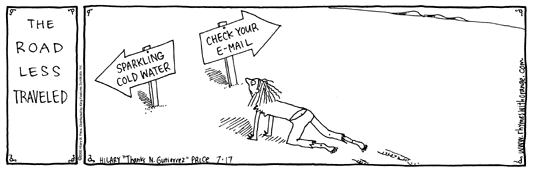
A couple of days ago I wrote about No Email Day. Are you plugged into email today? Have you turned off your email client? I have to admit, when I arrived at the office today, I was giving some serious consideration to avoiding my inbox. However, I couldn't help myself and had to check. I read a few emails and decided that I would read my inbound mail, but not use email to answer anyone. That lasted for all of about 10 minutes. Needless to say, I hang my head in shame. Although email is 40 years old, we've got to give credit to the designers who came up with it. I did a little research this morning looking for someone to give credit to, but was only able to find the name of Ray Tomlinson. He's credited with originating the idea of the "@" as a separator for email addresses. I can't think of anything in tech that has lasted as long or been as effective as email. I have a kind of love/hate relationship with my email. It sometimes seems to get me into trouble. Even when I don't have my laptop open, my iPhone gives me access to my email (all four email addresses). This isn't always a good thing. Sometimes at night when my wife and I are watching a movie, having a conversation or even out someplace eating dinner, she'll hear the phone go off and glare at me. I can see it in her face, "Are you going to see what that is? Or pay attention to me?" Although I try to leave the thing alone, I've been programed. I'm able to be strong and ignore the first couple of alerts, but after the third or fourth alert, I can't help myself—I've got to check. I know I have a problem. When I was younger I was able to better compartmentalize my life. Work was work and after work was after work. Today, work and non-work seem to be divided by a very fuzzy line that allows work and non-work to often share the same space at the same time. This has to be detrimental to the space-time continuum or something, but I'm pretty sure I'm not alone. Most of my colleagues and friends seem to be connected 24/7. At least I never have a hard time getting a hold of anyone. I'm still asking the question though, as great a tool as email is—is it the best tool for teams to to use for communicating and collaborating? My team often rolls their eyes at the email threads I missed because of the sorting that goes on every day in my email inbox. We all do it: What can wait? What can be ignored? What can be discarded? And, what do I have to deal with now? Email is a great tool, but the volume of mail most of us get every day makes managing the inbox a significant investment for a lot of people. I feel better now. What are you doing to leverage email more effectively? Are you doing something else? And, have you turned your email off today? Or like me, do you feel you're standing in front of a room full of people saying, "Hi, my name is Ty. I have an email problem." |
71 Percent of American Workers are Not Engaged in Their Work
|
"Companies are facing an epidemic of employee disengagement. If not addressed, productivity is bound to suffer if it hasn't already," says Joanne Sammer, writing for BusinessFinance magazine. "A new Gallop tracking poll shows that an astounding 71 percent of U.S. workers are either 'not engaged' or 'actively disengaged' in their work. In other words, these workers are emotionally disconnected from their workplaces. Moreover, the poll, which is part of a special tracking series that has been ongoing since the fourth quarter of 2010, shows this trend toward lack of engagement has remained relatively stable throughout this year." I have long felt that the biggest challenge faced by project leaders is getting the team engaged in the project management process. If we can successfully do that, they take ownership of their tasks, they contribute at a higher level and their performance increases. If Gallup's survey is correct, we're only able to do that with three out of every ten. I know, this statistic wasn't talking about project teams specifically, but I think ignoring this statistic because it's about the workforce generally would be a mistake. Here's something else to consider: "Perhaps the most disturbing part of this poll is the fact that workers who should be at their peak working years are the most likely to be disengaged," writes Sammer. "The Gallop poll found that workers with at least some college education are significantly less likely to be engaged in their jobs than those with a high school diploma or less. In addition, those between the ages of 30 and 64 are more likely to be disengaged than younger workers." This is starting to sound more like the demographic of a project team. Sammer makes a suggestion as to how we can increase engagement (which I agree with, but think it falls short). It's number one on my list of three things we should be doing:
I have to admit, when I look at my team I don't see this. In fact, my entire department seems to be very engaged and performing at a high level. Much of that I attribute to the individuals I work with, but some of it is a reflection of how our boss manages the department. Do the above three drivers to team engagement really work? I see them work every day. |

The Supreme Quality of Leadership
|
I have to agree. Those leaders I have responded to the best over the last thirty or so years have been those that I felt I could trust. I could trust what they said. I could trust the motives of what they did. And, I never had to second guess them. Some time ago I wrote about honest project communication and was surprised that the reaction wasn't a unanimous, "Yeah, honesty is the best policy." I have to admit, I've probably spent more time thinking about those who suggested that it was OK to lie to colleagues, co-workers and team members than I should have. I have even recalled some of the poor leaders I've experienced over my career and recognized that many of them were liars. They lied to me. They lied to the rest of the team. They even lied to our boss. It was Mahatma Gandhi who said, "A man is but the product of his thoughts. What he thinks, he becomes." I have observed that the great leaders I have worked with, regardless of their position, were men of unquestionable integrity. I recognize that for many this isn't as black and white as I have just portrayed it, but maybe it should be. |

Simply Say, "Thank You."
|
Have you ever experienced a great success, but when a colleague offers congratulations you make some self-deprecating remark about how it wasn't really anything important or anyone could have done it? I know I have. That's what imposter syndrome looks like. It's a psychological phenomenon in which people are unable to internalize their accomplishments. Highly-skilled and talented people often dismiss success as luck or timing, often thinking that others more capable than themselves will eventually discover them to be the fraud they believe themselves to be. I'm sure that most of us grew up with parents or others who suggested that it wasn't a good idea to "blow your own horn." This was certainly the way I was brought up. I think it's pretty natural to feel a little self-conscious when someone compliments a success. However, you may be surprised to know that you have a tremendous amount of expertise that you take for granted. I often find myself explaining something or answering a question that I have long felt everyone understands only to observe that everyone didn't. I minimized my expertise—and almost apologized for it. Although this might have saved me from tooting my own horn, this kind of behavior could potentially have a detrimental effect on our careers and our ability to effectively lead a project team. P.T. Barnum famously said, "Without promotion something terrible happens. Nothing." I'm not suggesting that we should always be out shouting our accomplishments to the rooftops, but when a colleague approaches and offers some congratulations for a particular accomplishment, a simple "Thank you" is probably in order. No excuses. No self-deprecating comment. Simply, "Thank you." What's more, there are times when a leader needs the confidence of those who follow to effectively lead. If the leader is regularly making comments that imply that he or she doesn't really have confidence in his or herself, it doesn't inspire confidence among those who need to follow. The famous football coach of the Green Bay Packers once said, "Confidence is contagious. So is the lack of confidence." Elizabeth's article referred to above offers 10 tips to overcome imposter syndrome. It's worth reading. Geoff's video also includes a suggestion or two regarding how to deal with imposter syndrome and feelings of inadequacy. We all go through it. "Roll with it," says Elizabeth, "it's not just you." |



