Bas de Baar is a Dutch visual facilitator, creating visual tools for dialogue. He is dedicated to improve the dialogue we use to make sense of change.
As The Project Shrink, this is the riddle he tries to solve:
“If you are a Project Manager that operates for a short period of time in a foreign organization, with a global team you don’t know, in a domain you would not know, using virtual communication, high uncertainty, limited authority and part of what you do out in the open on the Internet, how do you make it all work?”
When you arrive for the first time at someones house, what do you do? Complain about the parking? Telling your host he should have smaller windows to save heat and energy? Explain him how your house is so much better?
When you conduct a project within a larger organization, an intervention, you might feel like an explorer at first. You arrive with your temporary tribe in a foreign culture. On an adventure. With maps and stuff.
What do you do?
Like the famous explorers from the old days, you can follow two strategies on arrival.
Arrive with a bang. Bring your own culture and let it shine. Brightly. And loud. Plant your own freak flag for all to see and scream your own tune from the top of your longs. This might appear hostile. Or not. It will be different for sure.
Or.
Stay low profile and try to adopt the culture of the Natives, the original inhabitants of the host organization. Be harmless. Or at least, appear harmless. Mostly harmless. And take things from there.
Plant your own flag or mix with the natives?
Now, I would start mixing with the natives first. They know the territory. They know the environment. And although you might think that you are there because the natives are too stupid to do the tasks themselves, you might want to check that first. Check that before you arrive in your big parade and get rolled in tar and feathers.
There is a huge difference between arriving on the scene all-knowing and arriving slightly clumsy. Seem a little off-beat and charmingly clumsy makes you appear harmless. Again. Mostly harmless. You mix with the locals, but might have a small version of your freak flag pinned onto your suit.
Then you start to introduce some of your own language to the natives. Words. Phrases. You share some of your goals. And flags!
You start.
You reveal part of the culture you think is useful to the temporary tribe. Slowly. And harmless. Mostly.
This is the power of a culture and its visible elements. Flags!
A flag for me represents a visible element of a culture that identifies that culture and the people part of the culture. Culture is encoded by a system of shared symbolic constructs. When I talk about "flags", I am talking about these things.
Boundaries are created by revealing the culture of the temporary tribe. Some people are attracted to the culture. Some aren't.
These boundaries provide a comfort zone that allows the group members to express themselves freely within the group. Enhancing the culture. Enhancing the boundaries.
And, as temporary tribes would go, after a while, they dissolve.
Leaving a legacy for the Natives.
This all starts with mixing with the locals.
I think that if you start with Your Own Parade, waving your Freak Flag, you either get kicked of the island before you can accomplish anything or have difficulties setting up your project boundaries, your protective tent.
But that is what I think.
And I am mostly harmless.
Bas de Baar is a writer who draws about people in transition. He loves to make visual maps and travel guides for the collaborators of our brave new world.
On my way to Cincinnati this week I picked up the book "Switch: How To Change Things When Change Is Hard" by Chip and Dan Heath. After watching "Eat Pray Love" on inflight entertainment (got to have my priorities straight - is the book as good as the movie?), I finally started reading Switch.
The woman seated next to me looked at me a little concerned when I started screaming: "Yes!! Exactly!". I recommended she watched "Eat Pray Love" (with Julia Roberts!) instead.
Before I tell you what I was so excited about I have to explain why I was going to Cincinnati. I was honored to attend the excellent PMI South West Ohio Chapter Mega Event and talk about The Wizard Of Oz. As a metaphor. For stakeholder management.
It's the metaphor for managing expectations. Although I find the word "managing" a little presumptuous. As if!
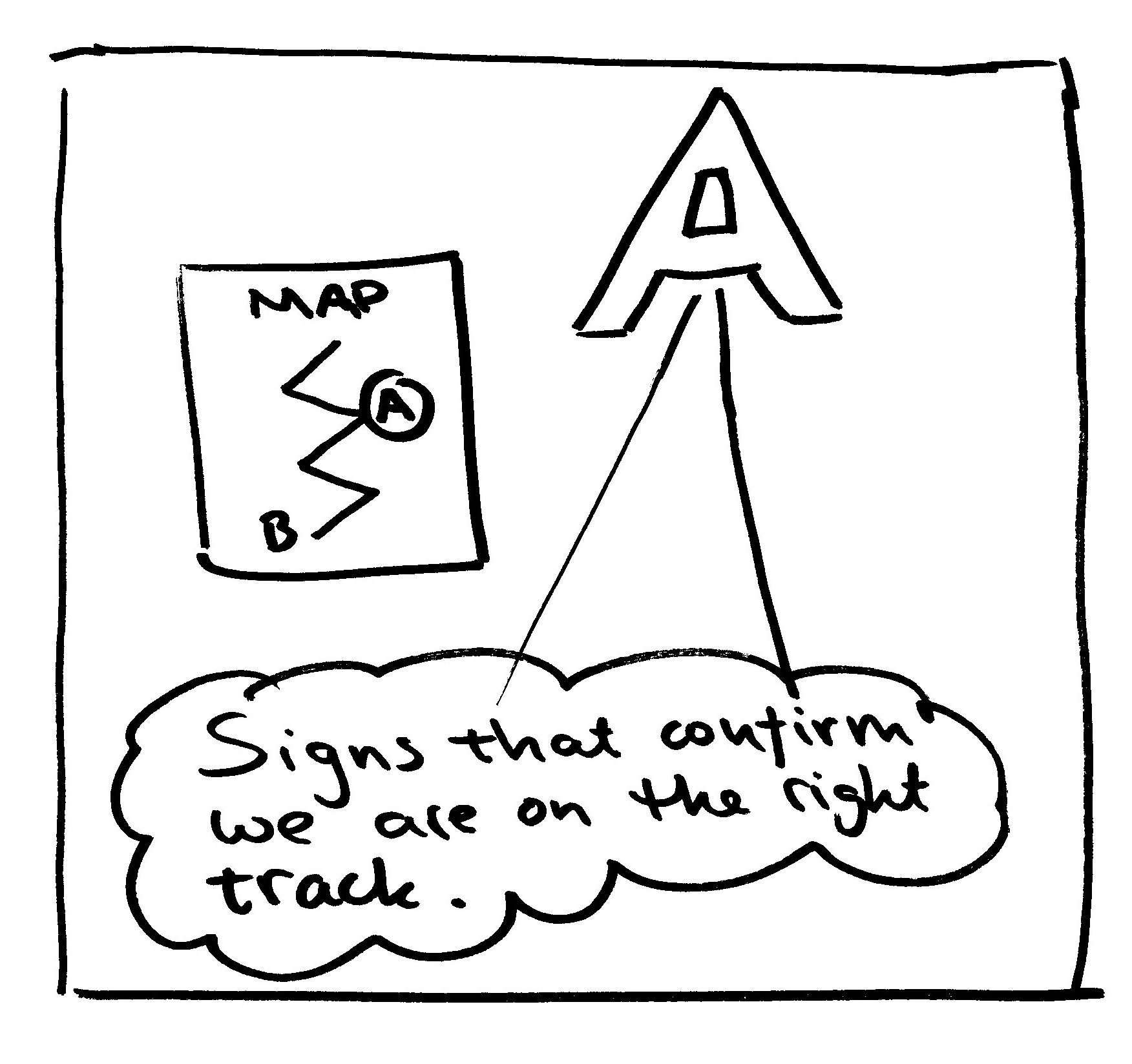
How does a stakeholder know his expectations are going to be met? How does he know that we are on the right track?
Important. Yes. It is.
If stakeholders don't have a sense that their expectations are going to be met, they get restless, unhappy, and all kinds of emotional states that are not productive for the project.
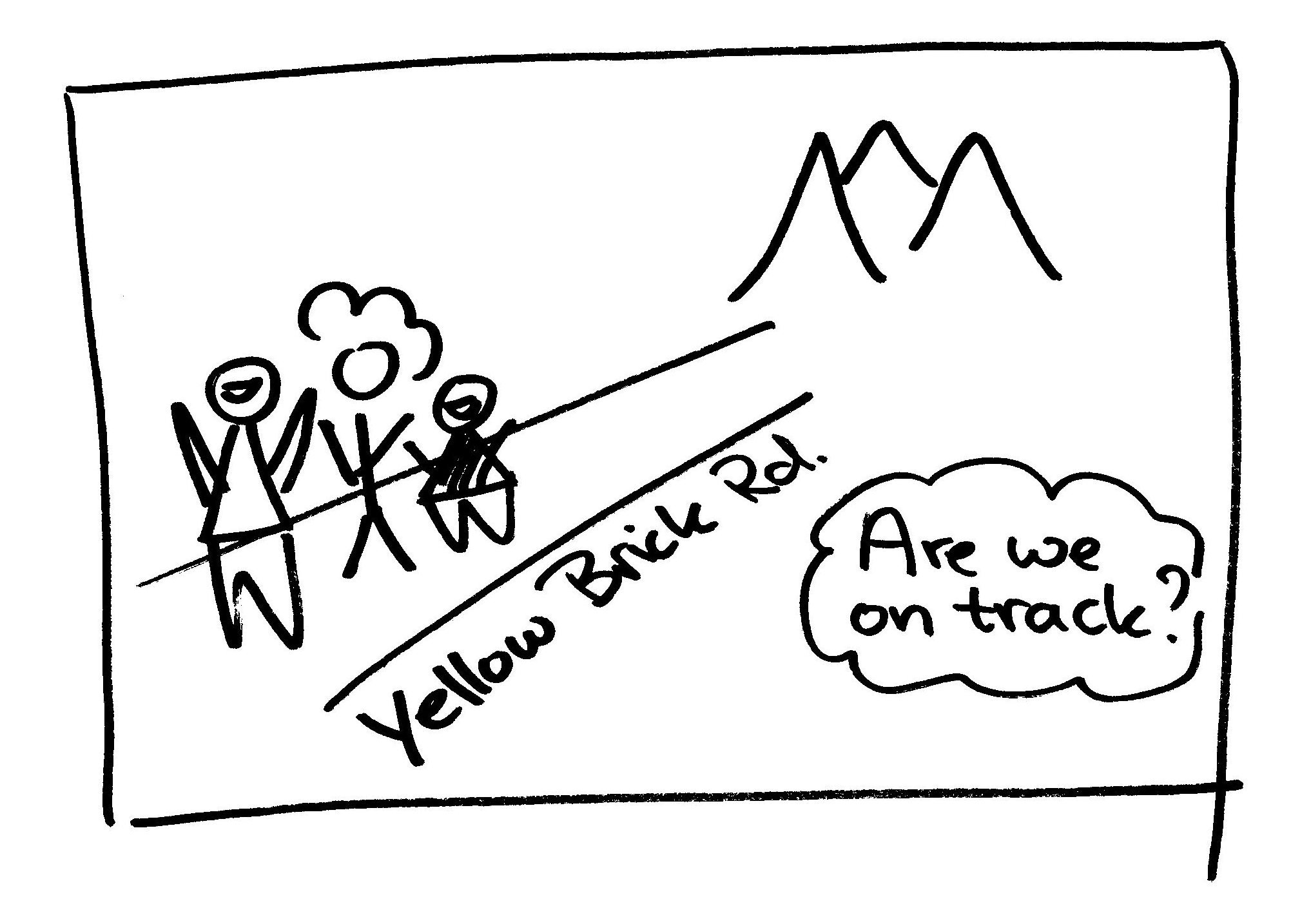
So. Yellow Brick Road. Yes.
Wherever you are in Oz, as long as you are on the yellow pavement you are on the right track. Awesome.
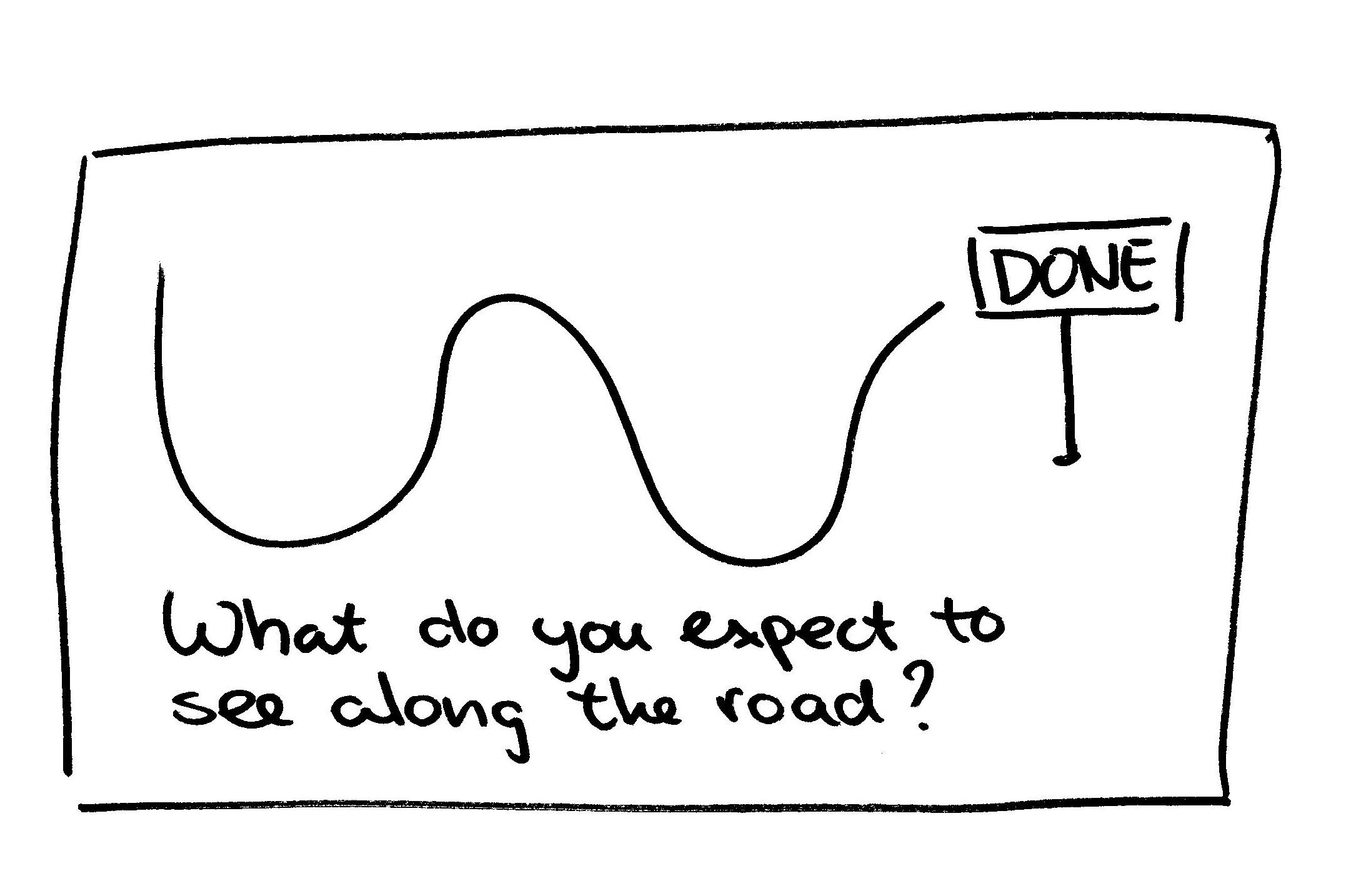
So. What is your Yellow Brick Road? What do you expect to see along the way to the end?
"When I was a kid my family drove every summer from The Netherlands down to the south of France. I loved those three day road trips. Navigation systems didn't exist back then (yes, I am that old) so my father had written down detailed instructions on how to find our way to the Cote d'Azur.
The drill went like this. He had written down checkpoints we should cross. Like a crossroad, a town, or a specific highway. I would set in the back of the car, leaned forward between the front seats and looking for the next checkpoint. Seeing a checkpoint made me happy. Waiting for one made me anxious. Looking at an expected crossroad provided the confirmation that we were heading in the right direction for our summer holiday."
We can even turn this into a "technique".
On a white board draw a road, with turns and twists and obstacles blocking the view from one turn to another.
Ask your stakeholders what they are expecting “to see” along the road. Start with the end in mind and work your way back. Before they go to production, what are they expecting to get? (Did someone just think “acceptance criteria”?)
Use project phases to indicate “checkpoints”. Use absolute calender time. Use budget scales. What are you’re expectations when 50% of the budget is gone? How do you know you’re expectations are met?
Back to the book "Switch".
The authors explain how challenging big goals can be. They can seem impossible. But by creating smaller goals, that ultimately lead the way to the larger end goal, people get motivated. Reaching the first check point on the map can provide them with the feeling that, yes! this is possible.
Yes!
Have to clean the entire house? How about your Yellow Brick Road consists of single rooms. Cleaning one room seems possible. After you have cleaned the first, you feel proud, and think "Yes! This is possible."
So. Yellow Brick Road as motivator in change. Wow.
Bas de Baar is a writer who draws about people in transition. He loves to make visual maps and travel guides for the collaborators of our brave new world.
We all have our own little tricks to remember things. Lets be honest, there is just too much information thrown at us to fit in our heads.
Our heads are just too small.
I write a lot about seeing projects as temporary tribes that go through some unknown country on some Big Adventure. It's almost hard to admit, but that is basically how my brain handles the concepts of projects, change in organizations and temporary collaboration.
It's the analogies with explorers making contact with foreign tribes, using tents, or sukkahs, as supporting structure for working in foreign environments, looking at rituals and procedures as flags that tribes carry around to identify themselves.
I am not making these things up just for entertainment. It's how I deal with complex matters myself.
Analogies and associations help us crunch information so it doesn't take up so much space in our brains.
Narratives compress information for storage.
This is one of the main points Nassim Nicholas Taleb makes in his book "The Black Swan: The Impact of the Highly Improbable” that I completely missed the first time I read it. At least I can't remember it. I reread the book recently and was almost screaming to myself: "Yes. Yes. This is it!".
What I got from it the first time around was his point about the human need to categorize everything. We have to put the world around us in neat boxes. Taleb coins the term “Platonicity” for this phenomenon — “the focus on those pure, well-defined, and easily discernible objects like triangles, or more social notions like friendship or love, at the cost of ignoring those objects of seemingly messier and less tractable structures.”
We put a label on an event and use that knowledge to reason about the future. We use this mechanism on everything, including people.
But it is not only labels. It's narratives and stories as well.
For me The Wizard of Oz analogy to stakeholder management is a awesome narrative that helps me to remember many important aspects.
Of course, when using analogies, narratives and associations we are simplifying reality and might be missing important details. But other than awareness, and engaging situations mindfully I am afraid there is nothing much we can do about it.
Answering the project questions "What does done look like?". "How do we get there?" and "How do we know how far we are?" are not just technical, planning and metric questions. It's even more important to see it is the elements for the project narrative.
Treating them as technical questions might even scare some important people away. Not everyone gets all fired up from Project Management concepts.
But everyone is up for a good story.
Bas de Baar is a writer who draws about people in transition. He loves to make visual maps and travel guides for the collaborators of our brave new world.
Together with Dave Prior I host a podcast called, of course, The Project Shrink. Podcast. It is a "increasingly-less-weekly" podcast. Actually, I can't remember the last time we recorded an episode.
Anyway. Dave goes places. Like the South-by-South-West (SXSW) conference in Austin. Everybody that is a big thing on the Internet goes there.
In our most recent episode, from the series ... "Dave Goes To ...", Dave explains what he was doing at SXSW and talks about the "PM for Humans" core conversation he attended.
And I say hello at the beginning of the episode.
And I make us promise to start doing this weekly. Recording episodes.
Sure.
If for some unexplainable reason you would like to subscribe through iTunes to this podcast, just follow this link.
"Whether small, medium or large in size, organizations have been or are set to grapple with remote based leadership issues. (…) the bottom line is that teams are going to increasingly become virtually segregated and leaders need to act differently. (…) Leaders must shift their thinking, they must re-think their style, they must suspend past assumptions."
“Since virtual teams are supported by technology and technology tends to filter out vital nonverbal cues, can a leader be effective in virtual contexts? (...) (Researchers) “found that the effect of transformational leadership on team performance was stronger in virtual than in face-to-face teams. (...) Transformational leaders motivate others by engaging their intrinsic interests (e.g., being associated with a particular cause) as opposed to engaging their extrinsic interests (e.g., salary or pay).”
Ok. Transformational leadership can also be found in the offline world. Leadership will not change for everyone. But for most it means an amazing shift in style.
If effective communication depends increasingly on reliable social cues, and the leadership style will focus more on social context for inspirational and intellectual stimulation, well, heck yeah, things will be different.
So.
I think that we need communication platforms that support this shift in importance of social cues and context. And that we need practices that are tuned in using social cues and context effectively.
Of course it not just about "tools". But people enable what you can do in a project. If tools enhance the abilities of people, those tools become more than "just tools".
And with "tools" I am not speaking about "social media". Well actually, I am. But not exclusively.
Social media will allow you, personally, to develop your social skills, get over fears of online expression and dealing with transparency. By developing your own personal skills, by creating your digital footprint you can effectively train your ability to lead virtual and resilient teams, and online communities.
Thank you.
Sites like Facebook, LinkedIn, Youtube, Twitter and blogs in general are primary concerned with social interaction, hence the “social” in media. The way they are constructed emphasizes social cues and context.
So.
They are a very good step in the right direction. It will surely beat pure email and storing an excel file on a shared server.
But as I said, it's not just about our communication platform. Practices that are in tune with the social cues and context concepts are also needed.
Bas de Baar is a writer who draws about people in transition. He loves to make visual maps and travel guides for the collaborators of our brave new world.