Rollerblades & Lemonade
Categories:
Culture
Categories: Culture


|
I was intrigued by my little daughter’s behavior. It reminded me on what we have been doing on change management and implementation. When you want people to adopt and adapt to change, what do you normally do to motivate and convince them? According to Daniel Pink in his book “Drive”, there are three types of motivation that affect our behaviors (watch the interesting video on Drive below).
It is interesting to see how these motivations worked out in the little endeavor of my daughter mentioned above. She started with a biological desire to try out a new sport which was immediately crushed when the psychological fear of falling developed in her. My attempt of rewarding her with lemonade as an extrinsic motivation worked as expected and corroborated with what Daniel Pink purported that ’carrots and sticks model works well for tasks that require only mechanical skill’. However, once she grasped the basic skills required for the sport, the intrinsic motivation of mastery kicked in and took over. The joy and satisfaction through mastery were so immense that the effect of the lemonade was dwarfed. What can we learn from this to help us in change management? Clearly, the effect of intrinsic motivation is much more powerful than extrinsic motivation and we should always work towards the course of intrinsic motivation in order to achieve maximum impact in implementing change. But, this does not make extrinsic motivation irrelevant. When applied properly in the right context and timing, extrinsic motivation does have its values – e.g. the way lemonade was used as a temporary reward to encourage my daughter to continue with the rollerblading lessons. The key here is to know when extrinsic or intrinsic motivation works best for you in a particular situation and devise a way to insinuate them in the change process. Below are a few tips to guide you along the way.
|
 Recently, my five-year-old daughter took up rollerblading course as part of her planned school holiday activities. However, after the first lesson and a few bad falls, she developed some symptoms of basophobia and was quite reluctant to continue with the rest of the lessons. In order to encourage her, I promised to make her lemonade, something she could not resist, as a reward after each of the lessons. As I had expected, she pushed herself to attend the next few lessons for the sake of the lemonade, of course. Something strange happened after that. Once she had mastered the fundamental footwork and managed to balance herself on the wheels, the psychological fear in her subsided and the long repressed interest on the sport bounced back in full zeal, overwhelming the phobia. I no longer needed to coax her to go for lesson anymore. Instead, she was the one that kept asking – “When is my next lesson?”
The Invisible Lid
Categories:
Culture
Categories: Culture
| There is this popular flea experiment which was used by many authors and speakers to discuss topics like paradigms, limits, beliefs, and perceptions etc. If you have not heard of it, here is how it goes.
It occurs to me that we might be facing the same conundrum in the domain of project management. Recently, I have seen a number of discussions going on in forums and blog posts which asked questions similar to this – “Should we have more flexibility in our methodologies and processes?” Isn’t this analogous to what we have just observed in the flea experiment? If we started off by allowing too much freedom, things will go chaotic. It is like putting the fleas in the jar without covering it with a lid, they will jump out and escape in no time. If we tighten the control and governance, people will start to learn and follow the rules just like the fleas that have learned not to jump beyond the height of the lid. Things may go well and in proper order for some time. However, if we do so, are we restricting the potential of individuals to go beyond their limits? Are we stopping them to be creative and adventurous? What will happen if we remove the lid now? Will they still stuck with the psychological invisible lid that hovers above them just like the fleas? People may get accustomed to their comfort zone and stopped challenging the status quo. Are we guilty of turning a good team into a legion of zombies that only follow instructions? We need to be cautious and take all these concerns into consideration when we impose control and governance in our operational processes. It is not just about control anymore. It is also about the kind of culture we want to foster in our team. Do you have an invisible lid over your team? |

An ASCII Art Anecdote
Categories:
Design
Categories: Design
|
It is exactly this same spirit that a productive and successful project team should have. So, stop grieving over budget cuts and headcount shrinks. Work with and work over your constraints. Do not let the constraints cloud over your creativity. It is always the ability to continue to excel in the toughest situation that separates the bests from the mediocrities. Show your boss that you and your team, too, can be creative.
|
 For those of you who have gone through the era of
Where Have All The Talents Gone?
Categories:
General
Categories: General
|
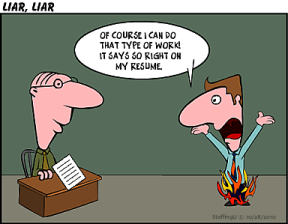
Before we proceed to discuss the above question, let’s take a step back and reexamine the hiring process. When you need to hire someone for your project team, what do you usually do? Most of you will probably contact your Human Resource department and they will request a detailed Job Description (JD) from you for the new position to be hired. Without further ado, you will enthusiastically send out a 3-inches thick JD to your HR just to justify the importance of the role and to ensure that your HR is able to get you the right person for the job. In fact, this is exactly what the HR will do – find the perfect match. They will scrutinize the pile of submitted applications and drop those that do not match the criteria highlighted in your JD (I suspect they might even have a super-duper software to do that automatically). What you will be choosing from eventually are those ‘lucky ones’ that slipped through your HR’s most stringent filtering system. Good luck, if the above process sounds familiar to you. What’s wrong with this? No, there is nothing wrong with the process; the problem lies in the screening and filtering procedures performed by your HR. Yet, do not blame your HR. They are not the experts in your domain. Hence, do not expect them to be able to differentiate between PMP vs. PgMP certification or know the significance of project management experience over domain knowledge. For example, if you are looking for a business analyst with 5 years of experience and strong investment banking knowledge; would you try someone with CBAP and 10 years of business analysis experience but no banking knowledge? Or what you need is a seasoned project manager with 10 years of experience; would you even consider a PMP certified junior project manager with 5 years of experience? Your HR will, without doubt, drop the two applicants from the above examples since they do not match the criteria in your JD. Now, isn’t this ironical? Dropping a PMP certified, and supposedly much younger and energetic, project manager just because he or she does not have the required years of working experience (assuming experience is not correlated to capability)? What the HR are doing is typical apple-to-apple comparison to pick your champ based on what the candidate has done in the past and not on actual capabilities of what he or she could potentially contribute to your team in the future. In other words, they are selecting someone that is ‘ready-to-serve’ for the immediate needs in your team. However, are we going to rely solely on a person’s history and credentials to judge his or her potentials? While work experiences, academic achievements, domain knowledge and skill set can be easily presented and identified in a person’s resume, less quantifiable attributes like soft skills and personalities can only be validated appropriately through interviews and psychometric tests. Not to mention it is well known that resume can be easily cooked up and nicely spruced, and most of them are usually over-claimed. Should we still stick with this old way of headhunting? If you are going to continue to do so, there is a high chance that you might miss out potential talents through this kind of filtering procedures. The key question is – are you looking for someone who can fit nicely into the current role or a potential star player who may contribute beyond your expectation? If I were you, I will either do the screening myself or keep the JD as simple and short as possible. Ultimately, what I want for my team is a creative individual, a thinker and a future leader, and not someone who just wait for instructions. What about you? |
 According to the recent
The Full Monty
Categories:
Philosophy
Categories: Philosophy
| The classic ‘Monty Hall Problem’ is one of the most debated paradoxes in recent years. It is a probability puzzle based on the American television game show ‘Let's Make a Deal’ that was originally hosted by Monty Hall. Here is how it goes,
If you are attempting this problem for the first time, there is a good chance you will get it wrong. The good news is you are not alone as there is a horde of great mathematicians and physicists that tripped over this veridical paradox as well. Most people will think that it is a 50-50 chance and it does not make any difference to switch. The correct answer is you should always go for a switch as it will give you a higher probability (66.7%) of winning the car. For those who are not convinced, you may read up the solutions given in Wikipedia or watch this clip in YouTube that explains it clearly. There are two interesting observations from the Monty Hall Problem that provide us insights on how people handle risk in decision making. A good understanding on the factors underlying all these may help to improve risk management in projects. Let’s start by first defining what risk is. In general, risk can be defined as a future event with a probability of occurrence and a potential impact on our environment (or project) that results from the consequences of our actions. In other words, there are two key factors to consider when we analyze risk – occurrence and impact (there are other factors but we will leave them out for now). The key question in Monty Hall Problem is simple – switch or stay? The impact involves is straight forward and is an extreme case of all (car) or nothing (no car). The tricky part is on the occurrence and this is what those debates are all about. The first observation from Monty Hall Problem shows that when people are under immense pressure with little time to think, just like those in live shows, they will tend to follow their hearts and make hasty decisions based on emotional intuition. This was what actually happened in the game show for most of the participants. They had skipped the process of thinking and jumped straight into conclusion based on guts feel. If they had done some basic probability calculations, they would have gotten a better chance to win the car. However, given the situation in the game show, it is not surprising that most people had gone for the hunch. What we may learn here for project management is we should rely more on objective statistical estimation than natural instinct when we analyze risk. In addition, we should always conduct risk identification, analysis and assessment earlier so that we have sufficient time to plan and prepare ahead of time instead of reacting to the situation. The second observation suggests that even if we are given enough time to do a proper probability calculation we might still get it wrong if the information we have is insufficient or the way we perceive the problem is incorrect. Many people had attempted the Monty Hall Problem and read the solution given, but still unable to accept the reasoning behind it despite that there is a host of strong supporting mathematical proofs. They are those who got stuck with the 50-50 chance argument and failed to perceive the problem from another angle. When we conduct risk analysis and assessment in projects, we have to be extremely careful that we base our analysis and assessment on the right information through the right perspective. A way to make this more effective is to have the risk analysis and assessment done with a group of people represented by different stakeholders instead of a single person. This will help to reduce errors that are due to lack of information, biases and differences in perception. One last thing to take note – even with proper risk analysis and assessment, there is no guarantee that the decision we make will turn out good. In other words, we can only manage risks but not always possible to eliminate them completely. How are you conducting your risk analysis and assessment? |