6 Ways to Keep Agile Teams on Track


| By Soma Bhattacharya
An agile team can, in most cases, work around the uncertainty and still get things done. To keep your agile teams moving forward, implement these six strategies: 1. Focus on the planning. Yes, everything is subject to change, but planning is essential. This exercise (release planning, grooming or sprint planning) allows team members to understand the upcoming work and ask the right questions on time. Additionally, it’s a great way to train team members to provide estimates after going through the requirements in detail. This allows for better planning, wonderful execution and timely delivery instead of spillovers. Teams can use a variety of platforms available online to get the training done. Tools aren’t as important as the interaction itself. 2. Track team health. I always think the organic way to look at team health is through the consumption of buffer percentage. It is simple because during planning, your team assigns hours to tasks and you get the total hours you will need to complete the user stories. You also know the team’s total capacity (availability of the team during the sprint). Create a team buffer of about 10 percent and then plan for the sprint. If during the course of the sprint your team consumes the buffer and still has spillover, you can increase the buffer. Track the consumption of the buffer percentage and determine if the team is estimating correctly, and if they are clear about the user stories. Buffers can let you know the team’s performance and, with it, the trend of the team’s deliverables. 3. Prioritize retrospectives. Teams must have a growth mindset, and nothing is better for fostering one than the ingrained cultural habit of retrospectives in agile teams. There are creative ways of conducting retrospectives during these times, even if they require workarounds. For example, perhaps instead of just focusing on the work and aligned data, retrospectives can include personal challenges as well. This not only allows the team to gather and feel seen and heard, it also allows teams to evolve and see if there are ways to reduce personal challenges. 4. Encourage leadership. Leadership shouldn’t be limited to just a coach or the leadership team. In fact, team members should be trained to make decisions when it comes to work or conflict management. I have always found that when the team lead or management encourages an open mindset for teams, teams take up challenges or new learnings because of the support they receive. These teams always perform better in the long run. 5. Determine the happiness index. Apart from other team data, there should be an insight that allows you to understand how a team is doing emotionally. In a 2013 Harvard Business Review article, Rosabeth Moss Kanter explains that a happy team can better handle complex problems. Finding the happiness index is one of the most revelatory exercises you can do with a team. Simply ask everyone to rate their happiness working with the team on a scale of 1 to 5 and why. Keep it anonymous so people share honestly, and you will be surprised what comes out. These are all hints that can lead you to identify unresolved conflicts, build retention and discover serious issues. 6. Take action. Many of us have good intentions. But unless there are actions that follow, trust falls apart. Be careful in committing too much and always follow up, whether it involves actions required from the last retrospective or something that has come to your attention. What are some ways you keep your agile team on track? Share in the comments below. |
.jpg) Agile teams are being tested. The world has changed, and many teams—no matter what their structure was prior to the pandemic—are working from home, on top of dealing with increased COVID-19 challenges. While the demand for deliverables and work continues, the roles, responsibilities and efficiency of agile teams come into question.
Agile teams are being tested. The world has changed, and many teams—no matter what their structure was prior to the pandemic—are working from home, on top of dealing with increased COVID-19 challenges. While the demand for deliverables and work continues, the roles, responsibilities and efficiency of agile teams come into question.
Demanding Stakeholders Are Good Stakeholders
Categories:
Career Development
Categories: Career Development
|
By Kevin Korterud Managing the dynamics of stakeholder engagement is an essential component of successful delivery. Stakeholders offer direction and support, and enable key strategic and tactical decisions needed for delivery progress. Especially early in our careers, we tend to think about stakeholders as being two-dimensional entities that have an equal say in delivery directions. For those of us who have completed several project, program or product delivery initiatives, we know this equally representative model of stakeholders does not practically exist. At one time or another, we’ve all had a demanding stakeholder. True demanding stakeholders tend to be standouts from the traditional body of stakeholders in several dimensions. Demanding stakeholders are almost always well-intended. They seek a path to delivery results and are not focused on gaining political capital for their own personal benefit. However, their dominating professional presence, business/technology domain knowledge and sense of urgency can be intimidating. Project, program and product managers early in their careers often make mistakes in working with demanding stakeholders. Many of us tend to misinterpret their high level of needs as a liability. In fact, the opposite is usually true with demanding stakeholders. With a proper connection, they tend to be one of the most valuable assets for effective project, program and product delivery. Below are three techniques for re-thinking the way you interact with demanding stakeholders: 1. Recognize their unique strengths and skills. There is no mistaking what a demanding stakeholder needs from a project, program or product delivery initiative for success. In addition, their needs are made very clear as to what success looks like from the delivery team. Demanding stakeholders typically possess strong business and/or technical knowledge, which gives them a highly capable foundation from which to quickly enact the best possible slate of improvements. They understand these processes end-to-end and typically have an external view of how other companies execute the processes. Demanding stakeholders are also often efficient communicators who can phrase their needs in the minimum amount of words. In addition, they can readily visualize and demonstrate to others the required elements and outcomes from prospective improvements. Leveraging these skills, demanding stakeholders can readily align their improvement ideas with organizational strategy. This alignment is key to realizing the maximum amount of value from a project, program or product solution. By doing so, the demanding stakeholder—by having the best interest at heart for real results—is a key factor in true delivery success. 2. Practice setting boundaries, and use “not now/yet” vs. “no.” The size and scale of a demanding stakeholder’s needs may at first seem daunting. In addition, there often doesn’t seem to be enough time to meet their needs. The demanding stakeholder realizes that there is typically a limited opportunity to enact high-value change, so they try to maximize what can be done—even if it means running over schedule and budget. When interacting with demanding stakeholders, start by setting the boundaries for the size, scale and duration of improvements that are possible. Mutually agree that these boundaries are solid and can only be revised with a change control process. By setting these boundaries, you can enable the next step in optimizing demanding stakeholder needs. Saying “no” is not an effective path for progress. The approach should be to set a grouping, ranking or other priority-based construct that can be used to determine the relative order of stakeholder needs. By using more of a “not now/yet” approach, you create clarity into the relative importance of needs, while building the bridge for future enhancements. 3. Become a demanding stakeholder yourself. One of the most effective approaches for working with demanding stakeholders is to become one yourself. For a project, program or product manager, this is quite straightforward due to the disciplines already inherent in the work that we do on a daily basis. To increase business or technical knowledge, put yourself in the role of a demanding stakeholder. Seek opportunities for business or technology immersion through training, shadowing the stakeholder’s subordinates and visits to company sites or customers to fully appreciate their position. With any stakeholder engagement, such as a working or status meeting, devote additional time and effort to preparations. Role play and predict the likely set of questions or directions that would be provided by the demanding stakeholder. Leverage your team members to assist with demanding stakeholder dialog. Demonstrate the ability to make fact-based and data-driven decisions in a quick and decisive manner. In addition, clearly communicate acceptance criteria, timing and desired outcomes to team members. Pay strict, unwavering attention to the scope, scale and time boundaries. Finally, fully support the demanding stakeholder with any change control effort needed to revise scope, scale and duration boundaries. By exhibiting the core behaviors of a demanding stakeholder, you will gain the respect of that stakeholder and let them know they have a willing and capable partner in creating value for the company. What are some ways you’ve successfully collaborated with demanding stakeholders? |

3 Ways To Simplify Complex Projects
Categories:
Leadership
Categories: Leadership
|
by Dave Wakeman My mind has been so focused lately on the leadership failures we’ve seen during the pandemic that I often forget to think about ways that we can help our project teams move forward right now. That got me to thinking about something we often struggle within any situation: simplification. I imagine most of us feel like we’re managing teams of complex individuals working on complex projects, with answers and solutions that are also complex. If you catch me at the right time, I’ll tell you everything is complex. Over the years, one thing I’ve learned that adds value—for all my stakeholders—is the ability to take the complex and make it simple. Case in point: A friend of mine asked me about a branding project his organization was focused on. He asked if I could sprinkle some of the “Dave three-point simplification” on his marketing challenge. I joke, but the ability to simplify projects and decisions for our team members can help steer us towards success—if we do it well. Here are three points to keep in mind: 1. Focus on the essential. When we’re working on something, we can go down the rabbit hole pretty quickly, running through all of the minor details, dead ends and roundabout ideas that don’t actually matter. To be fair, most of us and our team members have a lot of knowledge, and we want to share our relevant experiences. But in many cases, we allow this abundance of knowledge to get in the way of just focusing on the key ideas or tasks. Instead, think through the essential details, actions or points that need to be made. And stick to those. 2. Cut the lingo. I’m sure you’ve experienced this: people using a crazy language of acronyms, shorthand and code that only makes sense to those within the field. Even if they’re confused, a lot of folks don’t want to speak up and say, “Hey, what does this jumble of alphabet soup and buzzwords mean?” To make sure we’re getting our points across, we have to step back and focus on using simple and clear language—even if it might seem too basic. When you’re talking and sharing instructions or feedback with a stakeholder, don’t assume they understand every definition, acronym or idea familiar to you. Take the time to define concepts, frame ideas and make sure the point you’re making is getting through—even if you sound like a first-year business student. 3. Lean on visuals and metaphors. When we’re focusing on simplifying a topic, we need to consider the fact that everyone learns in a different way. Some folks like to learn by reading, others by listening or through imagery. And in most cases, learning is aided by actually doing something. So as you’re working on simplifying and coaching your team, don’t be afraid to use visuals or metaphors that draw distinctions or illustrate your point in a different way to help others better understand the information. For me, simplification is a great tool. And even though I know I don’t always get it right, I’d still much rather be known for talking at too basic of a level than as an out-of-touch bore. How do you use simplification on your project teams? Let me know what you think in the comments below!
|
Lessons Learned: Don’t Be Afraid to Share Responsibilities
|
By Yasmina Khelifi, PMI-ACP, PMP There’s no “I” in project team—or volunteer. While volunteering on a 2021 forum for an association, I was assigned to work with a new volunteer. At the outset, I had some reservations. Throughout the experience, however, I gained knowledge that I can now apply to collaborations with my other project teams. I’ve outlined some lessons learned that will help you open yourself up to more collaboration in your volunteer efforts (and become better project leaders in the process): Lesson 1: Get over yourself. When the project manager first proposed to me that I find another volunteer to help manage the forum’s communications, I had to confess I was not particularly enthusiastic, despite the high workload ahead of me. Why? I enjoyed hogging the spotlight, I took more pride in managing alone and I thought it would be extra work to synchronize my efforts with someone else. But after I made the effort to connect with a fellow volunteer, I came to some realizations that showed me how wrong I was. I discovered she was a specialist in communications and marketing, which I am not. Because of her background, she was able to bring fresh perspectives and challenge my views. She also prevented me from being a bottleneck by sharing in the labor and compensating as needed. Finally, she forced me to look more closely at my delegation style in a safe, low-stakes environment, which helped me to grow as a better leader overall. This collaboration revealed a rich tapestry of lessons learned—ones I wouldn’t have experienced had I not opened myself up to the idea of working with another volunteer. Lesson 2: Embrace a different mindset. During your volunteer experience, seize the opportunity to challenge yourself:
Sharing responsibilities does not mean micromanagement. It means learning to trust, learning to give autonomy and learning to oversee. Conversely, giving team members space does not mean pushing them into the unknown without a safety net. Make yourself available and accessible to assist, encourage and explain, as needed. Lesson 3: Think about the future. By working with others, you can contribute to the growth of the next generation of leaders—and that’s rewarding. You will revel in helping them demonstrate their value. I once was in a small language association where the president managed all alone, complaining he had too much to do. When he left, the association died with him. Do you want to be remembered in that way? On a pragmatic side, motivated volunteers with increased responsibilities improve the retention rate, help the association avoid falling into a rut and, more importantly, cement stronger ties, strengthening the feeling of belonging and inclusion. Be a part of shaping that future. Lesson 4: Work toward change in increments. You can’t reshape the organizational culture overnight. But you can take small steps to make a difference:
Sharing responsibilities will bring unexpected benefits for yourself, your co-volunteers and the association. What are some lessons learned you’ve taken from volunteer experiences? Share in the comments below. |

The Not-So-Secret Ingredients to Success? People and Purpose
|
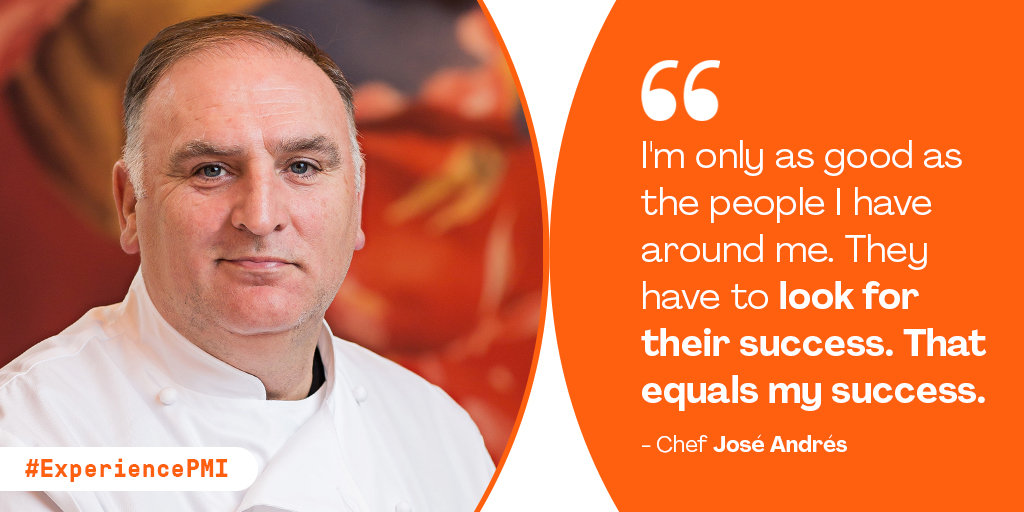
By Cyndee Miller Whipping up tapas and shaking cocktails isn’t your typical day in Project Management Land. So why was I watching master chef José Andrés prepare seafood delicacies as PMI President and CEO Sunil Prashara played mixologist? It was all part of the fun—and the learning—at the first gathering in PMI’s Virtual Experience Series: “My Work. My Life. My World.” Not to sound too much like a fangirl, but I went into the conference really looking forward to the presentation from Andrés. (And no, this wasn’t just about his salt air margaritas). This fellow is one impressive manager of projects. Not only does he helm more than 30 wildly popular restaurants, he’s also creating super-smart solutions to hunger and poverty through his non-profit. Along with the group’s disaster-relief efforts around the world, it also stepped up its response to the COVID-19 crisis, delivering 150,000 fresh meals in dozens of U.S. cities every day. How does he do it all? Well, along with demonstrating how to create some tasty tapas from his home in Spain, Andrés also revealed his personal secret sauce: You’re only as good as the people around you. To have success, you have to provide others with the opportunity to succeed, Andrés said. That means teaching them how to adapt. While projects certainly require planning, there are just too many variables in the world to cover everything, he said. And often, the one you didn’t plan for is the one that happens. “The communities that will be successful today will be the ones that are ready to adapt to any circumstance,” Andrés said. Sometime that means breaking out of the same old patterns: “Don’t be shy of big, bold ideas,” he said. “This keeps you going. This keeps you motivated.” The idea that people and purpose are “critical to business success” as the hype goes is not exactly earth-shattering. But what struck me was how the concept resonated just as much with a superstar Spanish chef as it did with a strategic lead at a U.S. healthcare giant. “People are what make things happen,” said Wale Elegbede, PMP, director of strategy management services at Mayo Clinic. That’s true whether it’s putting together small plates in a Spanish restaurant or transforming a big company. “We’ve seen in our research that the successful organization sets itself apart from others by transforming not just the organization, but the employees,” explained Emil Andersson, a project manager at The Brightline™ Initiative. And those people need purpose. “The biggest mistake we make in any type of gathering is we assume the purpose is obvious,” explained Priya Parker, author and host of podcast Together Apart. “Always start by stating the purpose of a meeting. And then connect people to the purpose—and to each other.” That’s especially true for next-gen team members: Millennials and Gen Zers need to “work for purpose, not just a paycheck,” said Foodeo CEO Marcel Furmie, PMI-ACP. To create a team of true changemakers, though, project leaders must build trust. “Trust provides a sense of safety,” said Dan Mircea Suciu, PMI-ACP, of Babeş Bolyai University in Cluj-Napoca, Romania, during a presentation on the neuroscience of project decision making. “And when team members feel safe, they’re more productive—and more comfortable taking appropriate risks.” Missed out on the action this time around? Tune in to the next Virtual Experience Series event on 25 August with The Daily Show host Trevor Noah. I’ll be there. In the meantime, let me know in the comments below: How do you help the people around you succeed? |