Transparency improves customer satisfaction
Categories:
Agile
Categories: Agile


|
The link between transparency and trust is well known. You are more likely to trust the quality of the food you are served when eating at a restaurant with an open concept kitchen than if the food preparation is done entirely out of sight. Transparency is a pillar of the Scrum framework and while it is not explicitly spelled out by other frameworks or in the Manifesto for Agile Software Development, it is indirectly referenced. When I teach classes in agile fundamentals, I often say that a virtuous cycle commences when greater transparency builds increased trust in the team by senior stakeholders. This in turn leads to greater support from those stakeholders for team self-organization and empowerment which reinforces the team's willingness to be more transparent. But will transparency do more than just build trust? I had a follow-up appointment with a medical specialist this week. It was scheduled for 4 PM and shortly after that time I was escorted to the examination room by a nurse who told me that she'd let the doctor know that I was there. I waited (and waited, and waited). At 5 PM, I got tired of sitting on the examination bed and stood in the doorway looking out. A few nurses saw me, but no one stopped by to ask why I was not waiting patiently in the room. Finally, at 5:15 PM, the doctor came into the room. No apology was offered for her tardiness but she did complain that she has no control over her normal schedule on days when patients needing urgent medical attention show up. My demeanor was externally pleasant but internally I was seething. I have no issues with a delay resulting from a medical triage process. What frustrated me was my complete lack of knowledge of where I was in the queue or any idea as to when I would eventually be examined. I don't expect that my doctor would have had the time or inclination to stick her head in my room to update me once or twice over the hour and a quarter I was waiting, but the nurse who had brought me there could have set my expectations appropriately. The clinic could have posted a simple information radiator showing the number of consults waiting for each specialist to help manage patient expectations. Better still, they could have implemented a simple online site to make this information available remotely which would have enabled me to show up close to the actual time when I would be examined. Increased transparency would have increased customer satisfaction. “I’ve learned that people will forget what you said, people will forget what you did, but people will never forget how you made them feel." - Maya Angelou |

Handling complexity requires psychological safety
|
I wrote two weeks back about Complex Adaptive Systems (CAS) and the benefit of models such as Cynefin and the Theory of Constraints for being able to understand them. What I didn't focus on in that article was how important the people element is when dealing with CAS. Two HBR articles published this week reminded me of that critical ingredient. Amy C. Edmondson, who has literally written the book on psychological safety (The Fearless Organization), wrote about the culture at Boeing which enabled the 737 Max issues to fester for a long time before they tragically became mainstream news. In her article, Amy lists three contributing factors including:
In the same week, Ryan Gottfredson and Chris Reina, wrote about the importance of leaders having the right mindset. Going beyond the well known Growth vs. Fixed mindset model, they covered three other mindset pairs:
Out of these three, the middle one is apropos. According to Ryan and Chris: "Leaders with a deliberative mindset have a heightened receptiveness to all kinds of information as a way to ensure that they think and act as optimally as possible... Comparing the two, leaders with deliberative mindsets tend to make better decisions because they are more impartial, more accurate, and less biased in their processing and decision making." This aligns well with two of the leadership actions which Amy recommends in her article. Leaders need to insist on input by explicitly soliciting feedback and by responding productively to concerns raised by staff. So what does this have to do with CAS? Most of you would probably agree that a modern jetliner is complex system given the large number of interdependent software and hardware components which all need to work effectively together under a wide range of physical operating conditions. While it is possible to build solutions in which complexity won't increase non-linearly as the size increases, this requires significant, sustained commitment to good architectural principles with an appropriate balance between quality and other delivery constraints. When faced with a CAS, psychological safety within a delivery team is more important than with simple or complicated systems as there is a higher likelihood of things not going as expected which drives a greater need for legitimate transparency and candor. |

How do you handle unresponsive key project stakeholders?
|
It is a common challenge for anyone who has managed projects for a meaningful amount of time. One or more of your key stakeholders who are integral to the successful completion of the project appears unwilling to engage as expected. It could be the project sponsor who ignores your pleas for assistance with a project issue, the functional manager who turns a blind eye to your requests for staffing support or the executive who never seems to have the time to review and sign off on a key deliverable. How should we handle this situation? As usual, "It depends!" is the correct, yet, most unhelpful answer! While the response varies depending on the scenario, we need to understand the root cause for the behavior and then assess the range of options available to us within the specific context we are facing. Four causes for unresponsiveness are:
If the stakeholder isn't being responsive to an urgent request they are rarely going to tell you the real reason why. You will have to do some digging to determine the truth. It is fairly easy for someone to say they are too busy or they don't see why your request is important when their real reason is they actually don't want your project to succeed. Or, they might take the easy route and pass the buck ("I don't have the authority") when it could be one of the other reasons. Even still, once you've identified the root cause, it may not be easy or even possible to implement an effective countermeasure. For example, if you are delayed on the sign off from a key stakeholder, there is no way to proceed without that key stakeholder's approval and they are unable or unwilling to appoint a proxy, your project will be delayed. You might have done a great job of informing all other stakeholders in a timely manner about the cause and impact of the issue, but if schedule performance is one of your project's success criteria, it won't be met. This is why the scope of risk management is so critical. Identifying critical dependencies, failure points in decision processes and stakeholder unresponsiveness issues from past projects can help us to be better prepared. It can also be helpful to identify common decisions over the life of a project and define the decision processes and exception paths up front before we find ourselves in trouble. You can't control other people. But you can proactively plan your reactions to them. |

Thriving at the Edge of Chaos - a review
|
Over the past couple of years I have regularly heard companies, their portfolios and even individual projects referred to as Complex Adaptive Systems (CAS). With a CAS, understanding of the individual components does not convey an understanding of the whole, and reductionist thinking which can work so well with simple or even complicated systems is of limited use. Given this, I felt it was somewhat timely when I was invited to review Jonathan Sapir's new book, Thriving at the Edge of Chaos - Managing Projects as Complex Adaptive Systems. In the first half of the book, Jonathan does a good job of covering the challenges we face when trying to apply traditional planning approaches to complex projects. His differentiation between complicated and complex contexts, the importance of systems thinking and his walk through of the Cynefin framework make these sections a good primer on the subject. Whether it is Ian Malcolm's quote about non-linearity from Jurassic Park, the old joke about the drunk looking for his keys around a lamp post, or the analogy of a fence and treats for a dog as examples of boundaries and attractors, Jonathan provides many quotes, analogies and examples which all help to make a complex (no pun intended) topic approachable for most readers. A number of the principles he covers in the first half of the book will resonate with both agilists and anti-fragilists including:
I liked his guidance that operating at the edge of chaos is where modern organizations should strive to be as excessive control leads to paralysis and eventual obsolescence whereas a lack of any guardrails will often result in chaos. Uber is frequently referenced in the book as almost a "poster child" for living on the edge, but I found the inclusion of Cemex and how they overcame the challenges they were facing in a traditional industry more appealing to me given that the majority of organizations are not founded to disrupt an existing business model. The second half of the book covers Dr. Eli Goldratt's Theory of Constraints (ToC) and focuses heavily on its application in Critical Chain Project Management (CCPM). While CCPM provides good solutions for dealing with common scheduling issues, I did feel that the book could have delved deeper in terms of applying ToC and other models to addressing some of the non-scheduling concerns caused by CAS. There could have also been some guidance provided for leaders who face the challenge where there are multiple resources who are all equally constrained. ToC works well when there is a single bottleneck but with multiple equivalent bottlenecks what should we do? The following qualifier from the Introduction also raised some concerns: "This book applies primarily to repetitive, as opposed to one-off, never-to-be-done-again projects. It does not apply to software development projects that use agile methodology." I would argue that some of the most complex projects we have to deliver are highly unique. Also, while many of the ideas shared by Jonathan are already incorporated in agile methods, these approaches haven't fully solved CAS challenges and the book could have addressed those. If we accept that complexity is going to continue to increase in delivery, Jonathan's book provides a solid grounding on the subject and I hope that a future revision will address some of the opportunities I've raised. |

The perils of myopic metrics and insular improvements
|
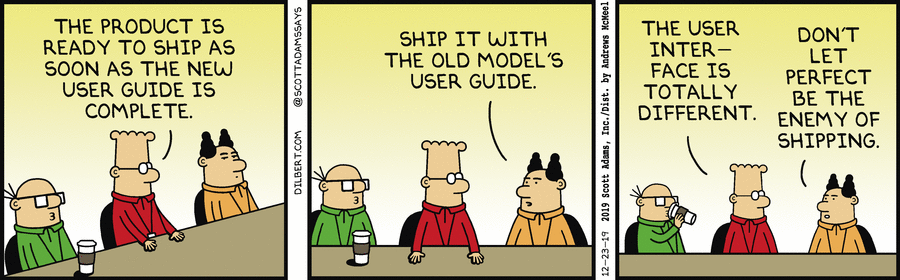
This Dilbert cartoon from December 23, 2019 illustrates a couple of anti-patterns which I've sometimes witnessed in companies who are going through an agile transformation. While it is often true that 80% today is better than 100% tomorrow when we consider benefits such as being first to market, an increased return on investment or accelerating validated learning, that rule of thumb refers to the depth and breadth of product features and not to basic needs. Successful agility implies improving across three dimensions - speed to value realization, product quality and stakeholder satisfaction. Shipping a product prematurely may (temporarily) address the first dimension, but not the other two, and any financial benefits achieved by rushing delivery would be negated by increased costs of poor quality. To add insult to injury, forcing professionals to do shoddy work to meet an artificial deadline will most likely demotivate them. What might have caused this? Perhaps the Pointy Haired Boss (by the way, I realize that Scott Adams wanted readers to be able to easily compare him to managers within their own companies, but I think naming him is well past due) has an isolated, near term performance objective such as achieving a specific product delivery date rather than looking at customer satisfaction or the volume of customer complaints. But there might be more at play here. A second anti-pattern might be localized optimization causing systemic sub-optimization. If the product build team had improved their ability to deliver without the user documentation team having been brought along for the ride, the overall product enhancement value stream won't have been improved. Product enhancement value streams are Complex Adaptive Systems (CAS). Improving a component of a CAS without understanding the upstream and downstream implications might generate more problems than the benefits achieved. When dealing with a CAS, a holistic, system-level approach is needed to understand and address root causes if the goal is faster delivery. This extrapolates the mindset of agile beyond the team level to addressing the needs of an overall CAS. Just as we wouldn't want individual team members making improvement decisions which benefit them but hurt the team as a whole, we wouldn't want individual teams optimizing their work processes at the detriment of other players in the CAS. This is why the seventh principle of Disciplined Agile is so important - Enterprise Awareness is a critical ingredient for successfully scaling agile.
|