Viewing Posts by Vivek Goel

No-Code and Gen Z: The Productive and Future-Proof Match


| For the new generation of workers just entering the workforce (who we fondly call Gen Z), it’s about meaningful jobs and building an impactful career than run-of-the-mill stuff. In the aftermath of the pandemic, people are reflecting on what they want from their jobs and growth trajectory. Gen Z, in particular, is placing more importance on workplace flexibility. “Work-life balance” has become the ultimate selling point to attract, motivate, and keep early-career workers. In addition, these young employees desire cutting-edge technology that will enable them to remain as productive, effective, and connected as possible. The Equation between Gen Z and TechnologyGen Z is the first generation who grew up in a digital age. Therefore, they are accustomed to connectivity and technology. Early exposure to devices from millennial parents is thought to have resulted in them having their smartphones by the age of 12. Global Web Index’s survey indicates that 98% of Generation Z worldwide own smartphones. At least 8 hours a day is how 74% of Gen Z spend their free time online. They are available on various gadgets, including laptops and tablets. Their exposure to digital media affects how people get information and form opinions. Advantageously, these can serve as platforms for creative expression, inquiry, and learning. They are more knowledgeable about the technical aspects of technology now that they have been exposed to it. Coding has already been incorporated into the middle school curricula in nations including the United States, Australia, and Israel. Teaching coding to young minds can facilitate adoption and provide them the ability to approach challenges logically and creatively. They can use this expertise not just in programming but in a variety of other careers. However, due to a lack of mentors and modernized technology, this has not yet been appropriately implemented in other nations. But now that no-code platforms are available, kids will find it simple to start creating their no-code programs, websites, or apps. These resources will make visual programming as simple as dragging and dropping for them. Although there is some code, the learning curve is simple and can be quickly picked up on sites like Youtube, Twitter, Discord, etc. No-Code and Gen Z – The perfect matchMaintaining employee engagement and preventing burnout is more critical than ever in the face of the “Great Resignation,” which saw four million Americans quit their jobs in July alone. Giving employees the ability to automate away the most tedious parts of their days is the best approach to handle this. Gen Z is accustomed to using technology to solve problems because they were raised in an era of Google, YouTube how-to videos, and drag-and-drop website builders. There is no reason why this should be any different in the workplace. But unfortunately, no-code is the DIY technology this generation has been waiting for. No-code platforms have become a golden goose for Gen Z, who have limited access to coding education. A generation of young, “not so obsessed with coding” personnel is being given unprecedented flexibility, thanks to no-code platforms. They can build team-specific applications without much dependency on IT. No-code is not limited to apps and websites but can enable workflow automation for mundane tasks. As a result, flexibility-loving young employees can save many hours on admin tasks and involve themselves in other high-level analyses and processes. Of course, no-code tools require deductive reasoning that is inherent to coding. For example, you must be able to create pivot tables or comprehend what machine learning capability is and its potential applications. The critical thing to remember is that no-code tools are practical because they are simpler to use and appeal to a younger generation familiar with the reasoning these platforms need to operate. Moreover, today’s students view their computers and mobile gadgets as more than merely consuming screens they can activate. Instead, they use them as tools of self-expression, research, and analysis. Gen Z, No-Code, and Creator EconomyIn the creator economy, a person or a group creates visual material or a tangible good and uploads it on a platform. It might be a YouTube video, a handmade necklace sold on Etsy, or even a carefully cropped Instagram photo. It can generate income if someone interacts with it or sees it. Selling, sponsorships, and subscriptions for unique content are ways they can make money upfront. It’s a tailor-made model for Gen Z for running independent businesses. No-code is now a tool for creators and young entrepreneurs, with Web3 enabling the decentralization of content delivery. Platforms that can facilitate the production, distribution, monetization, and business management of Gen Z are indispensable for the creator economy to expand. No-code development gives more individuals the ability to become creators and gives creators control over how their work is distributed. No-code platforms give creators access to other key technologies like AI or blockchain, which can significantly benefit their solopreneur ship. Additionally, they can now create NFT collections consistent with their brand. Given that most young creators are presumably not tech-savvy, no-code is an ideal tool for the creator economy. Only a tiny fraction of people can create apps or websites from scratch; even then, it typically takes them years to learn and even longer to complete. For a variety of reasons, no-code can give a big push to the middle-class creator economy. ConclusionRaising the bar is a crucial aspect of progress in many ways. For example, the standard for data utilization in the workplace, in business, and entrepreneurship is being raised by Gen Z. They are more adept than ever at combining multiple standalone services and integrating them into seamless user interfaces for their clients, readers, and users. The No-Code Generation can close the productivity gap in the global economy, improving our lives and saving everyone’s time in the process. |
Are citizen developers slated to outnumber professional coders? Let’s find out.
| Gartner made a significant prediction at the virtual symposium for CIOs and IT leaders. By 2023, there will be at least four times as many active citizen developers at large businesses as professional developers. For those who don’t know, a citizen developer creates software without receiving formal training in software development by leveraging no-code platforms and analytics tools to automate processes for themselves and their teams. What is causing this shift in application development?Essentially citizen developers are business users whose productivity is hampered by laborious, disjointed processes; as a result, they are more than prepared to improve routine operations through no-code development. They can create software to automate manual operations. They can design optimized workflows (automation sequences) by selecting from a list of pre-configured stages and placing them in a logical flow using the drag and drop feature of no-code platforms. In a survey done by Forrester, 64% of business and tech leaders indicated that process automation is crucial to corporate strategy, supporting digital transformation and customer experience. From a single no-code platform, citizen developers can build and customize administrative, data-tracking, and reporting tools. Typically, there are separate apps spread across many departments and go unnoticed by IT teams for each of these characteristics. IT teams may quickly monitor and maintain apps by using a single no-code platform to configure all of the applications. Because of these reasons, a majority of businesses today rely on citizen developers to produce enterprise business software or applications specific to marketing, sales, HR, or other critical functions. These developers typically report to the IT department, and skilled/professional developers supervise their work to ensure the final product/outcome matches the standards. Moreover, organizations are constantly pushing themselves to build operational and strategic agility for: • Democratizing application development. On the other hand, hyperautomation is on the rise, helping firms make it possible for non-programmers to create complex software. Most of the time, employers do not require prior software development training, although there are specific qualifications for this position. Things to keep in mind while choosing non-programmers• Business users who are or have been involved in time-consuming manual processes are known as citizen developers. Therefore, a person with practical experience working with paper-based processes and knowledge of the associated pain spots is the ideal candidate for citizen development. • Although no technical knowledge is necessary to use no-code platforms, users must have a strong understanding of business logic to construct apps visually. As a result, this may be the second factor to consider when selecting your citizen developer. • Because citizen development is carried out through a governance model and is not autocratic, an ideal candidate should also have a collaborative approach. • Citizen developers are much more than just lone contributors. No-code development is not their primary responsibility; they must balance various tasks. Time management is thus yet another trait of a successful citizen developer. • Business technologists or skilled, full-time developers or coders brought into departments like operations, finance, accounting, or marketing are ideal candidates for citizen development. Citizen Developers are breaking stereotypesTo automate business processes and data integration, Gartner firmly believes that businesses must collaborate with experts outside of IT. This essentially ends reliance on software development teams. Additionally, it stated that businesses should reject the idea that the work of citizen developers is easy and non-critical. Most citizen developers actively work on developing new features, user interfaces, and algorithms. Hyperautomation has played a key role in the success of citizen developersGartner defines hyper-automation as a business-driven, focused approach that businesses need to identify, enhance, and automate their enterprise processes rapidly. Because hyperautomation has so much potential and entails many possibilities, relying solely on traditional coders and IT teams will never produce the desired results. Enterprises have quickly realized this and have been proactively training more employees to become citizen developers. Organizations are no more holding themselves back from realizing enterprise-wide process management and workflow automation. As most of them are adopting a hybrid workforce model, it becomes imperative to encourage non-technical employees toward citizen development and reduce the burden of IT teams already stressed out with simple troubleshooting. Enterprises are actively investing in citizen developers to democratize and pace up innovation – enabling UI/UX designers, business analysts, and marketers to build priority-specific applications without writing a single line of code. They are trying to nurture code-agnostic development teams with the help of no-code platforms. Just like the future of coding is no coding, the end of automation is no-code automation. Organizations are stretching themselves to achieve end-to-end automation while rooting for a hybrid workforce model (where the availability of IT resources will always be a matter of concern). Citizen development is evolving and providing a fantastic opportunity for business and IT leaders to fulfil their primary strategic goals, the most significant of which is enterprise-wide automation. The rise of citizen developers aligns with the rise of digital-first organizationsOrganizations are going full throttle in digitization by investing heavily in low-code and no-code tools to build various applications. They are building teams, for example, a team of citizen developers, that rely on agile methods to integrate critical operating units with the IT organization, augmented by a set of new digital roles that are helping in value creation. The idea behind establishing such teams is to promote innovation and value generation by focusing on: • Using analytics to assess operations and performance before taking action based on the findings. • Using agile principles to test and deploy new hardware and software. • Building and delivering new digital processes and solutions for field operations along with back-office processes (that can be standardized and scaled across businesses). There are a lot of examples and trends that indicate the growing popularity of citizen developers. Can they outnumber traditional developers? It doesn’t seem a remote possibility anymore and is as accurate as it can get. |
Well begun is half done: Take these steps to kick-start Citizen Development project
| Digital acceleration is a buzzword today because of the new technological trends such as cloud computing, mobile phones and social media. There is an increased focus on delivering customer experiences and business agility through the use of digital tools and platforms. Users are encouraged to become citizen developers who can deliver products faster than traditional programming models. This can be done by using no-code technology and platforms that enable business users to build custom apps without requiring any coding knowledge. But how can organizations create a conducive environment for citizen development? This article explores the key steps organizations can take to become citizen development-friendly. Step 1 - Demarcating the key roles to cover the entire gamut of citizen developmentCitizen development requires coverage on a strategic level and tactical and operational levels. Fusion teams should be created in order to support enterprise innovations. The roles and responsibilities of citizen developers and technical people need to be demarcated. i). Strategic RolesThese are citizen development champions having the experience and skill set of CxOs. This role requires someone who understands how citizens interact with technology. They need to know the requirements of citizen development and understand the challenges involved in developing software solutions. Appointing such people may require effort and time, but the benefits are great. ii). Tactical RolesIndeed, no-code platforms don't require any coding skills. However, a certain section of your business users' and programmers' teams should have the technical and tactical understanding of no-code platforms, and know-how is still required. This can help you nurture individuals who can oversee applications built by citizen developers. To successfully carry out integrations with third-party solutions, your technical staff should understand the nitty-gritty of no-code applications. These individuals can also provide relevant guidance to programmers and citizen developers. iii). Operational RolesTo some extent, operational roles and responsibilities are primarily held by citizen developers and also by no-code masters. Depending on your organization's functioning (centralized or decentralized), you may put citizen developers in one or more departments or business units. When defining the scope of work for citizen developers, you will need to decide whether you will adopt the no-code approach to build departmental workflow apps or customer-facing apps. The primary role of citizen developers (business users) is not to build applications, and therefore, it's essential to designate the minimum and the maximum number of citizen development hours. Step 2 - Selecting business users who are the best fit for citizen developmentCitizen development is an important part of modern software development because many manual tasks that used to be performed manually have now been automated. Examples include data entry into databases and the creation of spreadsheets. Therefore, people who excel as citizen developers are often sought after by businesses looking to automate some of their mundane back-office operations. Citizen development doesn't require any technical knowledge but requires some basic business skills. For example, if you are a citizen developer and want to create an application, you first need to know how to use visual tools (like drag & drop) and then learn what type of data your app collects. You also need to understand how to handle errors and validate user input. In addition, there may be other prerequisites depending on the platform you choose. An ideal candidate must be an independent contributor without being a lone wolf. Citizen developers do not act independently but participate with others within the group to develop solutions while juggling different roles. Time management skills are therefore essential when working with citizen development groups. Step 3 - Choosing the right no-code platform for citizen developersYou can follow these steps to choose the best possible no-code platform for your innovation goals. i). Determine your focus goalsYou can't go overboard with no-code application development, and it is essential to have some focus goals. In this regard, choosing the right project is paramount. For example-
Some of your focus goals can be:
ii). Create a list of functionalities you want in your no-code applicationDifferent no-code platforms support different sets of functionalities. Of course, you should select the one which covers the maximum ground. Here is a general list of functionalities that no-code platforms support, and you can map this list with your requirements.
iii). Create a list of integrations you want your application to supportSome applications exist within an ecosystem of other apps, systems, and devices and therefore require integration capabilities. For example, the application may require access to user contacts and the company's financial data. You can refer to the below list of integrations. Based on your selection, you can zero in on a no-code platform.
iv). Address critical questionsWhen choosing from a list of prominent vendors, it all comes down to their value proposition. These questions will bring you more clarity in the context of no-code platforms.
Step 4 - Imparting training to citizen developersNo-code platforms are designed to simplify application development. Non-IT professionals can develop software applications without needing a background in programming. These platforms allow businesses to create custom apps quickly. However, there is still a significant learning curve for citizen developers who want to use these no-code tools. Frequent education and training need to be imparted as new features continue to enhance these platforms. To seamlessly collaborate with IT, you need a no-code platform and a common language to communicate. Yes, citizen developers don't need to learn to code, but they need to understand the nitty-gritty of software development life cycle and agile methodologies, prototyping, wireframing, and design thinking. Citizen developers should also be briefed on relevant data lists and connected systems. It's ideal for them to take multiple before gaining access to a no-code platform. You can ensure cross-functional learning opportunities for citizen developers in workshops, hackathons, and community events. ConclusionCitizen Development requires an agile approach where new technologies and skillsets are adopted quickly and iteratively. Your governance should be flexible enough to adapt as requirements change. The above-mentioned steps will help you streamline the humongous task of rolling out citizen development. |
Citizen Development Can Pave the Way For Agility in 2022. Here’s how!
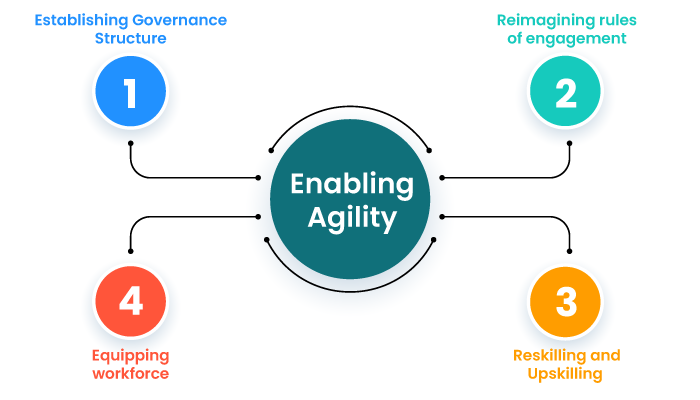
| On one hand, businesses are going full throttle on digitizing their operations, but on the other hand, IT talent shortages hamper the timely implementation of complex software. However, no-code development platforms are proving to be effective. No-code platforms reduce development complexity to the point where business users can create solutions without knowing programming, APIs, or how to deploy web or mobile apps. No-code solutions, which are frequently packaged as a SaaS (software as a service) or PaaS (platform as a service), simplify many complex aspects of development so that business users and IT teams can become more agile and focus on generating functionality. According to Gartner, the market for no-code/low-code application platforms would grow by more than 30% from 2020 levels by 2022. By embracing these no-code solutions, project managers may serve the diverse and often siloed interests of both IT and business as IT project leaders and business process stakeholders. But what are the advantages of no-code development, and how can you put them into practice in your project teams? The answer could be in citizen development — creating a group of non-technical team members to take up some of the tasks that IT teams can’t focus on due to lack of bandwidth. According to Gartner, citizen developers will build 80% of all technological products by 2024, up from just 25% in 2014. This rapid spread is attributed to the COVID-19 pandemic: New business models and processes arose as organizations hurried to implement cloud services and digital initiatives to deal with a distant workforce. These occurrences coincided with the rapid adoption of agile frameworks in recent years, which place a premium on speed and shorter development cycles. Along with developer scarcity, all of this has allowed citizen developers to fix various issues. Citizen development from an agility standpointIn today’s organizations, there is a lot of unmet demand that central IT solution teams can’t address. When citizen developers are given no-code tools, they can build solutions ten times faster than if they had to rely on programming alone. They tackle problems as they arise, creating applications that are unlikely to be quickly built by IT, given the number of projects they are already handling. Developers and architects may focus on more complicated solutions that offer real value to the business. It translates to higher overall productivity (98 percent less time spent producing operational dashboards, for example) and better business results. Embracing no-code means adopting a philosophy that prioritizes user empowerment. However, it would help if you had a new software development life cycle that is flexible and built on agile principles to empower consumers. You also require a framework to assist citizen developers in rapidly developing applications and getting real-time feedback from stakeholders. Enabling agility with citizen developmentUnderstanding citizen development is one thing, but understanding how to scale it is another. To successfully adopt and scale citizen development, your organization needs to:
Without the aforementioned considerations, citizen development applications may cause more harm than good, causing extra work or confusion instead of solving a problem. Your citizen development practitioners need tools to design and build their applications within the context of the business and the entire organization. Citizen development governance structureAlthough business users can easily use no-code platforms to build custom, priority-specific applications in an agile fashion, their roles and responsibilities need to be earmarked to prevent the challenge of shadow IT. This can be achieved by establishing a well-thought-out governance structure. Your IT governance model can take a top-down approach, with a single authority overseeing your entire citizen development programme, including various projects and initiatives. Your CTO can lead this office, which can be placed within your IT department. There are other governance models as well, and organizations can choose based on the assessment of their maturity level. The office can establish no-code development best practices and roll them out across the firm, ensuring that all teams (technical and non-technical) are on the same page. Other tasks may include the following:
Identifying the “right fit” candidate for citizen developmentSomeone with hands-on experience dealing with paper-based processes and understanding the associated pain points is a great candidate for citizen development. No prior coding knowledge is required to use no-code platforms, but the desired candidate must have a solid grip on business logic. It’s important to note that citizen development is not a one-man show and is carried out through a governance paradigm. Therefore, an ideal candidate should also have a collaborative approach. Citizen developers are much more than self-sufficient contributors. They are primarily business users; therefore, no-code development is not their primary responsibility, and they must balance numerous tasks. As a result, another quality of a productive citizen developer is time management. ConclusionWith the rise of citizen developers, the extent of democratization of software development is also rising, which is significantly facilitating agile application development. Although realities like shadow IT may appear frightening, having a defined set of governance principles, roles, and obligations can help make citizen development successful. As more companies adopt a hybrid workforce model, it’s critical to direct non-technical staff toward citizen development rather than burden remote-based IT personnel with day-to-day troubleshooting. No-code platforms are democratizing and speeding up innovation by allowing business analysts, product designers, and marketers to act as citizen engineers. |