

Citizen Development Can Pave the Way For Agility in 2022. Here’s how!


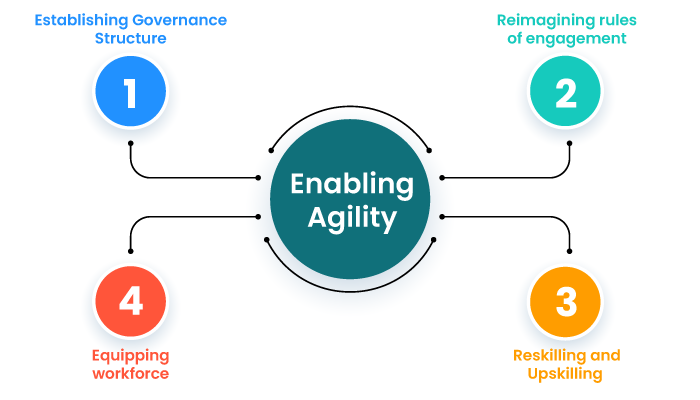
| On one hand, businesses are going full throttle on digitizing their operations, but on the other hand, IT talent shortages hamper the timely implementation of complex software. However, no-code development platforms are proving to be effective. No-code platforms reduce development complexity to the point where business users can create solutions without knowing programming, APIs, or how to deploy web or mobile apps. No-code solutions, which are frequently packaged as a SaaS (software as a service) or PaaS (platform as a service), simplify many complex aspects of development so that business users and IT teams can become more agile and focus on generating functionality. According to Gartner, the market for no-code/low-code application platforms would grow by more than 30% from 2020 levels by 2022. By embracing these no-code solutions, project managers may serve the diverse and often siloed interests of both IT and business as IT project leaders and business process stakeholders. But what are the advantages of no-code development, and how can you put them into practice in your project teams? The answer could be in citizen development — creating a group of non-technical team members to take up some of the tasks that IT teams can’t focus on due to lack of bandwidth. According to Gartner, citizen developers will build 80% of all technological products by 2024, up from just 25% in 2014. This rapid spread is attributed to the COVID-19 pandemic: New business models and processes arose as organizations hurried to implement cloud services and digital initiatives to deal with a distant workforce. These occurrences coincided with the rapid adoption of agile frameworks in recent years, which place a premium on speed and shorter development cycles. Along with developer scarcity, all of this has allowed citizen developers to fix various issues. Citizen development from an agility standpointIn today’s organizations, there is a lot of unmet demand that central IT solution teams can’t address. When citizen developers are given no-code tools, they can build solutions ten times faster than if they had to rely on programming alone. They tackle problems as they arise, creating applications that are unlikely to be quickly built by IT, given the number of projects they are already handling. Developers and architects may focus on more complicated solutions that offer real value to the business. It translates to higher overall productivity (98 percent less time spent producing operational dashboards, for example) and better business results. Embracing no-code means adopting a philosophy that prioritizes user empowerment. However, it would help if you had a new software development life cycle that is flexible and built on agile principles to empower consumers. You also require a framework to assist citizen developers in rapidly developing applications and getting real-time feedback from stakeholders. Enabling agility with citizen developmentUnderstanding citizen development is one thing, but understanding how to scale it is another. To successfully adopt and scale citizen development, your organization needs to:
Without the aforementioned considerations, citizen development applications may cause more harm than good, causing extra work or confusion instead of solving a problem. Your citizen development practitioners need tools to design and build their applications within the context of the business and the entire organization. Citizen development governance structureAlthough business users can easily use no-code platforms to build custom, priority-specific applications in an agile fashion, their roles and responsibilities need to be earmarked to prevent the challenge of shadow IT. This can be achieved by establishing a well-thought-out governance structure. Your IT governance model can take a top-down approach, with a single authority overseeing your entire citizen development programme, including various projects and initiatives. Your CTO can lead this office, which can be placed within your IT department. There are other governance models as well, and organizations can choose based on the assessment of their maturity level. The office can establish no-code development best practices and roll them out across the firm, ensuring that all teams (technical and non-technical) are on the same page. Other tasks may include the following:
Identifying the “right fit” candidate for citizen developmentSomeone with hands-on experience dealing with paper-based processes and understanding the associated pain points is a great candidate for citizen development. No prior coding knowledge is required to use no-code platforms, but the desired candidate must have a solid grip on business logic. It’s important to note that citizen development is not a one-man show and is carried out through a governance paradigm. Therefore, an ideal candidate should also have a collaborative approach. Citizen developers are much more than self-sufficient contributors. They are primarily business users; therefore, no-code development is not their primary responsibility, and they must balance numerous tasks. As a result, another quality of a productive citizen developer is time management. ConclusionWith the rise of citizen developers, the extent of democratization of software development is also rising, which is significantly facilitating agile application development. Although realities like shadow IT may appear frightening, having a defined set of governance principles, roles, and obligations can help make citizen development successful. As more companies adopt a hybrid workforce model, it’s critical to direct non-technical staff toward citizen development rather than burden remote-based IT personnel with day-to-day troubleshooting. No-code platforms are democratizing and speeding up innovation by allowing business analysts, product designers, and marketers to act as citizen engineers. |
How to Choose the Right Low-Code No-Code Software
IntroductionThe technology world advances every second, which is fantastic if you, like me, love technology. However, at the same time, in such a vast world of tech solutions, you can easily feel overwhelmed and lost. Regarding Citizen Development, it’s no different. The movement has grown so much in the past few years and we have so many low-code and no-code players in the game now that deciding who is the winner has become a hard task, but when it comes to choosing a winner, are they all really playing the same game? And apologies for the spoiler here, they are not. Your Needs Come FirstWhen it comes to choosing a low-code/no-code tool, you need to have an overview of what you want. Don’t worry, you will probably not get it all in the first go, no one does and that is all right, but it is crucial to describe and decide on some features or requirements that are a “must have” for your citizen development project. For example, “I want to use charts in my solution” or “I want it to be mobile native”. If you don’t have a few requirements in detail to start filtering down the software platform to use, you will be stuck. In the last project I worked on, one requirement was as simple as “we need a radar chart”. With that we were able to discard about 85% of platforms. You only need a few points on what you want and need, and this will make the process a lot easier. It is like deciding where to go on your summer holidays, if you are looking for a warm and hot place going to Scandinavia is probably on the bottom of your list. Alternatively, Scandinavia could be on the top of your list if your goal is to see the Aurora Borealis! Do Not Reinvent the WheelAnother important piece to consider is an Environment Check. If you have read PMI’s Citizen Development Handbook, you will know what I’m talking about. The Environment Check section asks questions around if there is already a solution in the market or if there is a similar tool in your organisation, etc. I strongly recommend the book as a guide for this process. This might surprise you but many platforms offer plenty of templates where you can simply input or plug your data into it and are ready to go. How amazing is that? If you have a ready-to-go solution why would you try to create something from scratch? Don’t get me wrong, I do love to create apps to solve problems but I love to solve problems more. More important than just figuring out if there is already a solution for your problem is figuring out if you or your organisation have the skills, capacity and capability to build this app using a Citizen Development approach. Although it doesn’t look like it, creating might not be the hardest part of the process but maintaining and administering it needs consideration. Always have that clear in your mind whenever you start a citizen development project. It is A Game. Play Around.Your particular project idea might not be already done on an existing template but I’m sure the right platform for you to go and develop it is there. The best way to get to know a platform and what it is capable of, its strengths and weaknesses, is playing with it. The majority of the vendors offer a demo or have a tutorial where by the end of using it you will have an application, but that is not the key goal here. Although, having an application after a tutorial is great, better than that is having a really good understanding of how the platform works. In the first 3 minutes of using it, you will already have an opinion about the platform, such as “it is not user friendly”, “I couldn’t understand what is going on”, “this is amazing”, “where is the radar chart?”. I am a very visual person, so I think it is crucial that the platform offers a nice and smooth design and has an easy-to-navigate around it approach, but at the same time, spending extra time playing with the tool makes you feel more comfortable with it. It might not check all the boxes for you, the user, but it could check all the boxes for your solution, and that is what you should be aiming for. It is all about getting familiar with the tool and understanding what it is good at and where it is not so good. Answering a Million-Dollar QuestionIf you have managed to create a list of requirements, and have spent some time identifying strengths and weaknesses on the platforms you should be able to answer the million-dollar question “What is the best tool to use for my project?” This process can be stressful as the number of LCNC platforms out there keep growing and are every single day, but you need to make sure that they provide a solution for the area you are looking for, by that I mean automation, working with data on spreadsheets, or design and creating content, etc. For example, the tool that provides a LCNC approach for automation won’t be the right tool if you want to create a responsive website. Having clarity around what your problem is and how you want to solve it, will save you time on your search for the perfect tool. Believe me, the perfect tool is there, waiting for you to find it. If you have registered for my upcoming webinar on 16th of June then I look forward to sharing my experience with you, it will be available on demand afterwards if you haven't managed to grab a place. |
Citizen Development Part 1: What Is It and Why Do We Need It?
| In this series of five articles, I'll be taking a comprehensive look at citizen development, from getting started to governance to scaling. Of course, there are certain principles to citizen development upon most of us will agree, but at the same time, different types of organizations will naturally have different experiences to draw on. For that reason, I'm going to start with a basic overview of the key elements that make up citizen development – how we at Betty Blocks define it and why we're so passionate about supporting its adoption throughout enterprise organizations.
What is citizen development?For the sake of clarity, this is how we define citizen development at Betty Blocks: "A strategic program in which a new breed of developer builds applications on a platform that is governed by IT." Note the governance part. It's something that we see lacking in citizen development definitions from time to time, but citizen development without governance is simply 'shadow IT'.
How did we get to citizen development?The experienced developer shortageBy now, we've all heard about the increasing experienced developer shortage. But what are we talking about in terms of actual numbers? Statistics on the number of people in the world who can code range from 0.3% to 0.5%. That means that at least 99.5% of us can't write code. Isn't that crazy? With how much we rely on software in our everyday lives, for work as well as for pleasure, you'd be forgiven for thinking that these numbers have to be wrong. Enterprise organizations, however, see the full picture all too clearly. Enterprise leaders understand these numbers because they see them directly reflected in the infamous and titanic backlogs – and titanic isn't a bad metaphor, considering the many tasks that spend so long on these backlogs they eventually sink into oblivion, as markets move on and render yesterday's ideas obsolete. In fact, according to research by PMI, 86% of IT decision-makers site the greatest threat to digitally transforming their business as a shortage of developers. In other words, the demand for software is skyrocketing and there simply aren't – and won't be – enough experienced developers to fulfill this demand. The knock-on effect of this is that application delivery is too slow – far from ideal during the current pandemic, in which organizations need to speed up delivery to meet the rising demand for digital products and services. This leaves IT departments with their hands full just trying to keep daily operations running smoothly. And it leaves the business-side departments – customer services, sales, marketing, product, etc. – facing a roadblock in their need to modernize, adapt, and innovate. Shadow ITAnother reason we find ourselves in this brave new world of citizen development is shadow IT. I mentioned that many business-side employees, though dying to solve problems and innovate, are stuck, with no safe and effective way to realize their brilliant ideas. But that doesn't mean they won't try. Shadow IT is rife throughout enterprise organizations because when IT doesn't have the time to get the job done, the business side inevitably takes matters into its own hands. Although well-intentioned, this type of unsanctioned development leads to all sorts of problems, particularly in the areas of security, scalability, and maintenance.
Working smarterThere's more to citizen development than tackling the experienced developer shortage, the slow delivery time for applications, and the rising demand for software. As customers are able to shop around more easily and access a greater array of options – products, services, vendors – than ever before, organizations need to work smarter to stand out. What does working smarter mean? In this case, it means having the people that are closest to the problem play an active role in building the solution. If a customer service employee has a great idea for improving a customer-centered process, it makes sense to have them build the solution in an environment set up for citizen development success, under the governance of IT. Injecting that expert knowledge into the development process has, for many organizations, proven invaluable.
The tech that makes it possibleAn effective citizen development platform should make development accessible to non-experienced developers whilst facilitating governance for central IT. This is the reason why no- and low-code platforms are the go-to tools for citizen development. Both platforms generally utilize visual, drag-and-drop interfaces, which lower the technical barrier to entry whilst making it easy for IT to set permissions and roles, ensuring everything is done safely. We'll take a closer look at no- and low-code platforms later in this series.
Next time: Getting started with citizen developmentI've covered the main challenges that led to the birth of citizen development. I've covered how citizen development expands the developer pool, providing organizations with additional resources. I've touched on how citizen development invites business-side insight into the development process, making for better products and services. In the next article, I'll be taking a look at where organizations actually start with citizen development: The discovery phase. See you next time! |

Citizen Development Part 1: What Is It and Why Do We Need It?
| In this series of five articles, I'll be taking a comprehensive look at citizen development, from getting started to governance to scaling. Of course, there are certain principles to citizen development upon most of us will agree, but at the same time, different types of organizations will naturally have different experiences to draw on. For that reason, I'm going to start with a basic overview of the key elements that make up citizen development – how we at Betty Blocks define it and why we're so passionate about supporting its adoption throughout enterprise organizations.
What is citizen development?For the sake of clarity, this is how we define citizen development at Betty Blocks: "A strategic program in which a new breed of developer builds applications on a platform that is governed by IT." Note the governance part. It's something that we see lacking in citizen development definitions from time to time, but citizen development without governance is simply 'shadow IT'.
How did we get to citizen development?The experienced developer shortageBy now, we've all heard about the increasing experienced developer shortage. But what are we talking about in terms of actual numbers? Statistics on the number of people in the world who can code range from 0.3% to 0.5%. That means that at least 99.5% of us can't write code. Isn't that crazy? With how much we rely on software in our everyday lives, for work as well as for pleasure, you'd be forgiven for thinking that these numbers have to be wrong. Enterprise organizations, however, see the full picture all too clearly. Enterprise leaders understand these numbers because they see them directly reflected in the infamous and titanic backlogs – and titanic isn't a bad metaphor, considering the many tasks that spend so long on these backlogs they eventually sink into oblivion, as markets move on and render yesterday's ideas obsolete. In fact, according to research by PMI, 86% of IT decision-makers site the greatest threat to digitally transforming their business as a shortage of developers. In other words, the demand for software is skyrocketing and there simply aren't – and won't be – enough experienced developers to fulfill this demand. The knock-on effect of this is that application delivery is too slow – far from ideal during the current pandemic, in which organizations need to speed up delivery to meet the rising demand for digital products and services. This leaves IT departments with their hands full just trying to keep daily operations running smoothly. And it leaves the business-side departments – customer services, sales, marketing, product, etc. – facing a roadblock in their need to modernize, adapt, and innovate. Shadow ITAnother reason we find ourselves in this brave new world of citizen development is shadow IT. I mentioned that many business-side employees, though dying to solve problems and innovate, are stuck, with no safe and effective way to realize their brilliant ideas. But that doesn't mean they won't try. Shadow IT is rife throughout enterprise organizations because when IT doesn't have the time to get the job done, the business side inevitably takes matters into its own hands. Although well-intentioned, this type of unsanctioned development leads to all sorts of problems, particularly in the areas of security, scalability, and maintenance.
Working smarterThere's more to citizen development than tackling the experienced developer shortage, the slow delivery time for applications, and the rising demand for software. As customers are able to shop around more easily and access a greater array of options – products, services, vendors – than ever before, organizations need to work smarter to stand out. What does working smarter mean? In this case, it means having the people that are closest to the problem play an active role in building the solution. If a customer service employee has a great idea for improving a customer-centered process, it makes sense to have them build the solution in an environment set up for citizen development success, under the governance of IT. Injecting that expert knowledge into the development process has, for many organizations, proven invaluable.
The tech that makes it possibleAn effective citizen development platform should make development accessible to non-experienced developers whilst facilitating governance for central IT. This is the reason why no- and low-code platforms are the go-to tools for citizen development. Both platforms generally utilize visual, drag-and-drop interfaces, which lower the technical barrier to entry whilst making it easy for IT to set permissions and roles, ensuring everything is done safely. We'll take a closer look at no- and low-code platforms later in this series.
Next time: Getting started with citizen developmentI've covered the main challenges that led to the birth of citizen development. I've covered how citizen development expands the developer pool, providing organizations with additional resources. I've touched on how citizen development invites business-side insight into the development process, making for better products and services. In the next article, I'll be taking a look at where organizations actually start with citizen development: The discovery phase. See you next time! |
How Citizen Development Empowered by Low-Code/No-Code is Going to Unleash Innovation
How Citizen Development Empowered by Low-Code/No-Code is Going to Unleash Innovation
|



