7 Ways to Show Business Acumen in Your Day-to-Day Work
Business acumen can feel abstract. We see it in job descriptions, but what does it actually look like? Here are seven easy ways to demonstrate business acumen every day.
After layoffs, strong project management isn’t about doing more with less. It’s about resetting expectations, creating alignment, and ensuring that every commitment has a foundation in reality. The result is a roadmap that tells the truth—and a team and organization equipped to deliver on it.
Why do so many organizations remain focused primarily on traditional strategies and priorities? To gain a meaningful competitive advantage, businesses must seek to embrace a more diverse set of strategies—and execute on them consistently.
Compliance is too often treated as something to deal with later, as a final hurdle rather than a foundation. And that assumption is one of the most reliably costly mistakes a project manager can make.
Project management may be guided by universal principles, but the reality on the ground looks very different depending on where you work. Here we explore what happens when PMs move between startups and larger organizations, sharing real-life lessons, challenges, and success stories from both environments.
Organizational stiffness slows down decisions, stops creativity, and makes it harder to adapt. Learn how agile project principles, cross-functional collaboration, and rituals for continuous improvement can help teams get their flexibility back.
IntroductionIn today’s fast-paced, high-stakes business world, the drive to deliver more, faster, and cheaper is relentless. Product Owners and Project Managers stand at the crossroads of customer exp ...
Hi! PM specializing in IT projects here :) After the project charter was signed by the sponsor (and everyone else), we realized that we were missing one success measure for the performance of the soft ...
I recently completed the PMP exam through the Project Management Institute (PMI), after dedicating over six months of focused preparation while balancing full-time work and family responsibilities.Fol ...
IntroductionIn competitive industries, the ability to deliver high-quality products and services is a cornerstone of lasting success. Lean Six Sigma, a methodology rooted in data-driven process improv ...
IntroductionIn today’s complex and fast-moving business world, the demand for Agile transformation has never been higher. Organizations are investing heavily in Agile coaches—individuals who can accel ...
Over the past year, we've seen AI tools rapidly improve in areas such as scheduling, reporting, risk analysis, meeting summaries, documentation, and stakeholder communications.Many tasks that traditio ...
Los sectores que más proyectos movilizan no siempre son los que tienen mayor madurez para ejecutarlos. El caso ecuatoriano permite observar con claridad esta tensión. En 2025, el sector público aparec ...
For more than half a century, project success has largely been evaluated through three fundamental dimensions: schedule, cost, and scope. These measures, commonly known as the Iron Triangle, have pro ...
Compliance is too often treated as something to deal with later, as a final hurdle rather than a foundation. And that assumption is one of the most reliably costly mistakes a project manager can make.
Organizational stiffness slows down decisions, stops creativity, and makes it harder to adapt. Learn how agile project principles, cross-functional collaboration, and rituals for continuous improvement can help teams get their flexibility back.
This is a Partner Voice highlight with the PMI Educational Foundation’s long-standing partner, STEM Racing. This article accompanies the on-demand webinar Building Future Project Managers: Real-World PM Skills Through STEM Racing.
Why do so many organizations remain focused primarily on traditional strategies and priorities? To gain a meaningful competitive advantage, businesses must seek to embrace a more diverse set of strategies—and execute on them consistently.
After layoffs, strong project management isn’t about doing more with less. It’s about resetting expectations, creating alignment, and ensuring that every commitment has a foundation in reality. The result is a roadmap that tells the truth—and a team and organization equipped to deliver on it.
Project management may be guided by universal principles, but the reality on the ground looks very different depending on where you work. Here we explore what happens when PMs move between startups and larger organizations, sharing real-life lessons, challenges, and success stories from both environments.
Leaders who build trust intentionally, empower others consistently—and attract those who lead with humility and purpose—allowed this practitioner to move into being a project manager instead of a project messenger.
As part of the development of the Manifesto for Enterprise Agility, PMI spoke with executive leaders about how organizations can build this capability in practice. Zoë Merchant, Founder and CEO of Bright, shares her perspectives on creating learning cultures, leading reinvention, and more.
In this interview, Yannick Carriou, CEO of Médiamétrie, defines enterprise agility as the ability to keep adapting while staying grounded in a clear value proposition. He argues that organizations should replace long planning cycles with faster decisions made closer to the work and more frequent reassessment of priorities and value. He also says leaders must move beyond command-and-control, foster psychological safety for experimentation and mistakes, and embed learning across the organization. Ultimately, he presents enterprise agility as a practical way to navigate uncertainty by facing reality, challenging assumptions and aligning work to changing market needs.
In this interview, Sagar Kochhar discusses enterprise agility as an organization's ability to sense change early, make decisions quickly and execute at scale without losing alignment. Drawing on Rebel Foods' evolution from a single-brand restaurant business into a global internet restaurant platform, Kochhar explains that agility is not about speed alone but about combining adaptability with a clear strategic direction. Organizations must be willing to challenge their own assumptions, disrupt successful business models and continuously evolve in response to changing customer behaviors, technologies and market dynamics.
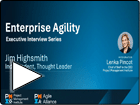
In this conversation, agile pioneer and Agile Manifesto co-author Jim Highsmith reflects on the evolution of agility from software development to the enterprise level. He argues that enterprise agility is not simply about responding to change but also about shaping it, requiring organizations to develop strong sensing capabilities, embrace continuous learning and build leadership judgment. To achieve it, organizations must move from a mindset of control toward one of learning and adaptation. He also explores the role of AI as both a driver of disruption and an enabler of faster learning, while stressing that human judgment remains essential in navigating uncertainty and leading transformation.
In today’s complex project environments, professionals must deliver results while managing competing priorities, stakeholder pressure, and limited authority. Yet many struggle to push back effectively without damaging relationships or credibility.
Many AI tools look impressive in demos, but quietly fail when projects depend on dates, versions, and changing requirements. Models may mix old and new documents, ignore effective dates, or misinterpret deadlines—creating hidden risks for project success.
Learn why and how to apply M.O.R.E. practices leveraging the latest PMBOK® Guide framework to organize project work and deliver value beyond scope, schedule and cost.
Attendees will learn the key dimensions of complexity and which practices drive strong outcomes. We will highlight examples that all project professionals can apply to their own roles.
This webinar explores the evolution of the GPM-b™ credential into the Certified Sustainable Project Professional (CSPP™) and what the transition means for modern project leaders. Attendees will learn how the CSPP™ positions sustainability as a core project management capability, how the credential is earned, and how it fits within the broader certification landscape. The session also examines why sustainable project leadership is becoming increasingly critical for long-term career growth and organizational impact.