To mark Global Ethics Day, we've curated a collection of content exploring ethics in project management from a variety of perspectives. They all remind us that ethical decision-making is not reserved for major dilemmas. It's a skill that can be developed, strengthened and applied in every project interaction.
Raising an ethics concern is a serious act. Therefore, ethical reporting requires more than conviction. It requires discipline, accuracy, fairness and evidence. These five checks before raising an ethics concern can help.
We're often held captive by a training course, watching the completion meter count down. But organizations don't want people to merely go through it. How can we leave people with something they can actually use?
"Not all it's cracked up to be" is a colloquial expression dating from the early 1800s. This term uses "crack up" in the sense of "to praise," as in "this is not praise-worthy."
(Source: atomica.com. )
Everywhere you turn these days it seems like you can't avoid getting bombarded with multiple articles about content management. But if you ask me, they are not all they're cracked up to be, because almost all of them start from the wrong place, with a wrong assumption about why you should spend time and money on content management.
According to IDC, knowledge workers spend up to 50 percent of their time looking for information, leaving them with only 50 percent to make use of this information. In the current economic climate, companies are requiring everyone to do more with less; reducing the time it takes for workers to gain access to answers is now even more mission-critical. But content management, as it currently manifests itself, doesn't help this problem one bit, because its focus is typically only on getting more information in front of people, and not necessarily the right information.
Maybe we need to back up a bit and examine what content is. The broadest possible definition (and the one used by most web-meisters and content managers) includes just about any digital representation of information--text, graphics, pictures, data, source code, HTML pages, XML pages, etc.--typically anything that is just shy of being a formal "document." Documents include books, reports, papers, records, contracts, applications, claim forms, invoices, etc. If they are electronically "managed" at all, it is usually in a manner quite different from content management. Content management, in a nutshell, is an electronic publishing process; it is about eliminating online publishing bottlenecks and optimizing the reuse of media. Content management has very little to do with determining the quality or efficacy of a piece of media or the information presented.
Knowledge management (and document management), on the other hand, is more about determining the quality and efficacy of larger, more formal pieces of content, content that is a combination of media and typically has a more concrete business purpose than does plain information. Additionally, document management then addresses the production and maintenance of those pieces of content that are large and complex combinations of data and information (i.e., documents).
Now let me give you the knowledge management viewpoint on content. Content is much more than data or information; it is knowledge that has been codified (i.e., an investment has been made to make it explicit) so that it can be more easily distributed and reused for a specific business purpose by a targeted audience. It can take many forms, including all of those mentioned above, and the investment may be large or small, but it's not worth much unless people are actively doing something with it in the pursuit of one or more business objectives (whereas many documents are just maintained for historical, audit or regulatory purposes).
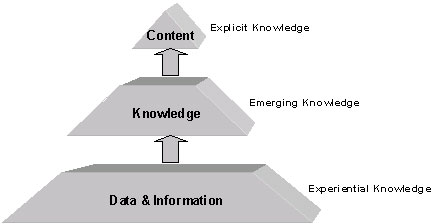
Take a look at the above knowledge "food chain." Data is just digital representation of facts, and information is data with sufficient context (which are just more facts) to make it potentially useful. Knowledge is information with enough intelligence (e.g., its relationship to other pieces of information is understood) to make it insightful and actionable. Content then becomes knowledge that has been codified and packaged--made explicit--so that it is easily delivered wherever it is needed, whenever it is needed.
So from a KM perspective the real question for content managers is not "What content do I have?" but "What content do I need?" Then you work your way back down the food chain to develop that content as efficiently as possible, in a way that will be both efficient and cost effective to maintain and distribute. Only then should you worry about the specific media you will have to organize, catalog, warehouse, package and present for the purpose of content delivery, and the tools you need for doing so.
Most businesses need to be good at both content management and knowledge management. Most businesses probably already have some content management going on--for their external website, intranet, etc.--but aren't doing any formal knowledge management. In fact most of the content being managed is either for external use--i.e., for customers--or is for general internal consumption. In either case the content is typically not linked directly to the execution of a business process, except maybe in the case of online product catalogs. But once you commit to doing real knowledge management--delivering content that has a direct impact on the execution of all of your key business processes--don't let the content managers continue to dictate the rules of engagement for the functions that are involved in both processes, because KM is now the higher order business process, even though content is the output of that process and is at the top of the knowledge food chain.
Bottom line: If you want your content management to be all it's cracked up to be, it must serve the higher purpose of knowledge management. Otherwise you're just moving a lot of ones and zeros through the ether at very high speed, with very little business value to show for it.