The Art of Asking Questions
From the Project Managers Without Borders Blog
by Aliki Courmanopoulos,
Deanna Landers, Romiya Barry, Marisa Silva, Jeffrey Cox, Emma-Ruth Arnaz-Pemberton, Veroni Brussen, Filipe Bergami

This blog provides project management content and tools for non-governmental organizations (NGOs). Our objective is to inspire project managers to volunteer and make a positive difference in the world through project management.
View Posts By:
Aliki Courmanopoulos
Deanna Landers
Romiya Barry
Marisa Silva
Jeffrey Cox
Emma-Ruth Arnaz-Pemberton
Veroni Brussen
Filipe Bergami
Past Contributors:
Chelsa Dornian
Tony Van Krieken
Mario Trentim
Recent Posts
How to be a more effective volunteer
Why Water?
The Art of Asking Questions
Lending Your Expertise When You Have Limited Time
Millennials: Your Best Resources for Project Management in the World of NGOs
Categories
agile,
Best Practices,
capabilities,
Career Development,
Change Management,
cloud,
collaboration,
communication,
Communications Management,
critical success factors,
efficiency,
Engagement,
humanitarian aid,
Managing for Stakeholders,
maturity model,
mentoring,
Millennials,
NGO,
NGOs,
Non-Governmental Organisations NGOs,
Non-Profit project management,
non-project,
Nonprofit,
NPOs,
PMO,
Professional development,
project failure,
Project Management,
project management,
Project Teams,
project teams,
Social Good,
Stakeholder Management,
Stakeholder Management,
Sustainability,
Sustainable Development Goals,
Teams,
training,
virtual,
virtual project teams,
Volunteer,
Volunteering,
Volunteers,
web
Date
As project managers, our role is to get work done through other people. This means we not only need the right people on the team, but we need the humility to admit that there are many people who know much more than we do. “When I started out as a project manager, I would listen intently to the information being shared as I was introduced to a project team. There were always many terms, acronyms, best practices, deliverables, and methodologies that I did not fully comprehend or that were contrary to what I had previously encountered,” reflects Louise Chalupiak, Project Managers Without Borders volunteer and co-host of the TechGenix Xtreme podcast. She recalls how she would quietly listen and take notes, all the while thinking, “don’t worry, it will all make sense as I become more engaged.” And sometimes it did. The problem is that sometimes it didn’t. As a project manager with a similar mindset, you may have experience playing “fix and repair” with issues that could have been avoided if only you had asked the right questions.
In developing the newest Project Managers Without Borders initiative, the WaterRico Project, Eric Schempp and his team had many opportunities to practice the art of asking questions. The WaterRico project was an evolutionary process in trying to understand what the Rotary Club [Centennial Colorado chapter] had in mind and what their goals were. I think there was a learning experience for all of us involved.” The team and project stakeholders used standard project management methodology to define the requirements of the project and to delineate the must-haves from the nice-to-haves in developing the ideas for the project.
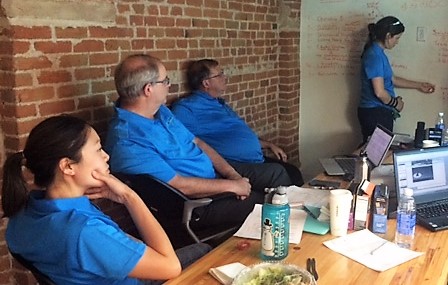 “We understood we wanted to do a water project. But what that meant, we weren’t quite sure,” reflects Schempp. Through research to answer their questions and asking stakeholders about their needs, the team narrowed the scope and goals of the WarterRico project.
Here are a few tips for asking questions:
- In that preliminary project meeting, when someone references an acronym that is your cue to speak up. Ask what the acronym stands for and how did it originate.
- If a reference is made to a program, ask the purpose of the program and who maintains or manages it. This will also help to identify stakeholders who might otherwise have been overlooked.
- If someone mentions a person’s name who is not currently in the room, ask who that person is and if they should be included as a stakeholder.
- If a statement is made that does not resonate with you or seem to make sense, ask for clarification.
Most importantly, also remember
TO BE ABLE TO ASK A QUESTION CLEARLY
IS TWO‐THIRDS OF THE WAY TO
GETTING IT ANSWERED
John Ruskin
The role of the project manager is based on research and communication. Project managers help scope out the vision of the project and help partners to narrow down the project so the outcomes can be realized. This all starts with asking questions, and it is never too early in the project to begin.
Posted
by
Romiya Barry
on: January 23, 2019 08:46 PM |
Permalink
Comments (11)
Please login or join to subscribe to this item

RAJESH K L
Project Manager, PMP| Bharat Electronics, Bengaluru, India
Bengaluru, Karnataka, India
Good post. Thanks for sharing

Alok Priyadarshi
Project Manager| Tata Consulting Engineers Limited
Jamshedpur, Jharkhand, India
Excellent post.
Thanks for sharing!!

Rami Kaibni
 Community Champion
Senior Projects Manager | Field & Marten Associates
New Westminster, British Columbia, Canada
A well thought out question may become half the answer
Excellent post.... thanks for sharing

Vincent Guerard
Coach - Trainer - Speaker - Advisor| Freelance
Mont-Royal, Quebec, Canada
Nice set of tips, Acronym for one is often a problem, many similar acronyms.
Good advice, add what we need to people and respect the conditions of each one, as well as their professional maturity.

Drew Craig
Sr. Agile & Product Coach| Vanguard
Philadelphia, Pa, United States
Great insights and tips, Romiya!

William M Hayden Jr
Adjunct Assistant Professor-Retired| University at Buffalo, School of Management, Operations Management & Strategy
Buffalo, Ny, United States
Blogs
“You may have experience playing “fix and repair” with issues that could have been avoided if only you had asked the right questions.”
Your point. . .. speak up early to clarify any and all questions BEFORE initiation
of the work. . . is unquestionably right on!
And yet, we learn from far too many members of troubled projects that very behavior was not encouraged at the best possible time in the project’s life cycle. . . at the project’s startup sessions!
Background
As frequently and confidentially reported to me from project staff of projects in trouble, their startup meeting went something like this:
8:30 a.m. . . . Senior VP congratulates the project “Team” on how proud the management is of them ‘winning’ this project, how important this project’s success will be to the firm, and wishes them well as he . . . yes, most frequently, ‘he’…leaves the room.
8:35 a.m.…Then, the project manager hands out the meeting’s agenda and asks each Function Manager if they have any need for clarification before they take their list of work back to their department for estimating time and budget breakdown. A couple of them ask “When is the deadline to get back to you?
8:50 a.m.. . . Then the PM asks the room of, perhaps, some 7 to 12 experienced senior professionals who have worked on many projects and have knowledge of this project’s client, fees, project’s physical location, nature of the subcontractors for this type of work, and schedule, the regulatory and administrative agencies who will be involved, and their department staff’s current workload without this new project “Does anyone have any questions?
One hand goes up. “Yes?” What’s the latest date we can get this back to you?
9:00 a.m. Meeting dismissed!
So, you ask, if what you report above is so, why does this happen?
Great question!
The answer is right in your charge to all of us, and I paste it in below.
“issues that could have been avoided if only you had asked the right questions.”
Our professionals are fearful of NOT asking the so-called ‘right’ question.
Actually, the only way, as it turns out, that one can ask the ‘right’ question is after work has failed and/or the cost has greatly exceeded the budget.
And then, as we all have learned, we go on a search for the guilty and punish the innocent.
More on this common project experience, and its cure, if interest surfaces.

Rashed Al Hammadi
VP, Project Division| Abu Dhabi National Oil Company - ADNOC
Abudhabi, United Arab Emirates
Very useful Information. Well said
Please Login/Register to leave a comment.
|
"Talk low, talk slow, and don't say too much."
- John Wayne
|




