Scrum vs Kanban
From the Scrumptious Blog
by Sante Delle-Vergini, PhD

Scrum is the most popular framework used within an agile environment to convert complex problems into valuable products and services. In this blog, we will examine all things Scrum to shed light on this wonderful organizational tool that is sweeping the globe. There will be engaging articles, interviews with experts and Q&A's. Are you ready to take the red pill? Then please join me on a fascinating journey down the rabbit hole, and into the world of Scrum.
Recent Posts
The Agile Engine
Scrum at School
Why SAFe may not be safe
Scrum on Mars
Scrum vs Kanban
Categories
Agile,
Agile Certified Practitioner,
Agile Release Train,
Agile Transformation,
Burndown Chart,
Burnup Chart,
business transformation,
Chief Project Officer,
Development Team,
Distributed Teams,
Earned Value Management,
Flexible Workforce,
Information Radiators,
Leadership,
Lessons Learned,
Mars,
middle management,
New Ways of Working,
PMI-ACP,
Product Owner,
Product Roadmap,
Release Train Engineer,
Remote Teams,
resisting change,
RTE,
SAFe,
Scope Creep,
Scrum,
Scrum Certification,
Scrum in Academia,
Scrum in School,
Scrum Master,
Scrum Team,
Scrum Training,
Scrumian,
Stakeholder Management,
Story Map,
War Room
Date
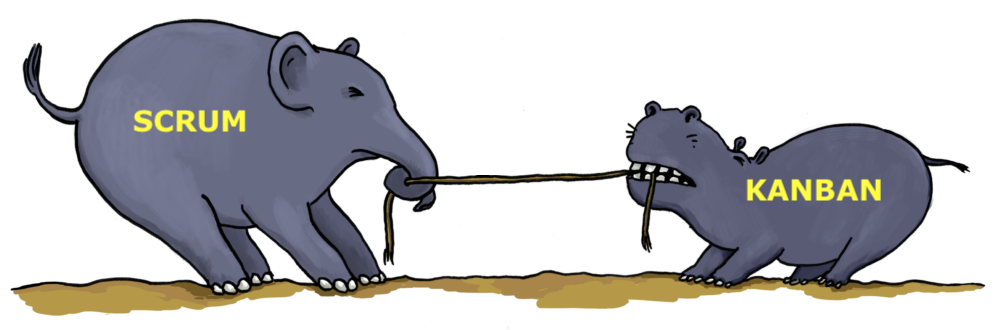
We all love Scrum right? It provides a great framework for providing valuable solutions in an Agile way. When it comes to adopting an Agile framework within organizations, it really has no competitors. But often I get asked the question: "What about Kanban; is that a better way of doing things?"
Of course, this depends on how you define "better". If we are to understand these two powerhouses in the Agile world, it would be prudent to take a brief look at their similarities and differences:
|
SCRUM
|
KANBAN
|
|
Has specifically defined roles
|
Does not have mandatory roles
|
|
Uses Velocity, Burndown Charts to manage and measure performance
|
Uses Lead Time, Cycle Time, WIP, Cumulative Flow Diagrams to manage and measure performance
|
|
Agile approach
|
Lean approach
|
|
Uses time boxes
|
No time boxes, just continuous flow
|
|
Work is based around capacity
|
Work is based around capacity
|
|
Daily meeting
|
Daily meeting
|
|
More structured framework
|
Less structured framework
|
|
Uses a product/issue backlog
|
Uses a product/issue backlog
|
|
More concerned with productivity
|
More concerned with efficiency
|
|
No changes allowed during Sprint
|
Changes can occur as needed
|
As Shakespeare might have said: "To Scrum or to Kanban, now that is the question." Actually, your organizational strategy or specific business requirement will answer that question better than Shakespeare could ever do. In reality, the two can exist together, and often do.
Take a software upgrade and rollout across an organization for example. Many projects such as this begin with Scrum (delivery of the solution), then transition to Kanban for support and issue logging (maintenance of the solution). This example might be closer to DevOps, but that is another buzzword for another buzztime!
Can you think of any other similarities or differences between Scrum and Kanban?
Thank you for your interest in the Scrumptious blog. If you have any ideas for Scrum topics, please message me here. Until next time, remember, projects can be Scrumptious!

Posted on: April 30, 2019 11:49 PM |
Permalink
Comments (30)
Page: 1 2 <prev
Please login or join to subscribe to this item
Hi Al, you get an A lol.
One of the most visible integrations of Scrum and Kanban is the use of the Kanban board, but Scrum doesn't use some of the Kanban elements such as WIP limits. Scrum will "iterate" the work, while Kanban will "flow" the work :-)

Al Taylor
I.T. Contractor| Independent
Waterloo, Ontario, Canada
@Sante...all kidding aside thank-you for your reply!
I mostly get Scrum. I mostly get Kanban. But if someone asked me to stand up and explain how they (maybe) interract I would be challenged...your last comment helps. One observation I will share with everyone is that I see Kanban being used heavily these days but I don't see any attempt to limit WIP. That seems kind of funny but not funny at the same time.
Al, when you say you see Kanban being used, do you mean a Kanban project or a Kanban board? Many projects are running a "Kanban" board but are in fact Scrum projects, or other frameworks using a similar board. Perhaps the project is small, low budget or not critical. If it is a Kanban project, perhaps they are not using WIP limits because they are not concerned about bottlenecks in the workflow, or resource utilization, or a focus on story completion. It would seem counter-intuitive not to consider all these things I know, but that is the reality of some projects.

Abhishek Sharma
Vice President| Change Healthcare
Austin, Tx, United States
Scrumptious, thanks for the comparison.

Justus N
Scrum Master| BCBSTX
Arlington, Tx, United States
Nice summary and very timely for me, since my team is now transitioning to Kanban.
Great to hear Justus. Good luck with the transition.

JonAnn White
Project Implementation Manager| Trax Technologies
Austin, Tx, United States
Thank you for laying out this comparison.
@deepash I am liking the ScrumBan concept!!
Page:
1 2 <
prev Please Login/Register to leave a comment.
|
"Technology is a gift of God. After the gift of life it is perhaps the greatest of God's gifts. It is the mother of civilizations, of arts and of sciences."
- Freeman Dyson
|




