Scrumptious
by Sante Delle-Vergini, PhD

Scrum is the most popular framework used within an agile environment to convert complex problems into valuable products and services. In this blog, we will examine all things Scrum to shed light on this wonderful organizational tool that is sweeping the globe. There will be engaging articles, interviews with experts and Q&A's. Are you ready to take the red pill? Then please join me on a fascinating journey down the rabbit hole, and into the world of Scrum.
Recent Posts
The Agile Engine
Scrum at School
Why SAFe may not be safe
Scrum on Mars
Scrum vs Kanban
Categories
Agile,
Agile Certified Practitioner,
Agile Release Train,
Agile Transformation,
Burndown Chart,
Burnup Chart,
business transformation,
Chief Project Officer,
Development Team,
Distributed Teams,
Earned Value Management,
Flexible Workforce,
Information Radiators,
Leadership,
Lessons Learned,
Mars,
middle management,
New Ways of Working,
PMI-ACP,
Product Owner,
Product Roadmap,
Release Train Engineer,
Remote Teams,
resisting change,
RTE,
SAFe,
Scope Creep,
Scrum,
Scrum Certification,
Scrum in Academia,
Scrum in School,
Scrum Master,
Scrum Team,
Scrum Training,
Scrumian,
Stakeholder Management,
Story Map,
War Room
Date
| 
In his 2006 book Innovation: The five disciplines for creating what customers want, Curtis Carlson said that “innovation is the primary driver of prosperity”. Many Agile enthusiasts who have read his book agree, and take it one step further, asserting that Agile is the “world’s best innovation engine” (Denning, 2015).
This may very well be true. Certainly, for Agile practitioners, Agile and its various approaches (i.e. Scrum, Kanban, DSDM) offer a creative and innovative way to solve project problems in an efficient way. It’s the reason why there are literally thousands of blogs dedicated to these Agile methods alone, including this one. So, with so many successes, why change anything at all? If it ain’t broke, don’t fix it, right? But I would argue that this complacency is actually part of the danger.
In our project world, every successful Agile delivery is a celebration of the framework we know so well. Every year the surveys boast growing numbers of successful projects under Agile and Scrum, and our old waterfall friend loses yet another trophy to its Agile counterpart.
But who is driving the Agile engine? People like you and me are driving it. No matter how squeaky clean and efficient the Agile engine is, if there is a problem with the driver, then you won’t get from Point A to Point B, and even if you do, you may arrive at a place you weren’t expecting.
Agile exists as a framework and approach shared by like-minded people with a common purpose. If we rely too much on the engine to steer itself, we will lose the innovation within ourselves, and instead, become slaves to an Agile prescription mandated by certifying bodies and self-proclaimed experts.
We have talked a little about the Agile engine and the driver. But no one has mentioned the fuel. That is a very different story for another time!
* * *
Sources:
Denning, (2015). Agile: The World’s Most Popular Innovation Engine. Leadership Strategy. Forbes Magazine.
Thank you for your interest in the Scrumptious blog. If you have any ideas for Scrum topics, please message me here. Until next time, remember, projects can be Scrumptious!

|
Posted on: November 30, 2019 07:09 PM
|
Permalink |
Comments (25)
| Have you walked around some of our classrooms lately? They are a far cry from when I was attending school several decades ago. Back then the classroom resembled something out of Pink Floyd's The Wall: rows of wooden desks, teachers preaching and writing from morning until afternoon, students sitting at attention and only speaking if they raised their hand and the teacher granted them permission. It was expected that children had empty minds just waiting to be filled by teachers who held the keys to all knowledge. Imagine if that was our workplace today? It used to be that way in school and at work.
Over time, the education sector changed significantly. Pedagogies became more constructivist with approaches such as project-based learning leading the way. Teachers became facilitators rather than directors, and the child had their own voice and agency in their educational journey. Physical environments also changed. The walls came down and large open-plan learning environments sprang up like a tropical forest among the mud plains. One-way instructional education transitioned into a collaborative educational experience involving the child's home, school and wider community.
The black chalkboard with barking teachers at the front of the classroom became a thing of the past. Instead, children were immersed in an engaging and vibrant learning experience. Rote learning gave way to experiential learning. Students joined the teacher in a partnership, standing alongside them at the modern blackboard.
This is what the classroom used to look like:

And this is what it looks like in many classrooms today:
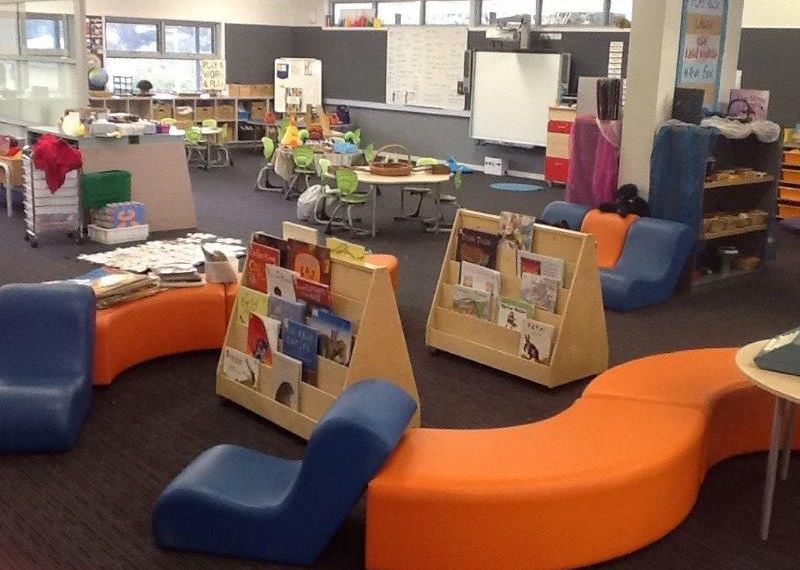
A slight difference!
When I visited my child's school last year, I noticed the whiteboards were not covered by endless rows or words. They were covered instead by columns, colored sticky notes, and bright messages and pictures. It was a Scrum Board detailing the most recent research project of the class. These were not KPMG consultants, but 6-year-old children designing, planning and executing their own projects using Scrum to assist in collaboration and workflow.
Scrum is just one of those easy to understand approaches that can assist children to learn, and adults to work. Kids are leading the way because as we all know, resistance to cultural change is the biggest obstacle to successful Agile projects. Kids minds are more flexible, open and dynamic than most adults could ever hope to be. Why is that? Mostly it's by choice. We can learn something from the new educational practices in our schools, which involve elements of Scrum at many schools.
The next time you find resistance in the workplace, or even find yourself swimming against the tide, consult your child on the best approach to handle your Agile project at work, or watch how they learn in the classroom. They might be able to teach you something.
Thank you for your interest in the Scrumptious blog. If you have any ideas for Scrum topics, please message me here. Until next time, remember, projects can be Scrumptious!
|
Posted on: August 31, 2019 04:40 PM
|
Permalink |
Comments (19)
| 
Once upon a time, in a galaxy not so far away, was a planet named Mars. A company called SpaceX landed the first humans there and colonized the planet. Among the many initiatives to deliver value were some Lean, Kanban and Scrum projects. One lucky Martian was appointed as the Scrum Master and decided that Scrum would be as successful on Mars as it had been on Earth.
Can Scrum be as successful on Mars? Well if you look at projects simply, very simply, they can be broken up into components that deliver predominantly: value and quality. In most of my short research on this topic, "value" gets a big thumbs up. But what about "quality"? That has some mixed reviews. Lean and Kanban are more about quality and reducing defects than Scrum, which leans (no pun intended) to the value end of the scale
Typically, this wouldn't be an issue. Businesses and customers make trade-offs all the time between quality and value, and in some cases, so do project managers, scrum masters and product owners.
But newsflash: we are talking about Mars! A reduction in quality by even 1% could mean the difference between life and death. With such dire consequences, project teams may rely more on Lean/Kanban to reduce defects and waste. So, does Scrum have a place in such a hostile environment? Well, in my opinion, yes it does. Projects can be divided into features that focus on quality, or value, or a combination of both. Since all of these project frameworks use what is essentially a backlog, work can be picked up utilizing whatever framework is appropriate to its feature/story's sensitivity to quality or value, then taken through that framework's system (flow, iteration etc.).
Scrum, of course, can be used for many other value-focused outcomes such as daily stand-ups, retrospectives and backlog grooming. Grooming or refining the backlog is not only a Scrum activity, but the term "grooming the product backlog" was first used by Mike Cohn in 2005 when talking about Scrum, and in 2011 made its way as an official practice within the Scrum Guide.
So, the next time you give it some thought, try and imagine how Scrum might be used on Mars. Put yourself in the shoes of that Martian Scrum Master, because the day will come when they are visited by a very special guest from Venus: the Product Owner.
Thank you for your interest in the Scrumptious blog. If you have any ideas for Scrum topics, please message me here. Until next time, remember, projects can be Scrumptious!
|
Posted on: May 31, 2019 10:17 PM
|
Permalink |
Comments (20)
| 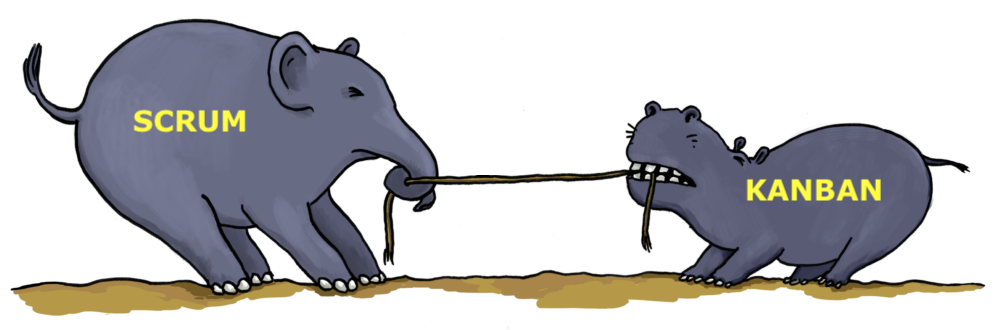
We all love Scrum right? It provides a great framework for providing valuable solutions in an Agile way. When it comes to adopting an Agile framework within organizations, it really has no competitors. But often I get asked the question: "What about Kanban; is that a better way of doing things?"
Of course, this depends on how you define "better". If we are to understand these two powerhouses in the Agile world, it would be prudent to take a brief look at their similarities and differences:
|
SCRUM
|
KANBAN
|
|
Has specifically defined roles
|
Does not have mandatory roles
|
|
Uses Velocity, Burndown Charts to manage and measure performance
|
Uses Lead Time, Cycle Time, WIP, Cumulative Flow Diagrams to manage and measure performance
|
|
Agile approach
|
Lean approach
|
|
Uses time boxes
|
No time boxes, just continuous flow
|
|
Work is based around capacity
|
Work is based around capacity
|
|
Daily meeting
|
Daily meeting
|
|
More structured framework
|
Less structured framework
|
|
Uses a product/issue backlog
|
Uses a product/issue backlog
|
|
More concerned with productivity
|
More concerned with efficiency
|
|
No changes allowed during Sprint
|
Changes can occur as needed
|
As Shakespeare might have said: "To Scrum or to Kanban, now that is the question." Actually, your organizational strategy or specific business requirement will answer that question better than Shakespeare could ever do. In reality, the two can exist together, and often do.
Take a software upgrade and rollout across an organization for example. Many projects such as this begin with Scrum (delivery of the solution), then transition to Kanban for support and issue logging (maintenance of the solution). This example might be closer to DevOps, but that is another buzzword for another buzztime!
Can you think of any other similarities or differences between Scrum and Kanban?
Thank you for your interest in the Scrumptious blog. If you have any ideas for Scrum topics, please message me here. Until next time, remember, projects can be Scrumptious!
|
Posted on: April 30, 2019 11:49 PM
|
Permalink |
Comments (30)
| 
When I started this Scrum blog over a year ago, I was encouraged by all the positive attributes of Scrum, and its scalable parents such as LeSS, DaD, SoS, Nexus, SAFe etc. SAFe is what I have been working with since 2018. Having said that, the benefits of Agile and Scrum can only be realized if they are being implemented correctly, and by correctly I mean in terms of the process, regularity, and consistency. In my experience, this is not the case with almost every organisation I have been exposed to.
Here’s some basic examples specific to Scrum. In my own workplace, standups dropped from daily ceremonies to twice a week. Not everyone stands up. The timebox is rarely met (in one case it went twice as long). It is not encouraged to ask questions nor discuss topics at any length during a daily standup, and yet they often are. Almost every participant talks about what they have on today, but rarely anything about yesterday or what they have been working on. This becomes even more important when the daily standups have been reduced to (in our case) twice a week. There are team stand-ups at the program and portfolio level, but very rarely at the project level, where the delivery of value actually takes place. Some critical team members have never been invited to team/project standups, such as testers who are so crucial to governance. The customer is involved to some degree in PI (Program Increment) planning sessions, but rarely throughout the sprint. Retrospectives per value stream are either not held or ineffective, and there is no review ceremony that involves customers to see the progress of incremental delivery, other than the occasional status report or update over the phone or email. I could go on, but I want to end on a positive note.
As my Scrumptious blog bio states: “Scrum is the most popular framework used within an Agile environment to convert complex problems into valuable products and services”. I still hold to this view. But it is up to us as project and Scrum professionals, or team members in a Scrum environment, to pick up the ball and run it through the goal line. When something is not right, call it out. It is for the benefit of the team, project and organization as a whole.
Don’t get a Scrum penalty. Kick a Sprint goal instead.
Thank you for your interest in the Scrumptious blog. If you have any ideas for Scrum topics, please message me here. Until next time, remember, projects can be Scrumptious!
|
Posted on: February 28, 2019 05:14 PM
|
Permalink |
Comments (16)
|
"I choose a block of marble and chop off whatever I don't need."
- Rodin
|




