Do your performance evaluation and recognition systems support cross-functional teamwork?
From the Easy in theory, difficult in practice Blog
by Kiron Bondale

My musings on project management, project portfolio management and change management.
I'm a firm believer that a pragmatic approach to organizational change that addresses process & technology, but primarily, people will maximize chances for success.
This blog contains articles which I've previously written and published as well as new content.
Recent Posts
Leading Through Crisis Means Leading Through Context
"It's the end. But the moment has been prepared for." - retirement lessons from the Doctor
Just because they are non-critical, doesn't mean they are not risky!
Just because they are non-critical, doesn't mean they are not risky!
How will YOU avoid these AI-related cognitive biases?
Categories
Agile,
Artificial Intelligence,
Career Development,
Change Management,
Communications Management,
Decision Making,
Governance,
Hiring,
Kanban,
Lessons Learned,
Personal Development,
PMO,
Portfolio Management,
Project Management,
Resource Management,
Risk Management,
Risk Management,
Schedule Management,
Scheduling,
Tools
Date
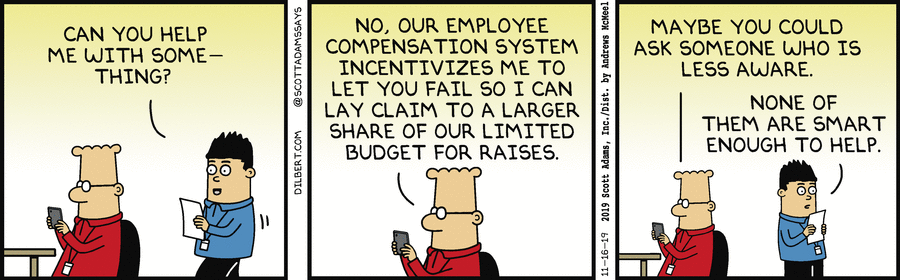
While it is usually Wally who openly expresses those thoughts which we normally keep to ourselves, Dilbert is letting his inner voice do the talking in today's strip. Let's imagine for a moment that Dilbert's co-worker is part of a cross-functional team which Dilbert is part of. Dilbert's response might seem unnecessarily blunt, but this behavior is not uncommon in those companies which place an undue emphasis on individual recognition or which don't require managers to actively solicit feedback from outside of their own teams.
While most of us would consider ourselves to be helpful, without some measurement and organizational encouragement our willingness to help someone is likely to be reduced by our need to finish our own work as we know the latter is what is measured.
In many organizations, functional managers are under no obligation to solicit feedback from others about their staff's performance. While these managers might ask for input from within their own team, they might be reluctant to contact those co-workers who report to other functional managers. If they evaluate their team members' performance purely on achieving functional objectives or on how they interacted with others from within their own team, they might not consider whether someone works well within a cross-functional team. While this type of feedback is certainly available from project or other functional managers in a matrix structure, the functional manager might not always be open to soliciting or acting on the feedback. When objective feedback from co-workers outside of a manager's team is a required component of formal performance evaluations, it encourages both managers and team members to look beyond the walls of their own silos.
It is also quite common to find generous enterprise-level budgets for individual recognition but not as frequently for team recognition. With strategic or large projects, a project manager might have sufficient influence to secure budgetary approval for team-level rewards but this is usually not the case on smaller initiatives. Without equal weighting given to both individual and team recognition, it is no wonder that team members will prioritize individual success over that of the team they are on.
We want team members to feel confident that if they ask for help from a co-worker who happens to report to a different manager that there is a strong likelihood that they will get it. We would like to encourage team members to be willing to slow down their own activities if it helps their team get ahead. But when environmental factors such as performance evaluation systems and recognition programs discourage such behaviors it can be difficult to build high performing cross-functional teams.
Posted on: November 17, 2019 07:00 AM |
Permalink
Comments (11)
Please login or join to subscribe to this item

Luis Branco
CEO| Business Insight, Consultores de Gestão, Ldª
Carcavelos, Lisboa, Portugal
Dear Kiron
Interesting your reflection
Thanks for sharing
Does the education system encourage teamwork or individual performance?
Are grades awarded to teams or individually?
How is it possible to create a collaborative organizational culture when for so many years our paradigm has been to compete?
Thanks Luis -
You make a great point - if the majority of childhood learning recognizes individual work and the only team work kids are exposed to is in sports or in secondary education when they start to work on group projects, it can be challenging to rewire those default behaviors.
Kiron
There are some points given in our evaluation form to capture input from person filling the review form. Like - Your contribution towards organization apart from your regular work.
Generating Ideas, Open to Criticism, and Knowledge sharing etc.
There could be a 360 where more teams share feedback.
Hi Kiron,
Thank you for sharing this thought-provoking piece with the cartoon illustration.
An organization may set up cross-functional goals to align with individual functions' goals and the overall organization's vision, follow by educating employees on the causal relationship between teamwork contributions and individual duties.
Thanks Kiron. When children are educated to compete and get the best test scores, they are hardly prepared for collaborative teamwork in working life. With sports, yes, but with curriculum assessments, no. By the time they start work, they need to balance Jekyll and hyde; individualism and collectivism.
So the question, Sante, is how do we better prepare kids at any early level to balance these two (sometimes competing) drivers?
A great piece Kiron, thank you.
I agree Sante, I'm aware of organisations who offer internships for graduate students and I hasten to say a proportion of these students are Dilbert.
Kiron, one way is to send kids to a "progressive" school where they deploy constructivist pedagogies such as Project-Based Learning. The issue is, even if we encourage our kids with axioms such as "it doesn't matter if you win, only that you did your best", the fact is kids are conditioned to compete at school by the curriculum assessment system. Parents have a big part to play. If they pressure their kids to perform at their best, compete and win, then that is the value system they will implant in their kids. If they promote teamwork, collaboration, to learn from mistakes and reflect on the outcomes, their kids will value that more. They might win less, but "losing" won't seem so bad, and they will be far better employees and citizens down the line.
Julie, they should probably screen internships the same way they do employee interviews. At the end of the day, whoever works onsite (employee or intern) is a reflection of the company.
Please Login/Register to leave a comment.
|
I think somebody should come up with a way to breed a very large shrimp. That way, you could ride him, then, after you camped at night, you could eat him. How about it, science?
- Jack Handey
|




