Project Management

Ignore Risk at Your Own Peril

From the Project Confusion in Transition Management Blog
by
Projects are about transition from one state to a desirably better state. Management is often viewed as a source of confusion. So lets break down the confusion and build up the means for transition to meaningful deliveries.

About this Blog

RSS

Recent Posts

Notes on Reporting Progress (ii)

User Acceptance Tests (documentation)

Start Right

Documents Supplied for Post-HOTO

Notes on Documenting Acceptance Tests

Categories

Agile, Agile Communications, App design, Communications Management, Give-back | Outreach, information communication technology, New Year, PMIef, Project Management, Quality, Risk Management, Risk Management, System design, Volunteering

Date

linkedin twitter facebook Request to reuse this  


Time and again I encounter problems on work quality that are easily mitigated. I learned from my colleagues recently they incurred losses due to sub-contracting work that were not thoroughly planned.

How did that happen?

Without the facts, the case may be attributed to the management of project quality & project risks which the project team may have neglected somewhat. A broad insight of that project:

Incorporate Quality

Project quality measures the effectiveness & efficiency of planned activities against common/acceptable benchmarks, best practices & standards. Quality is monitored to report progressively on developments, managed to keep things right, & controlled to deliver what was agreed/contracted. These are necessary quality processes performed throughout a project lifecycle.

The project team/manager is expected to abide & see to that:  

  • Corporate QA protocols are activated; e.g. QA processes tailored & defined specifically for assigned projects are followed
  • Risk management protocols are followed
  • QA and risk matters are communicated on time to customer /management /sponsors. Create a communications plan to keep stakeholders informed.
  • Feedback from stakeholders on quality & risk issues are attended to promptly
  • QA and risk assessments are discussed & examined separate from routine project development activities whenever possible

Their project suffered losses because the only quality process which they enforced (capable of) is to report on performance. That too in reporting superficially on ongoing task status & meeting task deadlines; in spite of established corporate quality policies of both contractor & customer. A prevalent practice which I observed, is that projects tend to focus on achieving stipulated terms, & to the letter at best. A common argument for this is that project management dynamics today are fluid. Quality hence is neither managed nor controlled — structurally.

Ignoring quality i.e. planning for quality & driving quality processes, in itself is a huge risk.

Plan for Risks

Risk must be identified, analysed, monitored & controlled with risk responses pre-authorized (where applicable) & confidently put in place. This should be a process with its own framework for risk ownership, accountability, and which is as-much-as-possible independent of the project development framework. Similar to that commonly practiced for corporate QA. The reason being risk matters should be evaluated separately from reviewing, planning & tasking project activities. More so when the project framework is Agile where activities are planned & tasks are assigned as like in a single breath, with little evidence of work, & seemingly always on schedule with hardly any impediment.

The least is to integrate risk & QA paperwork i.e. taking evidence that quality procedures & risk controls are effected. QA & risk management are key to ensuring the customer gets what was agreed and contracted. And the project team truly delivers what is expected.

Their lessons learned:

  1. Project team members failed to sit down to appraise risks on planned activities & tasks. The excuse being "work is Agile" & "risks were discussed" but in one go at planning.
  2. Project management failed to adequately define risk ownership, and with it the associated costs /costing of materialized risks.
  3. There is no formal ownership of known & identified risks. A typical chorus being "the whole Agile team is responsible" for the risks.
  4. Submission of assessment of identified risks through forms - using templates from past successful submissions, became a routine that no one would want to revisit & discuss. So "why rock the boat?".
  5. People saw each other as transients (due to the prevalence of engaging contract resources /expertise), & took a laissez-faire approach at work. A shortcoming without .. a teaming culture that inculcates professionalism, training, & upskilling competencies.

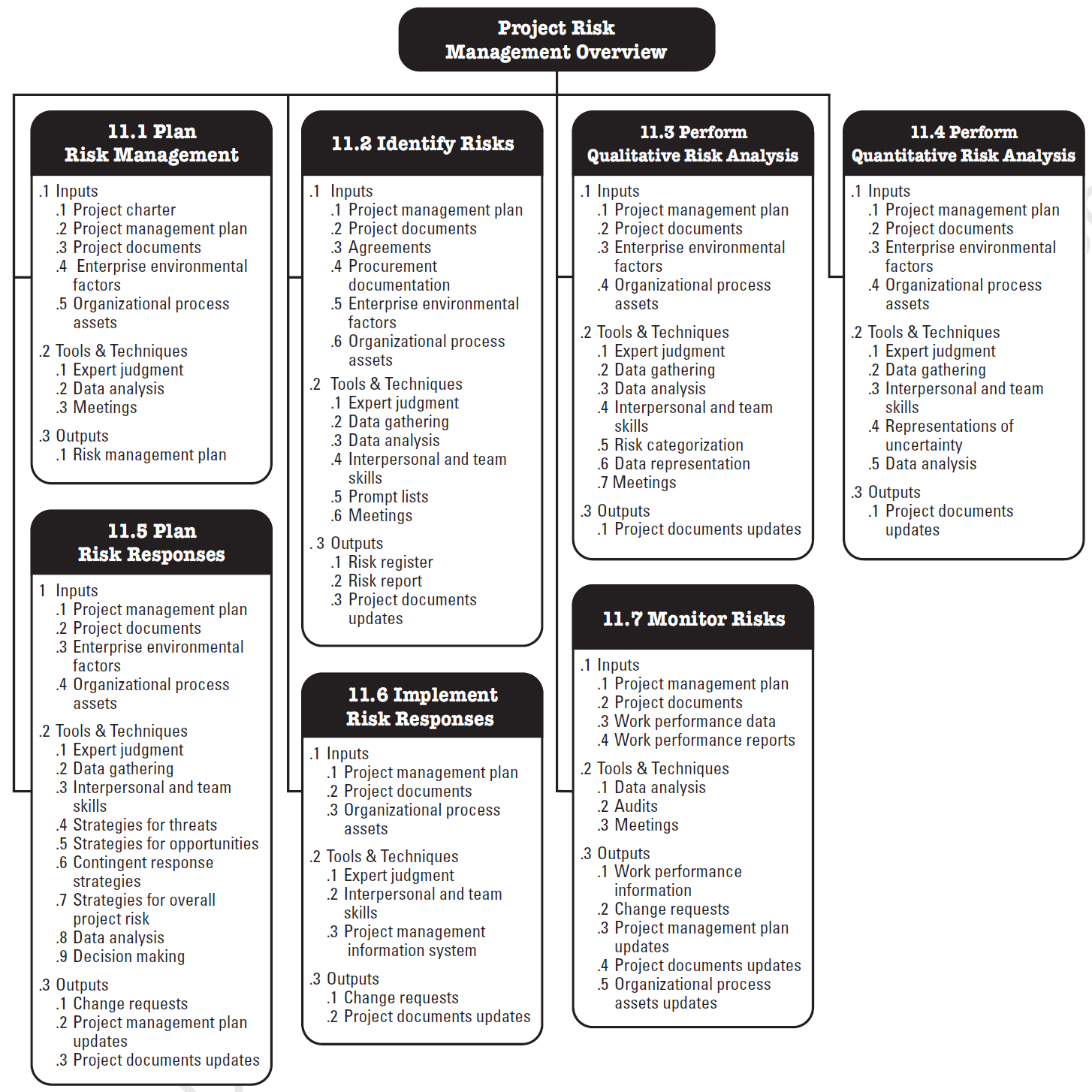
Risk planning is inevitable. There should be minimum protocols to follow for each & every project undertaken. There is after all a universal risk management standard


PMBOK® Guide – Sixth Edition (2017)


Posted on: February 01, 2020 04:10 AM | Permalink

Comments (8)

Please login or join to subscribe to this item
avatar
Luis Branco CEO| Business Insight, Consultores de Gestão, Ldª Carcavelos, Lisboa, Portugal
Dear Elok
Interesting your reflection on the topic: "Ignore Risk at Your Own Peril"

Thanks for sharing

Important tip to keep in mind:
"Risk planning is inevitable. There should be minimum protocols to follow for each & every project undertaken"

avatar
Rami Kaibni
Community Champion
Senior Projects Manager | Field & Marten Associates New Westminster, British Columbia, Canada
Good info and reminders Elok !

avatar
Amjad Ali Senior Business Analyst - Information Security| IFC Delta, British Columbia, Canada
Thank you, this is good information for sure. I think risk management is largely misunderstood, which in itself is a risk. Very good read.

avatar
Vincent Guerard Coach - Trainer - Speaker - Advisor| Freelance Mont-Royal, Quebec, Canada
Like the link, you make with QA.

avatar
Mushtaq Abdulrahimzai SWIS| Surrey Schools District 36 Toronto, Ontario, Canada
thank you for sharing, good information.

avatar
Suneel Kumar Nadella Director (Self Employed)| Manasai Services Pvt Ltd (Self Employed) Solihull, West Midlands, United Kingdom
Good article and very informative.

avatar
Gerardo Canavati IT Project Manager| Odevo Raleigh, NC, United States
Conclusion, overlooking risks... is risky business. Documentation enables us to at least tell our stakeholders "I told you so".

avatar
Abolfazl Yousefi Darestani Manager, Quality and Continuous Improvement| Hörmann-TNR Industrial Doors Newmarket, Ontario, Canada
Thank you for sharing

Please Login/Register to leave a comment.

ADVERTISEMENTS

I watched the Indy 500, and I was thinking that if they left earlier they wouldn't have to go so fast.

- Steven Wright

ADVERTISEMENT

Sponsors