It's the end of your project, but has the moment been prepared for?
From the Easy in theory, difficult in practice Blog
by Kiron Bondale

My musings on project management, project portfolio management and change management.
I'm a firm believer that a pragmatic approach to organizational change that addresses process & technology, but primarily, people will maximize chances for success.
This blog contains articles which I've previously written and published as well as new content.
Recent Posts
Leading Through Crisis Means Leading Through Context
"It's the end. But the moment has been prepared for." - retirement lessons from the Doctor
Just because they are non-critical, doesn't mean they are not risky!
Just because they are non-critical, doesn't mean they are not risky!
How will YOU avoid these AI-related cognitive biases?
Categories
Agile,
Artificial Intelligence,
Career Development,
Change Management,
Communications Management,
Decision Making,
Governance,
Hiring,
Kanban,
Lessons Learned,
Personal Development,
PMO,
Portfolio Management,
Project Management,
Resource Management,
Risk Management,
Risk Management,
Schedule Management,
Scheduling,
Tools
Date
 I'm sure some of you have led projects where everything appeared to be going swimmingly right up to the finish line only to find that you had somehow stepped into the project equivalent of the Hotel California. Everyone has a desire to wrap things up and move on to whatever is next but transition seems like it will never end.
While there might have been some reasons late in the life of the project as to why this unfortunate situation occurred, in most cases, problems with ending projects cleanly can be traced back to something that was missed early in the life of the project. This is why Stephen Covey's second Habit "Begin with the end in mind" is so apropos. Not only does this encourage key stakeholders to share their understanding of the project's outcomes to help in crafting the project charter, it also reminds the project manager to start to ask important questions of how the end of the project will be handled including:
- Who will be taking ownership for each of the key deliverables? If a RACI chart or similar staff assignment matrix is being used, an additional identifier could be added to indicate this.
- Who is responsible for ongoing monitoring and reporting of benefits realization and when will they be engaged?
- What are the expectations around "warranty" support for completed deliverables?
Transition activities can be identified and planned based on the answers to these questions.
When major changes occur or a significant milestone has been achieved, the impact on these transition activities should be considered. For example, if a deliverable has significantly changed or a new one introduced, ownership of that deliverable, impacts on benefits tracking and support needs might have also changed.
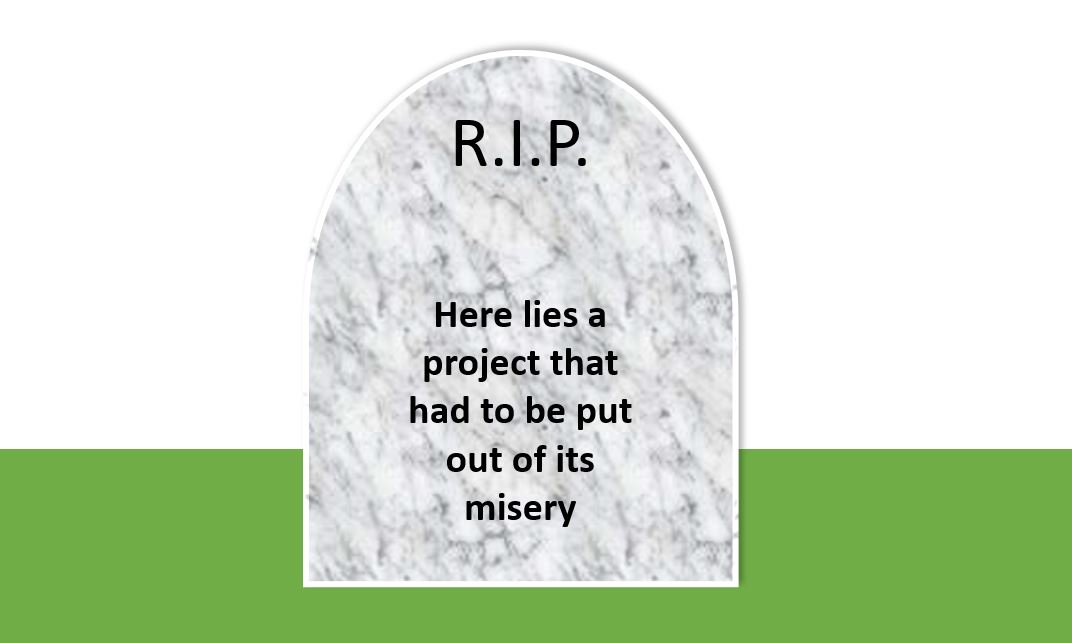
It is also a good idea to know when enough is enough and to articulate that up front too. I've seen some projects drag on for too long till someone finally shows the leadership to put them out of their misery.
I've been a fan of the fantasy TV series Doctor Who dating back to my distant childhood memories of hiding behind our living room sofa when Daleks threatened the Earth. While each of the actors (and now actresses) who have portrayed the titular character have been memorable, Tom Baker will always be THE Doctor to me. When it was his time to hand over the mantle to his successor, Peter Davison, his final line from the episode was particularly meaningful as he regenerates into the Fifth Doctor: "It's the end...but the moment has been prepared for."
Has the end of your project been prepared for?
Posted on: July 05, 2020 07:00 AM |
Permalink
Comments (6)
Please login or join to subscribe to this item

Rami Kaibni
 Community Champion
Senior Projects Manager | Field & Marten Associates
New Westminster, British Columbia, Canada
Kiron
I hear your point of view and that’s totally right but those activities are taken into account either in Program / Portfolio Management plans if the project is part of a program or portfolio or in the Organizational Strategic Plan if the project is a standalone.
There should always be a transition plan and sustainment plan for the benefits but this is all planned for on a higher level than the project itself.
RK

Ashleigh Kennett-Smith
ICT Project Manager| Australian Red Cross Lifeblood
Adelaide, South Australia, Australia
Very true Kiron. I'm amazed at how often people lose interest after a project has completed delivery of the core system, product or process. (Occasionally it's the finance dept that the bomb under things because they can't close out the finances until everyone signs off.)
A note on Rami's comment though, I would say that many of my projects don't have the higher level plan (rightly or wrongly) so the project must (is expected to) accommodate this. Sure there are organisational benefits and an expectation that the project will handover benefits realisation to be managed forward but typically for me the project is tasked with capturing the detail in a realisation plan section of the Project Management Plan (or separate document if large enough). Also most of my projects involve delivery of a system Support Plan. The detail of who, what and how of post project is captured there.
Ashleigh Kennett-Smith
ICT Project Manager| Australian Red Cross Lifeblood
Adelaide, South Australia, Australia
PS I think more projects need the gravestone in your header - lol
Thanks Ashleigh - yes, I've had a few projects go the Walking Dead route for too long!
Please Login/Register to leave a comment.
|
"A mind once stretched by a new idea never regains its original dimensions."
- Anonymous
|




